
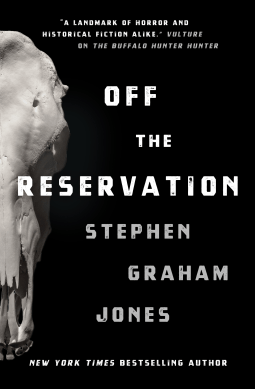
Off The Reservation is a follow-up to The Only Good Indians, a roadtrip horror novel about four Blackfeet on a mission to repatriate the bones of a Blackfeet boy at the Carlisle Indian Industrial School. Five years after the events of The Only Good Indians, Nate Yellow Tail finds himself in new trouble, with his best friend Sebby on the brink of death. He’s offered a chance to try and restore balance and save Sebby by joining others on a quest in a run-down RV: head to a residential school to save the bones of a murdered boy. The thing is, once they get there, it turns out something else is there too.
Ahead of reading this one, I reread The Only Good Indians, which isn’t actually necessary (Off The Reservation is more of a companion than a sequel that requires knowledge of its predecessor), and I found I had a greater appreciation for that novel on a second reading. Stephen Graham Jones has a distinctive writing style that sometimes leaves me disoriented, but once I’ve got into the style, it works, and I think for my first read of The Only Good Indians, I never got into it. For Off The Reservation, it was more that the pacing is slow for the first part, leading us deep into the characters setting off on their journey, so there wasn’t the momentum to slip into his writing style, but once I got a bit further in, I got into it a lot more. There’s also a whole bunch of different character perspectives throughout the narrative, some of which are easier to get into than others.
Like how The Buffalo Hunter Hunter is a take (an incredible take) on the vampire novel, Off The Reservation is a fresh take on a possession story, complete with misleading Christian iconography. It tackles some dark stuff, but also plays with a lot of pop culture inspiration (which the acknowledgements detail in great depth). I think if you’re a fan of Stephen Graham Jones’ style, this one will be up your street, with a great cast of fucked up characters and lingering message about the consequences of desperate choices. It wasn’t quite up there with The Buffalo Hunter Hunter for me, but it was a great read nevertheless.


You must be logged in to post a comment.