
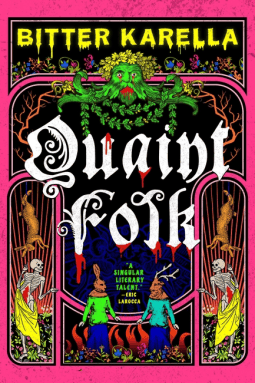
Quaint Folk is a horror novel about an American family who move to a British island where the inhabitants take their strange traditions very seriously. Jessica is trying to appear like the perfect wife and mother, whilst also feeling inadequate and scarred from her upbringing. When her husband Greg’s job has him, Jessica, and their non-binary child Sandy move to a town on a British island to complete a deal, Jessica sees this as a fresh start. Once they’re there, both Jessica and Sandy find themselves battling the town’s expectations and the traditions for the upcoming holiday.
Having read Karella’s previous novel Moonflow, I was expecting something queer and weird, and Quaint Folk is certainly those things too, but sometimes in a different way to Moonflow. Immediately as you begin reading, the narrative tone gets across the satirical side of the novel, from the parody of an idealised American family with a father working for a generic tech company to the utter ridiculousness of the quaint British town they go to, complete with nonsense elements and very real ones.
You need to read the book with this tone in mind, as the actual narrative combines this nonsense side with a very dark side, in which the characters are threatened for not conforming and treated with contempt, but the combination of the two elements gets across how Karella is exploring folk horror through a queer lens. For queer characters, folk horror isn’t just weird townspeople feeling a bit off; it is being actively misgendered or told you’re not the right kind of person, or being actually in danger. It’s more of an unsettling folk horror than something with scares, but that makes the nastiness more insidious.
There’s a lot of really interesting setup in the book, delving into Jessica and Sandy’s characters and building up the unsettling question of where the power in the town actually lies. The conclusion feels quite sudden after that, leaving a lot of questions unanswered and not quite exploring all of the implications, and I’m not entirely sure what I think of it. I think the ending might work better if it was a film, but as a book, I wanted slightly more from it.


You must be logged in to post a comment.