
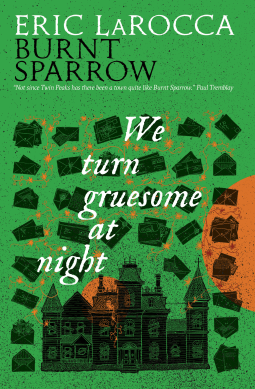
We Turn Gruesome at Night is the second book in LaRocca’s Burnt Sparrow trilogy, a horror series about a New England town with nightmarish goings on. This instalment comes ten years after the massacre from the first book, following two characters trapped in a house who find a potential way to escape and a strange secret society.
I’ve read a lot of LaRocca’s books and generally find them to good, but not as good as I’d hoped from the premise. However, the first Burnt Sparrow book was one of my favourites of LaRocca’s, with some actually horrible stuff and a nice weaving in of shorter stories to the novel format to showcase LaRocca’s usual tendency towards short stories and novellas. For the sequel, I was concerned that I couldn’t remember any of the details of the first book, and to be honest for a lot of the start of the book I really wished I did remember more about the first one. However, as it went on, this second book felt like it wasn’t as connected to the overall town as the first one, so I didn’t worry as much about not remembering the first book very well.
The concept of the novel is simple—being unable to leave a house unless you offer it a sacrifice—and I liked how it offers space to explore human nature and desires, but I felt like the book didn’t quite delve as much into the darkness in its characters as I would’ve expected. Some of the book is taken up with other stories, one which interacts with the main narrative and the others are just like side stories, and particularly the latter felt like padding that didn’t really add anything to the novel. I wish that the other stories in the book brought more in terms of Burnt Sparrow lore by connecting to the town more clearly.
This novel is less horrible than the first in the series (though there are some deaths that may well upset readers) and is more of a gothic story with some splatterpunk elements. For me, it did feel like a concept that could’ve been any length of story and hadn’t quite been fully turned into a novel, and the interwoven stories didn’t quite feel like they brought more to the trilogy itself. I’ll have to wait until the final instalment to fully reflect on how the series comes together, as I can’t tell if this book is perhaps just a middle part that suffers from not having a conclusion to build to. Once again with LaRocca, it’s a decent story, but it didn’t quite hit as hard as I hoped.


You must be logged in to post a comment.