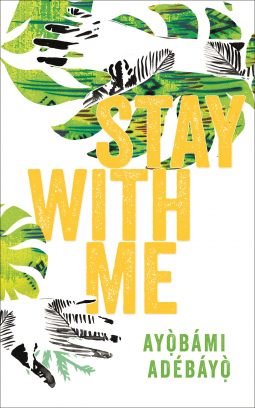
Stay With Me is an addictive read about a woman, Yejide, her husband, and her attempts to have children, set in Nigeria from 1985 to 2008. It is a novel about hope and it is the hope that keeps you reading, a hope for Yejide and for her husband Akin and for the hope that hope is worth it after all.
Adebayo’s book is often a subtle one, showing character relationships and moments rather than immediately telling the reader what to think or how everybody felt. The main characters are rounded and flawed, often thinking they know everything but missing crucial details. Yejide’s emotions in particular, from her huge desire to get pregnant to her feelings in the important final moments of the book, come across through the writing very effectively, making this a novel thoroughly grounded in its characters. The writing style is easy to get into and gripping, with the narrative jumping from Yejide’s point of view to Akin’s in order to show events from both sides. Neither character is wrong, but both characters think, hope, and love in different ways.
I read a proof of Stay With Me from Canongate (via NetGalley) after having been interested by the promotion of the book so far and it didn’t disappoint. It is a novel that draws you into the world of its characters and their lives. Stay With Me is literary fiction with emotion.
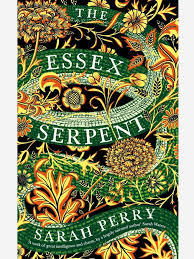
Whilst reading The Essex Serpent, I did feel like some mythical force was keeping me turning the pages. I couldn’t remember the blurb when I started reading and had chosen the book based on it being the Waterstones Book of the Year 2016, so went in with a clear mind. I did not know what to expect. The novel turned out to be a surprisingly captivating depiction of belief and friendship, the kind of historically set novel that isn’t bogged down by the period in which it is set.
The book follows the mystery surrounding a strange creature apparently living in the Essex waters, but also Victorian developments in science, poverty, and feminism. These elements form major parts of the narrative, rather than feeling like forced backdrops, and help create the vivid characters which seem to be the real charm of The Essex Serpent. From Cora, looking for freedom in the serpent’s legend, to Naomi, a village girl overwhelmed by the spell that has fallen over the village, the characters are interesting and torn between aspects of belief and relationships.
The Essex Serpent took me a little while to get into. Once in, I wasn’t sure what to expect and though the plot line does centre around larger dramatic events, it was mostly propelled forward by the characters, meaning that you end up caring more what will happen to them than what will literally occur. There are lots of books out there set in the Victorian period, but this is a good one for sure, a gothic tale that shows wonder rather than repression.
My review, originally posted here on Goodreads, for The Woman on the Stairs by Bernhard Schlink.
As the blurb on this book suggests, it is a novel about regret, lies, and perspective which lets the reader imagine the truth more than it is given. I won The Woman on the Stairs in a giveaway on Goodreads and had very few preconceptions about the book before reading, other than a sense that it was the kind of the book that I’d read the blurb of, think it sounded interesting, but not be drawn in enough to buy it. Though the blurb and some of the story focuses upon a painting, art, and creativity, the novel is more focused on life and time and what could have happened.
The narrator of the novel occupies a strange space as both part of the story and somewhat of an outsider, a character who has been not quite part of the action for his entire life it seems. This character and narratorial style are one of the defining things about the book, as you are given looks into his past and realisations about what he could or should have done differently, but also kept at a distance from him. The way that the novel reveals things about his life and also about Irene’s as he recalls his past with her and has to reconsider and find out things from her later on creates a gripping read even though there is not a large amount of action.
The Woman on the Stairs is most suited to people who enjoy mediative books that involve characters looking back on the past, but also learning a few things about the present. Its short length and tendency to hold things back from the reader make it good for reading in a short space of time and then thinking about it afterwards.
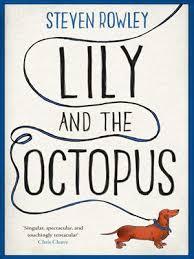
Novels about pets getting ill has never really been a category that appeals to me. The inevitable combination of sadness and positivity and the probable lack of much else is not something I’ve looked for. However, I was recommended Lily and the Octopus by someone who is exceptionally good at recommending books, so I didn’t doubt that it would be good. What it turned out to be, in fact, was a novel about coping mechanisms, loss, and hope that really gets inside how people think, grieve, and try to make deals with life.
The unreliable narration makes this book, because it allows for the processes people go through to try and deal with awful things to become the novel. You know from the start what the narrator is doing, but you can’t blame him because it feels so real. Whilst pet owners will understand the relationship between Ted and Lily and how their conversations are written, anyone who has ever tried to deal with something by trying to rewrite it in some way will understand how Lily and the Octopus is written.
Whilst it is not surprising how the book will move forward, it is the getting there that is the experience, the capturing of emotion and brain processes and how people tie things together and see them as interconnected. The ending (enjoyably for me) references another famous dog owner, Lord Byron, which I assume is there to chasten me for forgetting that I was already interested in an author who mentions his dogs. Even if – like me – you’ve no particular interest in a book about an animal getting ill, I still recommend Lily and the Octopus as a book about how we think and process things and also about hope and relationships. Also if you like dogs, I guess.
This Christmas, like many other Christmases, I got a number of books (though this Christmas, as with others, will not beat the Christmas when I was seven and got my own copies of the Harry Potter books that existed at that point). And now, as the dinner and chocolate and alcohol settles, it is time to share some of those and perhaps inspire some use of good old gift cards. Other than the first, these are all recent books that I’ve been seeing around in 2016.
Disobedience by Naomi Alderman – This is the only one of my presents that I’ve read so far because I impressively held off over Christmas and did things like hang out with my family. Disobedience is about a woman living in New York who has to travel back to her old Orthodox Jewish community in North London and face up to a few things about herself and her past. This book doesn’t quite go where you might expect it to and gives a variety of characters’ viewpoints whilst offering the reader the chance to question theirs.
Autumn by Ali Smith – Autumn was an exciting gift to me for two reasons: one, a new Ali Smith book, and two, it’s a beautiful new hardback copy. As someone who gets mostly secondhand books, it’s good to have a few nice copies. I expect wordplay and narrative play and can’t wait to start reading it.
A Little Life by Hanya Yanagihara – Probably one of the most recommended books of the year, but the kind of book that was suggested with a “it devastated me” kind of selling point. This is most of what I know about it, other than it featuring New York City, but I’m about to start it and find out more. Shoutout to KJ for recommending both this and Lily and the Octopus to me multiple times.
The Glorious Heresies by Lisa McInerney – Another of those books that I had seen on bookshop tables throughout 2016, the kind that is nominated for and wins prizes and you pick up when you see it and read the blurb and think ‘that sounds like something I would read’ and then put it back. The copy I have – all bright orange and in your face font – looks very much like a book I would read, so again, I look forward to it.
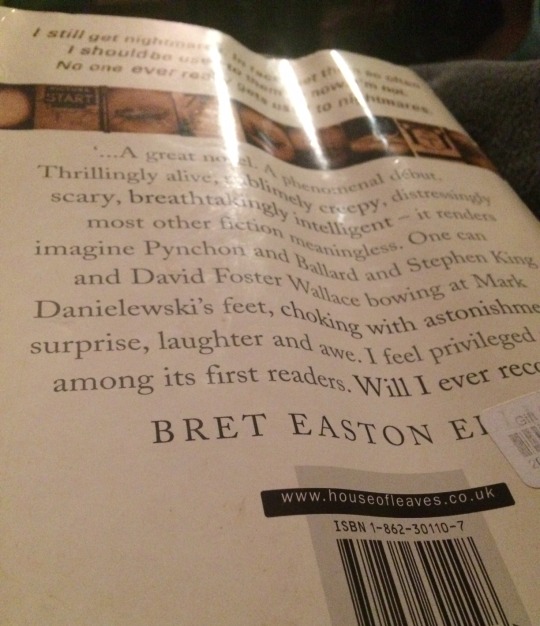
This is a review, if a review is meant to be written wide-eyed, a little uncertain of reality, of Mark Z. Danielewski’s House of Leaves. Known for being a scary cult novel approximately the size of the Argos catalogue, it is somewhat imposing. I started reading it last night, got about twenty pages in, and then today I continued reading and, in amongst other tasks like decanting homemade sloe gin, I read the whole thing. So I may be a little intense.
House of Leaves is 700 pages of text about an apparent documentary, footnotes both scholarly and telling stories in good postmodern style, appendices, pictures, and typographic display that can leave you dizzy. Each layer of the story – loosely the tale told in and by the documentary, the story of the writing and compilation of the main text by Zampanò, and the discovery, introduction, and notes by Johnny Truant – questions its own reality and others, meaning that reading the book basically requires a reader to question both nothing and everything. This is partly what makes it compelling: the sense that there might be a truth, or no truth at all, keeps you reading through chapters full of gaps from apparent scorchmarks or scientific analyses mostly lost.
The reading experience is perhaps the most important part. With its footnotes and appendices (some of which you are directed to only to discover there is nothing there), there isn’t quite an exact way to read House of Leaves. For example at one point, the option to read an appendix giving childhood background to the editor (who tells his own story in his footnotes) is offered, but to take this option is to read a series of letters that themselves form a not so simple story. The effect of this experience is to draw you into the uncanny, to be looking for where you must read next and whether it will be part of a narrative or a list of notable buildings that exist. It is more like an immersive experience.
Unnerving is perhaps a good way to describe House of Leaves. The layers of narrative and their layers of uncertainty mixed with a vast amount of fictional academic debate and references to real and fictional texts mean that the reading experience becomes unnerving, as expectations are denied and the nature of a text questioned. In my opinion, what is scarier than the stories within the book are the stories and parts of the narratives left on the outskirts, the ones in your peripheral vision and the ones that happen as you interpret what you read.
If these paragraphs haven’t convinced you yet, it is not an easy book to describe or recommend. I would say it is like a cross between the Lunar Park end of Bret Easton Ellis, Nabokov’s more postmodern stuff, and a confusing critical book about some abstract concept that uses popular references to try and explain its points. There’s mythology, horror, academia, and the kind of contemporary American novel where everybody takes so many drugs you lose track. House of Leaves is worth reading, though perhaps not in a day.
(As apparent here, my secondhand copy has the added uncanny fact that it has a huge mysterious wave/dent running through it.)
To reread or not to reread is one of the biggest issues book lovers can face. Rereading takes up time you could be reading any of the millions of books out there, so it can seem inefficient and a kick in the eye to the pile of unread books on the shelf. I begin with the caveat that at the moment I am not rereading very much because Goodreads won’t accept my rereads as part of my year’s books and I’m trying to double my year’s challenge on there and read 100 by the end of 2016. However, I do like to reread and am going to explain why.
Firstly, rereading allows you to savour details that you missed the first time, to take in foreshadowing and hints that didn’t make sense originally, and to generally enjoy elements that an initial read may not have caught. Books are long and full of words, so it is unlikely that a single read will allow you to notice them all. For favourite books especially, rereading a few times can really cement its merits in your mind and allow you to think about it whenever you want.
For the books that were less than favourites, rereading can allow for new perspectives. Maybe with time, knowledge, or experience, that hated book will seem a little better. For example, I recommend anyone who hated Frankenstein to try it again, especially literature students who know anything about the Romantics or gothic novels. It can improve massively (my best friend is a graduate student who studies the Romantics and the 18th century and loves Mary Shelley, but she didn’t like it when she first read it).
On the other hand, if you dare to reread a book you really hated, you also might be certain that you hate it, and with that remembrance have a better picture of its flaws to complain to people about or get into arguments about. Admittedly not the best form of rereading unless you’re someone who loves debating books with people.
For students, rereading can be very useful for having new things to say about texts. For general readers, it can enlighten or make books more enjoyable. So go and reread your favourite books, whether that means experiencing the prose style of Lolita again or giving the Harry Potter series another run through in case you missed an extra word or line about your favourite character.
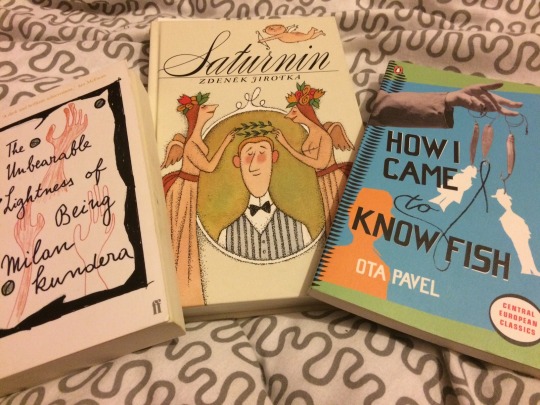
Firstly, I’m sorry about that pun. Secondly, I’m here to recommend some Czech books, which were in turn recommended (and given) to me by my friend Marcela, who deserves the credit for that. It can be difficult to discover literature from countries not your own without recommendations, so I was lucky to be given some Czech books (in translation, as I know only a few words of Czech) and had the chance to find out about their context. All three books were quite different and I suggest to pick the one that appeals to you most to start off with.
How I Came To Know Fish (1974) by Ota Pavel – This memoir of Pavel’s childhood in Czechoslovakia during the Second World War doesn’t sound from this introduction like it would be a sweet, nostalgic story of fishing and family, but it is. I wasn’t sure what to expect, but it turned out to be a quick, intriguing read that gives an unexpected viewpoint and the kind of story not often told. It is easily available in translation from Penguin’s ‘Central European Classics’ range, too, and is apparently popular for its nostalgic view of the rural past. Good for anybody interested in social history or looking for something insightful but not too intense.
The Unbearable Lightness of Being (1984) by Milan Kundera – By far the most famous on this list (and the only one I had previously heard of), Kundera’s novel is famous for its philosophical slant which gives it a fairly imposing reputation. However, The Unbearable Lightness of Being is much more readable than its reputation implies, a novel of love and tangled up lives with the backdrop of Communist occupation. The characters, whilst consciously created by the narrator and described as such, are also intriguing in what they stand for and how they view love and commitment. A novel full of both rich detail and metafictional awareness of the acts of writing and thinking, this is a book to get stuck into. Kundera’s fame means that this is also easy to buy in bookshops or find in libraries. Great for people who like novels that make you think, and also fans of books such as Nineteen Eighty Four or Steppenwolf.
Saturnin (1942) by Zdeněk Jirotka – The most fun of the three, Saturnin is a comic novel about the narrator and his strange manservant Saturnin. Their adventures are a kind of mundane-bizarre that is very enjoyable and there are classic comedy side characters such as a money-loving aunt who speaks in maxims. The fact it is in translation does not detract from the humour and in fact it’s a fascinating blend of a Jeeves-like character with Czech writing. The copy I have is a beautifully illustrated hardback one which is well worth it as it is beautiful. For anyone who likes comedy of manners, absurd situations, and well-meaning interfering servants.
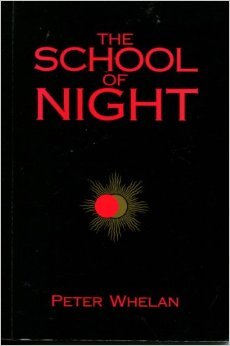
Christopher Marlowe, playwright, poet, and probable Elizabethan spy, is the perfect kind of historical figure to include in fiction. The information about his life is both striking and mysterious, with unexplained gaps of time and a suspicious death. Peter Whelan’s play The School of Night is one of many fictionalisations of Marlowe and doesn’t do anything particularly notable, but that doesn’t stop it being enjoyable.
First performed in 1992 and thus predating the publication of Anthony Burgess’ fantastic A Dead Man in Deptford, The School of Night features Kit Marlowe at Thomas Walsingham’s home in Scadbury, attempting to influence life with dramatic performance. For Marlowe fans, the characters are familiar: Marlowe, Thomas Kyd, Thomas Walsingham and his wife Audrey, Walter Raleigh, and the infamous men surrounding Marlowe’s death, Frizer, Poley and Skeres. Questions of religion, scandal, and betrayal haunt the plot, again no surprise to anyone with familiarity of Marlowe’s biography.The interactions between the characters and the play’s dialogue are what particularly help to make it stand out, combining literary and historical references with the kind of sixteenth century intellectual banter that draws you into the world.
As with many fictional Marlowe works, Whelan inevitably is drawn towards the Shakespeare question, weaving the more famous poet into the narrative and playing around with the claims that Marlowe either wrote Shakespeare’s works or was in deep competition with them whilst he lived. Whilst Whelan’s version manages to keep elements of this enigmatic, the plot requires the big Shakespeare question that Burgess was wise to sidestep in his novel about Marlowe. Luckily, Marlowe is written as a big enough character to keep himself central in his own narrative.
The School of Night is a worthwhile read for Marlowe fans, because unlike some other fictional versions of the playwright (for example, Tamburlaine Must Die) this one is solidly written and gets in all the major details or possible details of his life. For those more familiar with works centred on Shakespeare, the play may illuminate more about Marlowe the bit character in Shakespeare’s real/fictional life (though I’d recommend reading Park Honan’s biography of Marlowe too as the play format does not leave space for historical detail or elaboration).
2016 has been quite a year for most. The list of ‘negative things that happened in 2016’ is too long to fit here and also unnecessary, as undoubtably everywhere will be compiling lists as their ‘best of the year’ features quickly turn into ‘worst of the year’ features (my personal recommendation is to watch Charlie Brooker’s annual take on the year, 2016 Wipe, which if previous years are anything to go by, will be bitter and depressing, but with the kind of realistic hope possible from a cynical comedy take on events).
As gifts go, 2016 wouldn’t be great. Instead, here’s some lighter reads, but not those that are overly schmalzy, twee, or mundane. Books that offer a bit of a smile, hopefully, but also don’t patronise you by trying to claim that everything is rosy.
America Unchained by Dave Gorman – Gorman is a comedian who currently has a very good show airing on Dave (the channel, I know it’s confusing), but I first knew of him through his books. When recently rereading America Unchained, it was clear to me that his account of a challenge to get from coast to coast in America without using the big chain companies, a journey beset with problems and the signs of an unchained world quickly disappearing, is still relevant today. As well as this, it is touching and funny and provided me with a look at parts of America you don’t always see on TV.
‘Campus Trilogy’ by David Lodge – This trilogy that aren’t quite a trilogy, namely Changing Places, Small World, and Nice Work, are novels set on university campuses in Britain and America, featuring a lot of jokes about the disheartening side of academia (bear in mind these are quite dated now so even more disheartening) and confusions between British people and the rest of the world, particularly the USA. Particularly good to buy for English students/ex-English students who will understand both the literary jokes and the questions of what the hell to do with an English degree.
Spectacles by Sue Perkins – I’m not usually a famous person autobiography person unless that person is a writer with a tendency to write themselves into their works anyway (Isherwood and Burgess, I’m looking at you), but my mum leant me this and having got into Bake Off this year, I thought I’d give it a go. It’s a funny memoir with lots of self-deprecation and stories about dogs. There’s also a strangely accurate description of what its like to go to Oxbridge and have people tell you to make sure you don’t end up ‘going posh’ by the experience.

 Fiendfully Reading
You must be logged in to post a comment.