
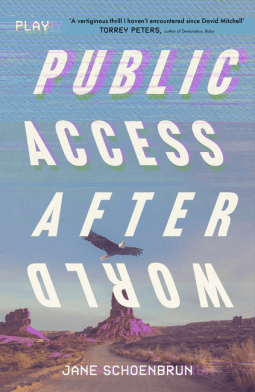
Public Access Afterworld is a genre-defying novel about the secrets of TV transmission and people who go missing to the static. David Sawyer and his best friend Erin Morrison witness the analogue TV switch off, but what Erin sees in the static afterwards changes both of their lives forever. Years later, Bethany Peters works as a content moderator for a huge tech company, but soon she’s trying to work out what the mysterious phrase Public Access Afterworld means after she keeps hearing it from one streamer, Jules.
This was perhaps my most anticipated novel of the year, as I love Jane Schoenbrun’s films, so I went in with high expectations. Immediately, there is a specific vibe, setting up the framing device of the story being told as a number of episodes (if you look online, it’s easy to find out that the novel started life as a TV script). We know that this is a book about television. This structure works really well for such a long novel as it feels episodic and can take an “episode” (a few chapters) to tell a different part of the story or do something completely different for a bit to feed into the wider narrative.
The main idea in the novel is transmission, a culmination of the ideas in We’re All Going To The World’s Fair and I Saw The TV Glow by taking what it means for the self to be transmitted and making that a universe-spanning concept. As with Schoenbrun’s films, some of the horror side of the novel comes from what happens if you lose yourself in service of the transmission, the fiction, another character. There’s also transmission as it relates to human relationships and how you connect to other people (again, like in their films).
The characters in the novel are a real highlight, like the narrative-proclaimed ‘hero’ trans woman Bethany (whose story has a different take on the ‘content moderation is bad for the workers’ plot that a few books have explored over the past few years), the mini golf stoner Jules who wishes desperately to escape to Public Access Afterworld, and Wilhem/Chimotera, the lead character from a decades-spanning horror movie franchise (who gets a Camp Miasma-esque long set of comedy sequels). The episode structure allows to have those ‘special episodes’ to get a different character’s perspective, and character perspective is done so carefully to get across different things as the novel progresses.
Once you start reading Public Access Afterworld, I feel like you are either locked in or adrift. I found the writing style so joyfully thrilling and the ideas so fascinating that despite the length I sped through. I imagine that for others, especially those who haven’t seen the two Schoenbrun films that set up the ideas in this book, the book might feel dizzying. Personally, I loved the energy the book brings as Schoenbrun experiments with having so much more space than in a film to explore ideas.


You must be logged in to post a comment.