
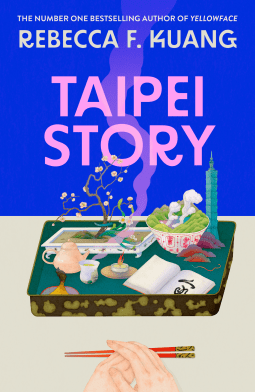
Taipei Story is a literary fiction novel about a Yale student who goes to Taiwan for a summer-long intensive language programme. Lily Chen goes to Taipei hoping for a connection to the language she wishes she knew better, but when she gets there, she realises how much hard work everything is going to be. Her classes are difficult, she struggles with her roommate and others on her programme, and she’s not having the revelations she hoped for. Then her grandfather in China dies and she is forced to think more about her family and her relationship to people and to learning Chinese.
This book is quite different to the other books I’ve read by Kuang, as those (Babel, Katabasis, and Yellowface) all have quite a lot of plot, whereas Taipei Story is a literary version of someone’s study abroad blog, so is much more focused on the details of Lily’s day to day life than much actually happening. I think if you’re a fan of that kind of literary fiction—broadly similar to Sally Rooney—then Taipei Story will work well for you, but if you’re not, it might be more hit or miss. For me, I liked all the detail about food and what Lily was and wasn’t getting used to, as that felt like it was building up a picture of what she was actually focused on, but I did find the book slow and difficult to get into as I was waiting to see if anything was going to happen.
Once her grandfather dies, there’s more about Lily’s family and their past, but I expected this element to go deeper than it did, and the short chapter near the end that focuses on her grandfather felt a bit forced as it didn’t quite fit with the rest of the novel. The book has a lot of ideas around culture, language, and colonialism, but I don’t think how they were presented through Lily’s perspective always worked (for example, I think it means that the book can never properly engage with the mentions of genocide that come up). By the end of the book, Lily is still disconnected from the other characters, to the extent that we as the readers know very little about any of the other characters, and it doesn’t really feel like even Lily gets much change or character development.
Overall, this is a book that combines some deep ideas with a superficial narrative that for me was just a bit too predictable and similar to other literary fiction in this kind of ‘lost protagonist coming of age’ genre. I really enjoyed Katabasis because it was so fun and I think Taipei Story is just quite different to that. After reading it, I saw that Kuang had similar experiences to Lily with studying abroad and it did perhaps feel more like someone’s nonfiction account of travel and struggling with cultural change than a novel (so I can see why the blurb I read compared it to Patricia Lockwood). As someone who is more of a literary fiction person than a fantasy person by a long way, I have to admit that I prefer Babel and Katabasis.


You must be logged in to post a comment.