
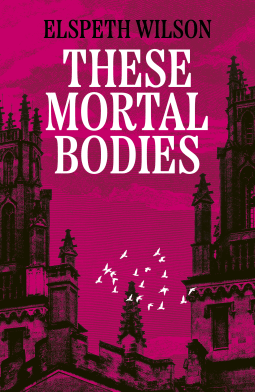
These Mortal Bodies is a novel set at an elite university in which a young woman is drawn into the world of secret drinking societies and ancient power. Ivy grew up by the coast, but now she’s about to start at a prestigious university. Despite feeling like a outsider, she quickly finds intoxicating new friends and becomes intrigued by the drinking societies and the witchcraft-related history of her women-only college, but she has to decide how far she will go.
This is a dark academia novel that blends detail about Oxbridge with invented history of women accused of witchcraft, and blurs the lines between traditions and rituals, power and mysticism. The narrative focuses on Ivy and her friends’ first year at university, structured around each week of term, but it is more about small dramas and Ivy’s trajectory that big plot points, with the ending being more about characters coming into their own as ‘sisters’ at the college. For me, the ending felt more like a setup for a sequel than an actual ending, with lots of unexplored areas and unanswered questions.
The settings in the book are never specified, but the words used give it basically away, so the blurb I read specified that Ivy is from Scotland, but only particular terminology like Hogmanay’ made that clear, and the university is clearly Oxbridge (I assumed Cambridge as I was reading because it has a women’s college still and Oxford doesn’t, but given that it is fictional, it could be purposefully either). One downside of this is that I think anyone without a familiarity of the terminology used at Oxbridge may end up confused, trying to guess where it is set and unfamiliar with concepts like different colleges, drinking societies, and the short terms. As I am familiar with them, I liked the detail (and I like dark academia that manages to be realistic with the university detail of where it is set), and it did accurately explore the balance between academic work and other elements that becomes all the more apparent when terms are short and workloads are high.
The characters were intriguing but perhaps lacking in detail at times, even Ivy as the narrator (anyone else you could blame on Ivy’s perspective, as a lot of the side characters seemed to have no personality traits at al). Again, the blurb I read said Ivy is neurodivergent, but the book itself leaves that unspoken as far as I remember, and there are a lot of points like this where things are hazy and unspoken, but which perhaps actually needed to be spoken. Ivy’s obsession with binaries, which is foregrounded at certain points in the book, brought something interesting to what I was starting to think was a book obsessed with the difference between men and women, but again, it wasn’t really followed through on, not even with the one lesbian character or the one singular mention of the concept of non-binary people in the ‘dear’ part of a letter/email. I think it is a perspective on Oxbridge that often isn’t explored—how so much is set up as some kind of binary—so I would’ve liked more depth around it (particularly as a non-binary person who went to Oxbridge myself).
The toxic friendship and obsession stuff is enjoyable, reminding me of things like The Craft in which there’s a blurry line between this kind of obsessive female friendship and ideas of witchcraft. Oxbridge drinking societies do work quite nicely as a way to do dark academia (they are perhaps one of the most famous ‘dark’ aspects of the places) and the way they are worked into the characters’ dramas and relationships make them integral rather than background. I think the darkness and actual narrative drama could’ve gone further, as what actually happens in very tame (and I assumed things were setting up for darker plot points, but then didn’t). And once again with dark academia I feel that ideas around kinds of obsession and betrayal are so focused on female friendships and boys as the distraction from them that they don’t even explore the homoeroticism they contain, not even in this case where one of the friends is a lesbian (though she never really mentions this).
These Mortal Bodies is fun if you like dark academia vibes with an accurate (if trying to be non-specific) Oxbridge setting, but for me it lacked substance and the combination of darkness and charm that makes The Secret History continue to be a standout book amongst its many successors. It felt like the first half of something, without the ‘fall’ or fallout from events ever happening (I do find it hilarious that Ivy gets a first even when she constantly admits she doesn’t take her work as seriously as she should). However, I do appreciate when dark academia books do actually understand how to combine the academic setting with the ‘dark’ obsession side, and it was a good book to read in autumn with the new academic year feeling.
 Fiendfully Reading
You must be logged in to post a comment.