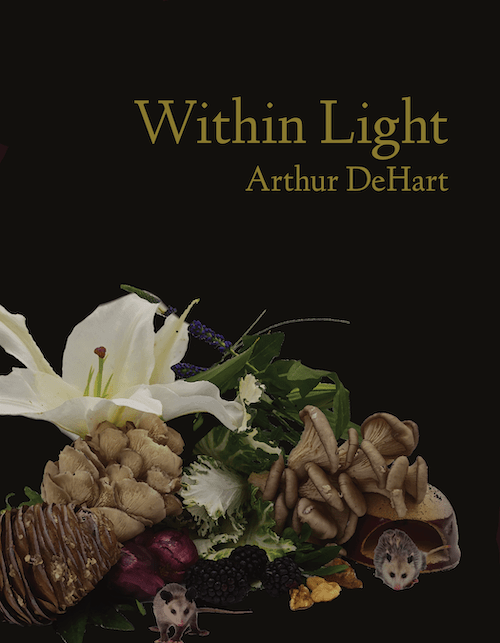
Within Light is a collection of poetry that combines love and longing with the harsher realities that surround them. What particularly stands out when first reading is the love poems in the collection, in various forms, from the eye-opening point of ‘Catch Your Breath’ to the realities of ‘Dirt’, and also the tiny moments of love that are suffused throughout most of the poems, including those talking about mental health. It is a collection that doesn’t idealise love, but presents it as both mundane and life-sustaining, and also a method of queer people forming the lives they want to live.
I also enjoyed the poems about being a poet or poetry running throughout the collection, a musing on what it means to be a writer but also how sustainable it is, and the amount of wishing and hoping that comes along with being a poet (particularly as I too find myself ending up writing poetry about writing poetry too often). One of my favourite poems in the collection is ‘Sunday’, which reclaims the day from a religious past and offers a laziness that can come post-transformation, both of the narrator and of the day itself.
Within Light is a tender collection that still has raw moments, exploring what love can mean and what a poet can be.
(Within Light is forthcoming from Kith Books in March 2023)
White/Other is a collection that defies boundaries, made up of prose-poetry-manifesto-essay pieces that explore the treatment of those who are white working class “other” in society, combining personal and cultural essay fragments with discussions of the purpose and history of language and who is allowed what language.
Language is the thing that jumps out the most from the collection: repetition, fragmentation, and the importance and slippiness of meaning. The title itself sets this up, with a question that is returned to again and again: what does “white, other” truly mean in the categories of neoliberal society and how does that materially impact people’s lives? The lyrical prose that makes up a lot of the collection plays with language as it asks which words are allowed and how much which words are used matters. At the same time, there’s plenty of consideration of class and politics, because it isn’t just systems of language that are questioned and attacked.
There’s a lot in White/Other as it moves between topics and thoughts, an angry trove that uses poetry to ask what can be represented in poetry and whose voices can be heard. I enjoyed the fragmentary style that flows between ideas and the repetition and echoes that make powerful points about how people are perceived and represented.
As I mentioned yesterday, I read a lot of great poetry in 2022, so it was tricky to put together this list. A lot of my poetry reviews boil down to ‘vibes good’ and ‘imagery or lines that just hit me in the chest’ so this isn’t the most articulate list of why these collections are good, but just some of my favourites of 2022. Links to full reviews in the titles where I’ve written them.
Please Press by Kat Sinclair – A powerful pamphlet that I sadly cannot say anything else about because I am many miles from my copy currently and I did not write anything about it at the time. But go get it from Sad Press and see why it’s great.
Limbic by Peter Scalpello – I ended up with two copies of this, one from each of the book subscriptions I had in 2022 (Cipher Press and Lighthouse bookshop’s poetry subscription), which tells you it must be a good intersection of my taste. Sex, queerness, tracksuits, tiny moments – there’s plenty to enjoy.
All The Flowers Kneeling by Paul Tran – A collection exploring violence and storytelling that was so compulsive I accidentally stayed up late reading it, not something I tend to do with poetry.
A Little Resurrection by Selina Nwulu – Some of my favourite parts of this great collection was the use of imagery and the engagement with space, as poems look at race and place and bring in elements of climate and convenience.
Yo-yo Heart by Laura Doyle Péan – Powerful poems moving through a breakup to show the political nature of healing, filled with wit and sadness.
The Moral Judgement of Butterflies by K. Eltinaé – I loved the form of these poems, which explore trauma and immigrant experience and the idea of home. One of the books I got from my Lighthouse bookshop poetry subscription and wouldn’t have discovered otherwise.
At Least This I Know by Andrés N. Ordorica – Going to steal a line from my own review to sum it up: “I knew I was going to like the collection from the first poem ‘November 16th, 2014’, which is a perfect opening for it: a moment at border control, encapsulating fear and desire for a place to belong, and a poem that almost makes you laugh and cry at once.”
Kerf is a poetry collection that explores woodworking and craft, autism, and language, often together, and is intercut with images of notebook pages and wooden crafts. Farmer’s thoughtful introduction ‘Kerf. A Brief Excursus’ sets up the book—I particularly enjoyed how the term ‘kerf’ was explored and then potential metaphors dissected. Some of my favourite poems from the collection are ‘And, Now What?’ with its repeated question and movement towards actuality, ‘Contra Expressivities’ for its thoughts and formatting, and ‘Sssssssstiiiiimye’ for the way it enacts experience and sibilance.
The collection seems to close with the longer poem ‘What’s That: Instead of Ego’ which moves through various phases to explore autism and woodworking craft hand-in-hand, though coming after this is both the ‘Glossary of Woodworking Terms and Concepts used in Kerf‘ and Further Reading. The Glossary was weirdly one of my favourite parts of the book, full of wit and offhand side notes that sit nicely alongside the linguistic cleverness and exploration of the poems that come previous. At times I became lost amongst the woodworking and theoretical terms in the collection, but I enjoyed finding my way back.
Yo-yo Heart is a poetry collection that tells the story of the aftermath of heartbreak, a personal diary after a split with a girlfriend. Split into five ‘days’ that correspond to phases in the grief and emotion of the narrator, the poems chart how everyday moments intersect with emotion and also explore the political behind such grief. Laura Doyle Péan opens the collection with a prologue about the process of survival, healing and vulnerability, ending with the memorable manifesto “allowing oneself to be vulnerable / is a political act” and they suffuse this throughout the book.
The collection is translated from Quebec French and the translator, Stuart Bell, also introduces the book to discuss the translation and the poetry itself. I particularly appreciated the discussion of some of the original French and where it has specifically Canadian and political elements, meaning that as I was reading I could have a sense of the original text lingering underneath even without having it on the page. There’s also short explanations of key pop culture references, which poetry collections have been doing more and more, and in this instance it allows for some Canadian references to be explained for readers from other countries.
The short length and powerful imagery of the poems as they move through each section makes this a hard-hitting collection, showing how healing mental processes take time even as the parts claim to be individual days. The use of space in the collection, both around words and also poems, adds to this, as well as to the initial isolation of the break up. The way images are expressed (in translation, of course) brings wit and sadness, for example in lines like “cooking soothes Ricardo tells me / i cut off the carrot ends / just like you have / all contact”.
Day 3 has some particularly memorable elements, starting with the poem containing the collection’s title and having a poem that explores grief for the personal whilst political injustice, especially borders and imprisonment, go on in the world. The way that the entire collection, not only through this poem, emphasises that personal and societal sadnesses occur at the same time and it can be a political act to be able to express yourself is a highlight of the book. Also in Day 3 is another of my favourite set of lines in the collection, “in pastel gel pen I have written / invitation cards / to all my demons / to the monsters under my bed / where I’m going / you are going too”.
Yo-yo Heart is a book that will stay with me for a while, thanks to the use of sparse imagery, emotion, space, and politics throughout a narrative of heartbreak and slow healing. It is in a style I love and I really enjoy collections that tell a full story using any style of poetry.
A Little Resurrection is the first full-length collection by Nwulu, with poems that explore places and spaces, race, and navigating your position in the world. Some of the poems form parts of sequences woven through the collection, like the ‘Conversations at the Bus Stop’ and ‘Repatriation’ poems, and others explore various facets of similar things, like the loss of a parent.
I particularly enjoyed a lot of the imagery throughout the poems, with lots of lines and ideas that really stick with you (for example, in ‘My Dad’s Jacket Lives On in a Pop-Up Bar in Shoreditch’ and the final line of ‘Half-Written Love Letter’), and carefully sketched out human relationships like the “what if” of ‘Never Mine’. The engagement with space, particularly the modern reality of living in a city in ‘We Have Everything We Need’ also stands out, bringing in the global and climate impacts of having city convenience and inconvenience, and also the idea of which spaces are for who which runs throughout many of the poems.
Artemis Made Me Do It is a poetry collection from the dual lens of Artemis and the poet, exploring ideas of survival and trauma and using your own power. The collection is split into sections, alternating between Artemis and “the poet”, and combines text poems with elements of collage and tarot. I particularly liked the Artemis sections, which explore the various myths surrounding Artemis and how these can be useful in a modern context, thinking about how stories are told and how someone is viewed. I enjoyed the collage parts too, and I think the general witchy/tarot vibe will appeal to a lot of people. Some of the poems were less to my taste as I’m not so much of a fan of very short poems that feel like aphorisms, which were particularly prevalent in the “poet” sections, though I feel that the collection did work well from having both parts, weaving together the two voices in conversation.
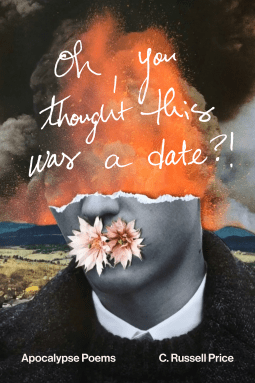
oh, you thought this was a date?! is a poetry collection exploring the apocalypse through trauma, desire, and the realities of America. The collection is split into sections, each with a quote, dictionary definition, ‘Soundtrack’ and ‘Ritual’, and the book feels like a ritual overall, a chance to speak about brutality and destruction through lyric and song. There’s a lot of music, titles and lyrics, infuses throughout the book and it almost feels like the hazy soundtrack to a wasteland, playing whilst poems explore kinds of apocalypse, trauma, vengeance, and personal histories. At times, in poems like ‘Ars Poetica: We Can Take Our Turn, Singing Them Dirty Rap Songs’ but also through its own structure and tone, it is also a manifesto for poetry that isn’t “fluff”, that does things rather than gently meditate, and that’s a good message to leave with: poetry should have power, and can feel dangerous to those who’d rather it was hidden.
100 Queer Poems is an anthology of, as the title suggests, 100 poems from across the twentieth and twenty-first century that evoke queerness in some way, with the introductions by each editor exploring some of the definitions and ideas behind this concept. Split into seven sections, the poems follow a range of topics and styles, with some in translation, so there’s likely to be something for most people to enjoy, regardless of what sort of poetry you prefer.
For me, I found myself often most drawn to poems by poets I’ve already read (Mary Jean Chan, Matthew Haigh, Peter Scalpello, Richard Scott, Danez Smith), which possibly suggests that I’m already good at finding the poetry I like, and it was nice to read various poets together. I found myself drawn into the collection and accidentally stayed up too late reading it all in one go, almost in suspense for what poem would come next. I would like to have a physical copy (I read the book in PDF form) to use as a proper anthology, to flick through and dog ear and find that specific poem you want to read again at that moment.
Probably my favourite poem in the collection is one I think I’ve read before, Harry Josephine Giles’ ‘May a transsexual hear a bird?’, which I don’t think will ever stop being such a powerful poem and one that strikes a real message about poetry and what can be in it, offering with that an interesting commentary on what should or could be included in any collection of queer poetry. Surprisingly, I also found myself really drawn to the ability to reread Auden’s ‘Funeral Blues’, a poem I’ve read a lot but not recently, in the context of poems from a range of decades, but especially alongside a lot of modern poetry. Some other poems that stood out to me were ‘Go Away and Then Come Back by Martha Sprackland, ‘I See That Lilith Hath Been with Thee Again’ by Shivanee Ramlochan, and ‘Ganymede’ by Jericho Brown.
As the introductions touch upon, it is refreshing to see a major publisher bringing out such an anthology, which feels like the sort of book that all queer poets and poetry fans need a copy of, both as something to return to and as a representation of a current moment (which the acknowledgements suggest, referring to the idea of there being another one of these in ten years). As with any anthology, people are going to prefer different poems or wonder why certain things weren’t included, but it is a great chance to survey some of the queer poetry out there from the past 100 years or so. It’s a jumping off point rather than a closed book, as any good anthology should be, and I think it just being readily available and visible is still important.
Time is a Mother is Ocean Vuong’s second collection of poetry, exploring grief and memory and the important details as well as larger questions of self and place. The writing is lyrical and beautiful, as I expected, but also the poems are highly readable, telling stories and putting together images masterfully.
My two favourites were probably ‘Beautiful Short Loser’, which feels like a collection of biting observations and tells multiple stories at once, and ‘Not Even’, which is a breathtaking look at self and the past. I also particularly liked ‘Dear T’ and ‘No One Knows the Way to Heaven’, and I enjoyed a lot of the different use of form, particularly space, and also the format of ‘Amazon History of a Former Nail Salon Worker’ which was very powerful whilst only using an Amazon purchase history.
Fans of Ocean’s Vuong’s poetry probably won’t be disappointed—I wasn’t, but was drawn into the poems, and I’ll definitely want to return to them. I’m still in awe at the combination of powerful meaning, concisely expressed thoughts, and sheer readability of Vuong’s poetry.







 Fiendfully Reading
You must be logged in to post a comment.