
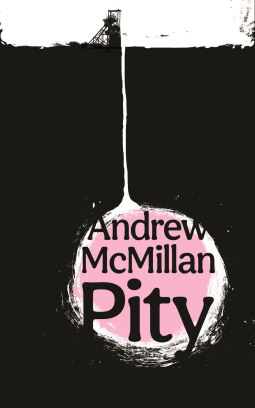
Pity is a novel about the lives of a family in a South Yorkshire mining town and the impact of place and self to the people who live there. Brothers Brian and Alex have always lived in this town, once a mining town and now haunted by the memories of mining strikes and disaster. Alex’s son Simon lives there too, but his world is different, working in a call centre by day but by night doing drag shows and sharing content on OnlyFans. Researchers come to the town, looking at the effect of memory, but sometimes the scars aren’t what you’d expect.
This is Andrew McMillan’s debut novel and being a fan of his poetry, I was excited to read this. The narrative is told through a variety of elements—CCTV footage, third person narration, research notes—and this gives it a particular atmosphere of looking in, almost spying on the lives on the characters (and there’s a lot of watching throughout the book, a lot of viewers). It is focused a lot on place, but really the people who make up a place and how that can change as times change too, that a place isn’t always just one thing, even when it seems like “mining town” is just what somewhere is. Though the novel is short, there’s a lot to think about in terms of these elements, ideas of viewing and memory, and this kind of psychogeography.
Though the time with the characters is brief, there’s some interesting things going on with them. There’s the obvious different trajectories of Brian and Alex, the latter of whom’s plotline is half-unspoken, very much mirroring ideas of what he feels like he can talk about. Simon’s narrative is focused around him bringing his drag performance back to his hometown, where he’s changing things up for something more political, and exploring his relationship with Ryan, a security guard who wants to be in the police. There was some complex bits with Ryan and with their relationship, which the novel doesn’t delve into much as a lot is hinted at and implied rather than explicitly covered, like attitudes towards drag and who people are when they do or don’t change outfits or make up.
I would’ve read more of this book, but I also like the fact that it is very much a snapshot, a controlled piece that teases you with glimpses of lives and experiences, but ultimately doesn’t give you everything, just like the CCTV and Simon’s OnlyFans. I enjoyed how it depicted queer life across different kinds of experiences alongside the focus on place and geographical and mental scarring (brought together neatly and horribly by the spectre of Thatcher).
 Fiendfully Reading
You must be logged in to post a comment.