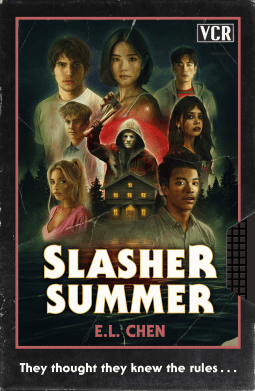
Slasher Summer is a horror novel about a group who were once friends in high school, now reunited in the remote cabin where their cult favourite slasher film movie was filmed. Patrick has invited his old group of friends, all of whom came together to watch horror films, back together to stay in the cabin in their hometown where the film Slasher was made. Things between them haven’t been the same since high school, but this is their chance to come back together. However, when they spot the slasher from the film in the woods, suddenly their reunion is more than just a chance to remember the horror films they used to watch.
This book is one of the many love letters to slasher stories that have been released in recent years, featuring many references to classic slasher films and characters. The book doesn’t get too bogged down in the references though, and it really builds up the characterisation of the group as the focus rather than just ticking off tropes. I loved the way that it plays with some of the more dated elements of slasher tropes, particularly around race and sexuality, and questions who is allowed to play which role in the genre. At the same time, the narrative has a slow build up and then a gory second half, so it doesn’t lack the kind of excitement you’d expect from the genre. I worked out the twist partway through, but it was still a satisfying ending that felt decently set up.
If you’re a fan of fun slasher stories, but also want a version that takes characters who are slightly older than the usual teens and has them wonder if they really want to stay who they were in high school, then Slasher Summer is one to look out for. There’s definitely a few characters whose deaths make you feel like you wished they could’ve had longer, which I think is a testament to the characterisation as in many slashers you can often struggle to tell the initial deaths apart.
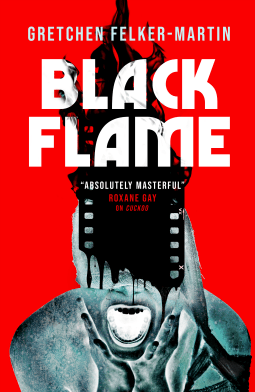
Black Flame is a short horror novel about a closeted Jewish woman who works on restoring a film seemingly destroyed by the Nazis. In 1980s New York City, Ellen works restoring old film and dodging her mother’s desire for her to settle down and marry a nice man. As she starts working on a film brought in by a group of German academics full of queer debauchery and strange occurrences, not only is Ellen’s repression pushed to breaking point, but she starts to realise that the film is bleeding into real life.
Having read Manhunt and Cuckoo, I was always going to read Gretchen Felker-Martin’s next offering. This one is quite different, a shorter book that focuses on a smaller story centred around one protagonist. It explores queer repression, Jewishness, and the concept of things from film stock coming into the real world, and has a level of gore and sex that you’d expect from Felker-Martin. It starts off fairly gently as we’re introduced to Ellen, but it gets nastier as the book goes on, with some memorable moments near the end. The horror is more around the horrors of repression and violence rather than actually being scary, but it’s still more of a book for extreme horror fans like Felker-Martin’s other books.
The Decadence is a gothic horror story that offers a new take on the country house novel, as a group of friends flee to an old country house during lockdown. Jan and her friends are floundering, and now lockdown has made things even worse as they can’t even party to escape their lives. But there is one option: a couple of weeks at the old country house Theo inherited from his great uncle. Fuelled by as many drugs as they could bring, things start falling apart almost immediately, as their interpersonal dramas surface, but quickly it seems to Jan that there’s something else going on, and maybe the house isn’t the safe retreat they imagined.
This is a book that takes a lot of other works and reinvents them into something new, as Leon Craig discusses in her note at the end of the book. The narrative perspective (entirely from Jan’s point of view, a woman trying to fit in despite being a queer Jewish woman in a upper class English environment) and characters are from the country house novel, even pushing as far as (again, as Craig states) The Secret History as a kind of country house novel without the house, but with the in-group rarified from others. The haunted house side of things easily calls to mind Shirley Jackson, House of Leaves, and Tell Me I’m Worthless, and the latter in particular feels like a good comparison for this book, with The Decadence having less of the horror but a similar connection between the evils of Britain and the haunting of its seats of power.
The story itself is pretty simple, with messy characters and drama between them building to a climax alongside the weird things happening in the house, and being forced together in a claustrophobic setting adding to all that. It starts in a slow burn gothic style, mostly focused on the characters, before things ramp up as they all take an experimental drug. Sometimes this kind of book can lack a dramatic ending, but The Decadence builds to something that feels in-keeping with the atmosphere it has created (though I think having read Tell Me I’m Worthless primed me to expect something like what happens). Due to being from Jan’s perspective, you never quite know what was going on with the other characters, which again, suits the genre, and also the overarching theme of belonging and what is knowable.
I thought from hearing about it that The Decadence would be my sort of book, with its combination of haunted house horror, the Brideshead-style novel, and a queer protagonist, and I’m happy that I wasn’t disappointed. Craig uses the range of books that influenced her to create a new version of a gothic country house that fits into the claustrophobia of lockdown (which I’ve not mentioned otherwise in the review, but I liked how it came into the novel, and how it didn’t) and explores the messiness of belonging (or not) in terms of identity, money, and power in modern Britain.
Acquired Taste is a collection of short stories by horror author Clay McLeod Chapman, with a huge range of premises across 25 stories. The stories in the collection are mostly pretty short, never outstaying their welcome, and I liked how much they could differ, meaning that the stories don’t end up getting too repetitive. There’s also a mix of horror styles, from darker, more extreme horror to more bittersweet moments and satirical stories.
There were a lot of fun concepts in the stories (there’s one that involves plushies similar to Labubus which is a great romp) and creepy moments (like someone hearing a crying baby in the cinema, only to realise they’re alone). The only stories I found less engaging were one about civil war psychic sisters (as I’m not really a historical fiction person) and another that was presumably the precursor to CMC’s recent novel Wake Up and Open Your Eyes as it felt like a slightly watered down version of part of that book, and as I’ve read that novel, it wasn’t very exciting to read that.
The collection is great if you like punchy horror short stories, and would work as a good introduction to Clay McLeod Chapman as well. Short stories aren’t always my favourite format, but this kind of well-paced, varied, doesn’t-shy-away-from-being-nasty collection is what I do like.
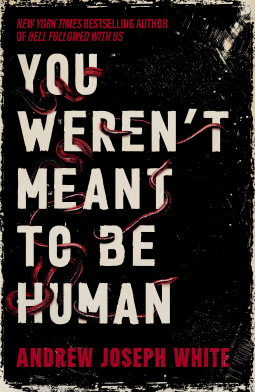
You Weren’t Meant To Be Human is an adult horror novel from YA author Andrew Joseph White, in which an autistic trans man who lives in service to a hive of worms and flies becomes pregnant against his will. Crane found solace in the hive, who have him permission to transition and to not speak, after growing up feeling like everything was wrong about him. He met Levi, an ex-Marine and fellow member of the hive, who treats Crane how he thinks he ought to be treated. But when Levi gets Crane pregnant, the hive insists that Crane must give birth, even though Crane will do anything to not have to.
Having read some of White’s previous young adult novels, I was interested to see what his adult horror would be like, and You Weren’t Meant To Be Human is suitably dark and horrifying for someone like me who much prefers adult books to YA books. The book is basically trans pregnancy horror mixed with Alison Rumfitt’s Brainwyrms, so very visceral not only in worm stuff and body horror, but also abuse, trauma, and the absolute terror of having to be pregnant when that is one of your greatest fears. That does make it quite tricky to review if you are someone who falls into that latter category, as I really don’t know how other people would find it, but if you’re a trans person who could get pregnant, this is quite a book.
I like how a lot of the background in the book isn’t really explained, because the story isn’t about worldbuilding but about Crane’s experiences and thoughts. Even the side characters mostly don’t get a huge amount of backstory, particularly those in the hive, but again, we are viewing things through Crane’s perspective. The visceral descriptions are really what make this book, with the body horror less gory and more horrifying in context. The ending has a dark twist that makes sense, and a lighter twist that I’m not sure how I feel about, though it does offer a kind of hope that might be needed in such a brutal novel.
This is trans horror that uses the horror devastatingly to explore an element of trans experience (Torrey Peters’ story ‘The Masker’ is another example I can immediately think of), resulting in a book that I think is going to feel horribly real for some people and open others’ eyes to something they hadn’t really thought about. Whilst I’ve enjoyed White’s young adult novels, I think that You Weren’t Meant To Be Human is even more my sort of book, and though it won’t be for everyone (as with any extreme horror, you should definitely take heed of the content warnings before reading), it is a tense, cutting horror novel that puts a fresh spin on some horror concepts.
Moonflow is a horror novel about a mushroom-growing trans woman who ends up being lured to a female cult in the woods by a mysterious entity. Sarah needs money and her best bet is to find the mushroom that her friend wants, the powerful King’s Breakfast. It only grows in the Pamogo forest, so Sarah heads off with the help of Andy, who works at the visitor centre and doesn’t approve of her plan to sell the mushroom. Once in the forest, they find themselves being lured deeper, but once there, they find a weird cult of gender essentialist women.
Before starting this book, I didn’t actually realise it was so much like something I’d usually read, as the blurb I read didn’t really emphasise the trans splatterpunk nature of it, but Moonflow is like if you crossed Alison Rumfitt’s books with the mushroom-y vibes of Mexican Gothic, with a heavy dash of Gretchen Felker-Martin as well. It’s the sort of horror that manages to become satirical and darkly funny, whilst also being cuttingly real about certain elements (the cult’s obsession with saying ‘phallic alec’, for example). It starts off slow, with a great glitched phone element and the fear of forgetting something, but quickly becomes much weirder with a cult focused on lesbian sex and psychedelic substances. The ending is satisfyingly disgusting, with a cosmic horror style lack of real resolution about what happened.
If you like trans horror, Moonflow is a fun botanical take on the genre that combines the horror of eldritch beings and mysterious fungi with the horror of a feminine-obsessed cult to explore different ideas of what happens once you learn something you can’t turn away from.
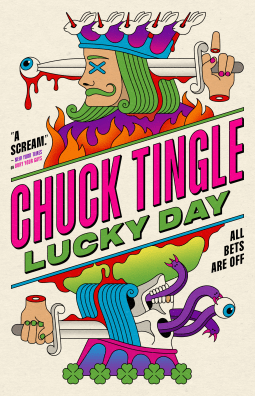
Lucky Day is a cosmic horror novel about a statistics expert who survives a global disaster only to try and work out why it happened and give meaning back to her life. Vera’s life was torn apart by the Low Probability Event that struck globally, causing death and destruction, so she hides away in her house, not wanting to care about anything. But when a mysterious agent turns up at her house asking for her help investigating a Vegas casino that seems to be linked to the event, Vera is drawn into the mission.
Having read both Camp Damascus and Bury Your Gays, I was interested to see what Tingle would do with this premise. Unfortunately, I found that the book didn’t work for me, and I found myself frustrated with it at various points. To start off with, the narrative is told by Vera in first person present tense and there were turns of phrase in the narration that felt jarring, like slang that didn’t quite flow in the narrative voice.
The overall tone of the book, despite being pitched as cosmic horror, is as comic as Bury Your Gays‘ satirical tone, and that matches the tone of the ridiculously gruesome violence that happens at a couple of points in the book (think Final Destination vibes), but not the fact that these events are meant to be genuinely horrifying to the narrator. For me, this made the novel, like Bury Your Gays, feel just a bit too ridiculous to feel serious, and that undercut the balance of the comic existential side (deaths so unlikely you’re meat to laugh) with the actual horror of contemplating the meaninglessness of that. Maybe the tone could’ve worked if it came together at the end to say something interesting about the concept of the absurd, but the end is a bit flat, feeling too neat and not really giving any of the characters a proper conclusion.
On that note, the characters also didn’t work for me. Vera was a series of stereotypes which move from ‘incredibly organised statistics professor’ to ‘depressed nihilist’ and then, by the end, never really resolves how she might rebuild something more like the former again, or how any of her former life and personality might be changed by her huge existential crisis. Her bisexuality feels like it is a plot device (which admittedly is a major plot device at the start and then that has a throwback later on which felt really randomly included) and Vera might’ve felt more interesting as a character if we learnt anything more about her experiences, either in terms of her sexuality and her relationship we see at the start of the book, or even just any interests she had before (other than presumably an X-Files-esque TV show that gets a lot of references in the book, without any further detail or point). Saying too much about Agent Layne would give away spoilers about the book, but again he was more larger-than-life stereotypes, and there aren’t really many other characters that appear more than momentarily, so the book really has to lean on these two.
I think that there will be plenty of fans of this book who like the fact that it is more of a campy sci-fi story with a few gruesome horror moments (especially as Tingle has a lot of fans who like that campy vibe to his writing), as long as you don’t want greater meaning from the existential side other than ‘maybe things do have meaning actually’. As with Bury Your Gays, it felt like there were moments in the narrative where you were really being hit over the head with an idea, even when it wasn’t fully considered, and in fact the entire book felt like it was trying to take the concept of people saying bisexuals don’t exist and make it into an existential joke, but it never really does that in a satisfying way.
And on a personal note, I’m really interested in fiction about Vegas and it felt like this book could’ve done so much more with the setting and atmosphere given that it was almost entirely set in Vegas. There could’ve been so much more about the fact it is a casino that is at the heart of events, or about gambling, or even Vegas and queerness. But if you’re looking for queer horror set in Las Vegas, I’d suggest reading Torrey Peters’ novella ‘The Masker’ from Stag Dance, which says a lot more about queerness itself.
I’ve ended up writing a lot about this book because it frustrated me how I wanted it to be more interesting and engaging than it was, and how much it felt like a bunch of stereotypes and trope jokes put together without saying anything about them. However, as I said, I think if you’re looking for something silly in the vein of Tingle’s other recent horror books, you might have more fun with it than I did.
House of Monstrous Women is a gothic horror novel set in the Philippines in 1986, in which a young woman finds herself in a nightmare of a house, playing a game alongside her brother and childhood best friend. Josephine lives in Carigara alone in the family home, running out of money since her parents were killed and her brother moved to Manila. When her childhood friend Hiraya offers Josephine a chance to come to her family’s old mansion to play a simple game that could give Josephine whatever she desires, it seems like a chance to escape. However, the house seems to not want to help, and the more Josephine learns, the worse her chances seem to be.
The book starts off slowly, building up Josephine’s family history and how tied their tragedies are to the political situation, whilst showing her exploring Hiraya’s house. Once the game begins, the book becomes much more fast paced, with a gripping run to the end. It also features some great horror moments like crawling through impossibly tight tunnels for your life and discovering the truth about the food served in the house. There’s plenty of the gothic side too in terms of social commentary, not just in the political situation but also the position of women in society and how Josephine is looking set to be forced to marry an older man, and the children’s game turned into a deadly fight fits in well with this.
Whilst the book was mostly a quite slow burn gothic novel for the first half, I liked how it then became more tense and also more creepy as it went on, especially with all the insects. If you like gothic horror, this book delivers a tense story that explores the complicated bonds between family and friends and a fight against oppression.
We Are Always Tender With Our Dead is a new horror novel from Eric LaRocca, centred around a cursed town, Burnt Sparrow, and what happens when three faceless creatures massacre a number of residents. Seventeen-year-old Rupert Cromwell is drawn into events by his father, and soon finds himself far too close to the dark cruelties that follow. It’s hard to say much more without giving too much away.
Having read most of LaRocca’s previous stories (liking some more than others as to be expected) and having a lukewarm reaction to his previous novel, I wasn’t sure what to expect from this one, especially as it is the start of a trilogy. However, I feel like this novel better showcases LaRocca’s skills in telling transgressive queer horror stories that explore human cruelty and trauma, whilst building up a sense of lore around Burnt Sparrow that I’m assuming will be continued in the later books in the series. The narrative is told from two characters’ perspectives, including a few horror stories told by those characters, plus some separate articles about Burnt Sparrow, and the narrative itself is episodic despite the overarching ‘plot’ of the three faceless murderers. By doing this, the book is able to delve deeper into some characters than you can in a shorter story, whilst still giving LaRocca space to weave shorter extreme horror stories and moments into the novel.
I’ll be fascinated to see what comes next in the series, as this one did feel like you were missing just that bit more about Burnt Sparrow, and the ending is quite sudden, with a lot of wider things left unanswered. The more extreme horror or splatterpunk moments in the book are quite brief, so whilst people should always take heed of trigger warnings at the start, I’d say that it isn’t as unrelenting as some other books I’ve read, and a lot of the horror comes from LaRocca’s trademark exploration of people’s choices and cruelty and the thresholds they are willing to cross. For me, this was one of my favourite LaRocca books, combining unnerving supernatural elements with the horrors of humans themselves, and using the novel length to weave in related stories.
Basilisk is a horror novel about an online game that leads two ethical hackers down a road towards a mysterious cyber weapon for targeting people, not technology. Alexandra Webster worked for a cybersecurity firm, and now we’re reading her story, written down to document what happened when her and her colleague Jay found the start of an online game created by ‘The Helmsman’ that rewarded participants with further “chapters” about a mysterious weapon. Jay disappeared, and Alex was still searching for what happened to him, and who the Helmsman was, whilst evading the strange smiling people trying to stop her.
This is a very distinctively-told horror novel, most easily summarised by saying it is like if you tried to do House of Leaves about a tech-focused ARG rather than a house. The actual writing is partly a narrative written by the ostensible protagonist, Alex, with added comments by someone else investigating the manuscript, and also the texts of the Helmsman’s chapters. On top of that, there’s links to articles, videos, and playlists, and a general expectation that you get drawn into the mystery enough to want to know what is going on. In that way, it makes you a player too, even if a passive one, and that is perhaps how it is most like an ARG as well as being about one: the meta- and intertextuality make it a horror novel with a ‘this is true document we found’ framing that actually has that creepy sense that could be true. Alex as a character isn’t particularly transparent—in her narrative she barely reveals anything about herself that isn’t part of what happened—but this works to allow the reader into the position of Alex, or to project their own things onto her. In a way, this is a book that is more about avatars than actual people.
Despite not being a hacker or a cybersecurity person, I’m otherwise perhaps the target audience for this novel: I love horror and internet horror, I find the concept of ARGs fascinating, I work close enough to tech-y stuff that I can recognise some of the tech terminology and don’t find the rest of it intimidating if I don’t understand it (and, I love mentioning ‘The Game’ as an example of a game). Like House of Leaves, there is a lot contained within this novel (or linked from it), including the hacker stuff, but also Old English, The Matrix, cryptic crosswords, philosophy, creepypastas, and other things that all feel part of a certain milieu. However, if you’re not really engaged with those as potential ideas that might fit together in some kind of weird way, this book might feel off-putting, rather than a fun sort of rabbit hole. For me, it was the latter, a story packed with references to things I knew a bit about and an atmospheric sense of dread as it slowly unfolds through Alex’s narrative.
There’s something about modern day fears captured in Basilisk even though it might appear to be a fairly silly horror concept, from the idea that there’s some kind of cyber weapon that could actually cause people to go insane as in the book, to other technological thought experiments and conspiracy theories that can cause people to extreme actions. The book itself has sections in The Helmsman’s chapters that discuss some of these things, such as Roko’s Basilisk and Slender Man, and being aware of some of the very real possible consequences of online ideas makes Basilisk even scarier in some ways. Again, this does require some knowledge of these things already (for example, I think the Zizian cult stuff around Roko’s Basilisk is too recent to even be mentioned in the discussion of Roko’s Basilisk in this novel), but even just knowing that ideas on the internet can become something more primes you. In this way, the book is also similar to something like Alison Rumfitt’s Brainwyrms, another horror novel that takes the internet seriously.
From seeing some early reviews before I started reading, I expected Basilisk to be difficult to read and impenetrable (ironic given that Alex and Jay are penetration testers), but it turned out to be a readable, slow burn descent into what is apparently a purposeful madness. Maybe I’m just really the right person for this book, but I had a great time with it, and if you have any interest in the intersection between horror and technology, especially in terms of the transmission of the horror ‘threat’, then Basilisk is fun, dark, and has a satisfying enough ending despite feeling like a book that could perhaps never end in a way that really brings it all together.






You must be logged in to post a comment.