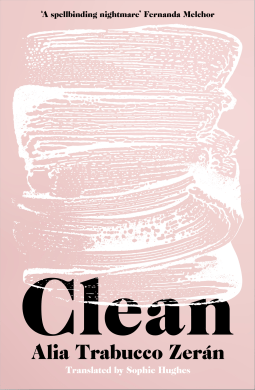
Clean by Alia Trabucco Zerán

Clean is a tense novel narrated by a maid in a locked room, telling her side of the sequence of events that left her there after the death of the daughter of the house. Estela moved to Santiago and found a job working for a well-off middle class family, a doctor and his lawyer wife and then their newborn daughter. She describes how over the seven years, things began to go wrong, always alluding and building up to the death of the girl.

This is a book that unfolds with dread, like a nightmare, as Estela narrates what it is like to work as if invisible, unless she does something wrong. As her life is contrasted with that of the family she works for, she argues that this didn’t cause resentment, but as death starts to impact them, it becomes hazy as to exactly what is happening. The book leaves as many questions as it answers, trapping Estela and her narrative in a limbo in which the reader can interpret, but not know for sure. One notable thing is how isolated Estela is, even with the backdrop of political change, and how much her story is about her isolation, not just the ‘present’ of the narrative in which she is locked in a room. In a way, you are locked in with her, forced to see the disgusting side of the family and the work Estela does, and it seems to give her some kind of purpose to be narrating, even though without any kind of response, there’s no real sense anyone is actually listening to her.

Clean is ideal for fans of literary thrillers, weaving together class and domestic work in Chile with a memorable character who is an invisible woman, a forty-something maid. It is especially enjoyable to get this kind of narrative instead of the many thrillers centred around the perspective middle class characters and families, and in that way it reminds me of fiction like the film Parasite, using class and wealth disparity as part of the tension in a thriller.

Quick book picks for April

With a whole load of books out this month, it was actually hard to pick out some recommendations. These are a mixed bunch aimed at a variety of audiences, but not limited to those audiences. Click on the title links to full reviews for more details.

  • I Still Dream by James Smythe – A novel about a girl who builds an AI to listen to her problems and how that AI becomes so much more, but also stays as her personal friend and confidant. Proof that books about tech can also be about memory, loss, and the minutiae of people’s lives.
  • The One Who Wrote Destiny by Nikesh Shukla – A story of three generations of the same family, and how their different cultural experiences in Kenya, Keighley, and beyond and their differences of opinion and life shape how they interact.
  • Clean by Juno Dawson – Exciting whilst also hard-hitting, Clean is a young adult novel about addiction, but also about privilege, what makes people different, and how you can have sympathy for abrasive characters. Treats the subject matter seriously, but is also witty and clever.
  • Circe by Madeline Miller – Miller turns from the Iliad to the Odyssey in this rewriting of the story of Circe that weaves together a great deal of stories, showing the tension between gods and mortals from the perspective of an outcast.
  • The Chosen Ones by Scarlett Thomas – The next book in Thomas’ charming magical children’s series that imagines a world where electricity is no longer reliable and magic and books become crucial.
  • Macbeth by Jo Nesbo – The next book in the Hogarth Shakespeare series takes Macbeth and gives it a crime thriller treatment that strips that magic and retains the paranoid corruption. Undoubtably will be popular in libraries.

Clean by Juno Dawson

In-your-face YA: Clean by Juno Dawson

Clean is a sharp and in-your-face young adult novel about addiction, recovery, and seeing everyone has different problems. Lexi Volkov is an heiress and socialite whose dad owns a chain of hotels. When she overdoses aged seventeen, she finds herself forced into an expensive rehab facility by her older brother, and thinks things can’t get any worse. She’s drawn into knowing more about the others in the facility, unravelling their problems along with her own, but can she really change? Can any of them?

Dawson has written the kind of hard-hitting and abrasive YA novel that needs to exist and is difficult to put down. Lexi is obnoxious at times—insulting and judging people in her head and more openly—and makes a great flawed central character, someone who doesn’t want to admit their addition or the ways in which their life has become centred around it. Most of the characters come from money and privileged, meaning the book also has a level of seeing how the elite live, whilst showing problems that the characters must admit don’t care about wealth or position.

Setting the novel predominantly in a rehab centre for under 24s means that it covers a variety of kinds of addiction and ways in which mental health affect people particularly when young, but also that it can have witty and harsh banter and modern pop culture references mixed in. Lexi is always ready to mock current hipster and celebrity culture even though she’s a part of it, and it’s a novel that loves as well as hates London for what it can offer. There’s plenty of seriousness and darkness in the novel—from death, drugs, and sex to what happens when all the options seem to be failing someone with mental health problems—but also fantastic characters and a sense of hope that people can pick themselves up from their lowest depths.

Clean doesn’t pull any punches. It deals with difficult topics—drug, alcohol, and sex addiction, anorexia and binge eating, and OCD are among some of the major ones—and shows another side to the life of the rich and privileged. Dawson shows how young adult novels don’t need to shy away from gritty topics that can’t always be neatly fixed. At the same time, she situates the book firmly in the contemporary world, in a recognisable London and with a modern sense of image versus reality engendered by the internet and social media. This is YA fiction being loud and bold.