
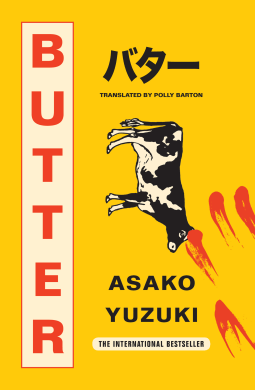
Butter is a novel about food and women in Japan, as a journalist tries to uncover the secrets of a gourmet cook who seemingly killed three men. Rika is a journalist who lives off instant noodles and convenience store food, focused on her work and getting tips from a connection she has, whilst keeping in touch with her old friend who is trying to build her life as a housewife. Meanwhile, Manako Kajii sits in Tokyo Detention Centre, refusing to talk to journalists, until Rika tries asking her for a recipe. Suddenly, Rika has a way to catch Kajii’s attention, and her gastronomical life is changed by Kajii’s instructions, but soon Rika and Kajii are caught in a strange game of fascination and food.
Told almost entirely from Rika’s point of view, this novel could just be a generic crime story about a journalist uncovering the truth, but actually, it is far more focused on food, society, and women’s roles within both, considering desire in terms of food and sexuality and exploring different kinds of relationships between people. For a book that is seemingly a crime novel, it has a slow, languishing plot, and is packed full of description, particularly of food and cooking, and it really does capture the titular butter and its impact on both protagonists’ lives through this. It also critiques Japanese society’s beauty standards and ideas about what makes a woman successful, in a way that is quite obvious, but as we’ve seen from things like the Barbie film, still a message that resonates with a lot of people.
Some of the subtler elements and points were more fascinating, like Rika’s own past and feelings of guilt around her father’s death, her best friend’s complex relationship to being a wife and looking to have a child, and generally the way that the wider cast of characters interact with each other and what they feel like they can do. There’s an undercurrent of female desire, and particularly queer female desire, that sits at odds with the images of heterosexual romance that characters want to perform, and though these elements are small, it’s interesting how they are hinted at. Another part that isn’t really addressed, but is running underneath the novel is ideas of Japanese and Western cuisine—particularly French cookery—and how these may or may not sit nicely alongside one another in modern Japan. Maybe these parts could be more overt, but I like how a novel that is quite big and obvious in its main points can also have these subtleties.
This is a novel that makes you hungry. People looking for something similar to other popular translated Japanese authors like Sayaka Murata may be disappointed, as it is far less transgressive than something like Earthlings, but instead it is a slowly simmering novel about people finding different places for themselves in Japanese society whilst also talking a lot about feminism and food.
 Fiendfully Reading
You must be logged in to post a comment.