The Underground Railroad by Colson Whitehead

The Underground Railroad is a book deserving of its hype. It is a sharp, clever novel that gives the Underground Railroad of US history—a network of routes and safe houses used by slaves to escape into free states—a physical form as a steam-powered escape that must stay secret. Cora is a slave on a plantation in Georgia, ostracised due to her mother’s disappearance from the plantation when Cora was ten. When a new slave, Caesar, tells Cora about the hope of escape on the Underground Railroad, her journey begins to find safety along the lines of the railroad, whilst being pursued by the slave catcher Ridgeway.

Whitehead’s conceit is simple, yet the transformation of the metaphorical railroad into a physical one feels momentous. It brings a sense of momentum and also gets across the idea of something beneath the ground, beneath both Southern states and those in the North, that is alive and working to help black people escape. Cora’s story is a compelling narrative of a desperation to keep escaping, even when those around her are not so lucky. By combining a character’s personal battle with a sense of larger scale—not only through the railroad, but also by describing other characters’ lives and looking into the future at times—the novel is both an engrossing and brutal read and a sharp look at not only slavery but race in America across the centuries. It is clear that many of Whitehead’s concise sentences are true now as they are to the time of the novel.

The Underground Railroad is an impressive combination of style, structure, narrative, and concept to produce a novel about slavery that is both devastating and fresh. Whitehead’s writing style, clever and direct,  gives the book an immediacy that feels vital to reading it and thinking about the past, present, and future.

Order in the bookcase

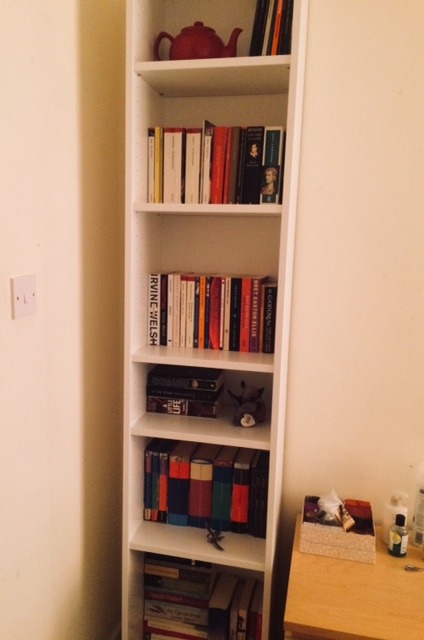
This blog has been a little quiet for the past week as I was moving house and working. One part of this was building a bookcase. Only a thin one because I left the majority of my books with my parents, having learnt my lesson that when you know you’ll be moving again in a year/under a year, don’t take all of them with you (unless you’re planning, as I did one year, to build your bedside table out of books and a piece of wood). After two English graduates remembered how 3D space worked and marvelled at how wood and screws can come together, a bookcase existed. And then I had to organise it.

How you organise your books is controversial (though there’s a fairly uniting disdain for people who do it by colour). There’s alphabetical, the classic, but then do you split further into categories like fiction and non-fiction or form or genre? You can just sort by categories, maybe subdivide by topic. Time period works if you own a lot of  ‘classic’ literature. When you’re lacking in space, as I have been, the best option can be by priority, creating your own ‘high use’ material (this is the only way to make a book bedside table without needing to dismantle it all the time).

I work in a library so you think mine would be very organised. Actually, they’re not. The shelves are as follows, from the top: drama (and a teapot); poetry and two books about Byron; prose, mostly novels but also Wollstonecraft’s Vindication(s); a small thematic shelf that is solely The Secret History, A Little Life, and If We Were Villains (and a cuddly bat); the Harry Potter books plus DVDs, a copy of Quidditch Through The Ages that my friend delightfully graffiti’d in character, and a Buckbeak keyring; and finally, a misc shelf that is keeping the bookcase stable by containing the complete works of Shakespeare, The Goldfinch, The Stranger’s Child, a single hardback book, and a selection of things I didn’t think I’d be reading too soon, but I did want to have with me.

It’s a fluid system that needs to be able to integrate parts of my to-read shelf once they’re read (these books are currently on my desk urging to be chosen next). It is also based upon whim and could be totally changed in a few months (say, after Christmas and my birthday, the main book gaining times of the year handily only a week apart). I think my point is, organise your books how you want. You’re the person who has to find/look at them, after all. Though if you have a particularly notable system, do share it so we can all be outraged/inspired.

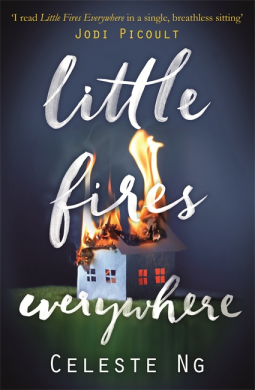
Little Fires Everywhere by Celeste Ng

Sparks and flames: Little Fires Everywhere by Celeste Ng

Little Fires Everywhere is an intricate and observant novel that shines a light on false perfection and the intricate way in which everyday things are interlinked. Shaker Heights is a carefully planned suburb of Cleveland, where everything has order and they pride themselves on being progressive. Elena Richardson embodies much of Shaker’s ideals, but when the Richardson house is found burnt down, the recent past must be unravelled to see how the arrival of the Richardson’s tenants, the artist Mia and her teenage daughter Pearl, affected the four Richardson children, their parents, and the whole community, showing how underneath things aren’t always quite as they seem.

The narrative structure is particularly impressive, with an omniscient narrator flashing back from the burnt house to tell the story from many perspectives in a way that foreshadows and hints at past events in a satisfying way. Key moments and details that will clearly cause a ‘little fire’ later on, be misunderstood or reinterpreted by other characters, are apparent to the reader, but also not overly signposted by the writing. Through this, the book has a great sense of connection and coincidence as the present and past come together in the relationship between the Richardsons and their new tenants and in the battle over the custody of a Chinese-American baby that grips Shaker Heights and puts Elena and Mia on different sides.

Little Fires Everywhere is a novel somehow both charming and tense, with the drama between the characters built upon tiny moments and the overall narrative one that doesn’t reveal surprises so much as fill in the gaps to show how interpretations can be different. The teenage characters are a highlight and this is the kind of adult novel that can also be enjoyed by older teenagers. This tangle of characters and detail is an impressive book with a very satisfying linking of structure and themes and a very apt title in multiple ways. The ‘little fires’ are what makes the novel blaze.

Quick book picks for November

Now that we are in the midst of autumn and I am sat here drinking smoky lapsang souchong (as if I don’t all year round), it’s time for a new list of books out this month. Here’s some portraits of American memoirs, an endearing memoir, and a weird book about Nabokov (with links to reviews in the titles).

  • Heather, The Totality by Matthew Weiner – The creator of Mad Men writes the story of a girl, her family, and what happens in their orbit. Summaries can’t capture the strange atmosphere Weiner creates.
  • Demi-Gods by Eliza Robertson – A stylistic and unnerving novel about growing up in the 1950s and 60s in Canada and the US, told in episodes.
  • Trans Mission by Alex Bertie – This YouTuber’s memoir about his life so far as a trans man combines humour and emotion and is perfect for older children and teenagers, but also parents and other adults who want to be more understanding or know more.
  • The Dreams of Bethany Mellmoth by William Boyd – A collection of stories of varying length about flawed characters at decisive moments in their lives and relationships.
  • The Future Won’t Be Long by Jarett Kobek – The 80s and 90s America novel that wasn’t written then. Kobek tells the story of a gay guy and a straight girl who become friends and try to survive America, featuring comic books, drugs, clubs, AIDS, money, famous authors and artists, and a metafictional awareness of what came next.
  • Insomniac Dreams by Vladimir Nabokov – A book on Nabokov and dreams that uses a combination of Nabokov’s own words in dream diaries and his published works alongside Gennady Barabtarlo’s notes and commentary.

Scariest Stories

Fear is pretty subjective. Obviously. Some people laugh at horror films and others scream. Around Halloween, there’s often lists of the scariest films/TV/books ever, but it’s impossible to agree with all of them. Is Kubrick’s film of The Shining a masterclass of tense, slow horror or a dated relic lacking in terror? Zombie flicks—scary or ridiculous (or Shaun of the Dead)?

This isn’t about books, you say. I know. My point is, this is all subjective. Books are maybe even more so because it is up to the individual to picture the scares, to be drawn in and see them as more than words (I hope that hasn’t derailed you into thinking about the Extreme song). So when I talk about books I’ve found scary, I know it won’t be the same for anyone else.

The book I remember finding most scary is a Point Horror novel called Fright Train. It was from the ‘Unleashed’ range, which I think was meant to be more intense in some way (I’ve talked a bit about my love for Point Horror before). In Fright Train, a couple got on a train only to find their fellow passengers acting weird and the conductor terrifyingly rude. It turns out (spoilers, in case you really fancy trying to track down a secondhand copy) they’re on a train to Hell, incorrectly. A different couple were meant to get on that carriage instead of them. Their fellow passengers all have horrible recollections of whatever it was that got them on the train to Hell and our heroes try and convince the devilish conductor they should leave.

Doesn’t sound that scary, I know, but there was something about it that caught my imagination aged about ten or eleven. Maybe the combination of scary devil stuff, people who had actually done bad things, and the injustice of it all. Whatever it was, it threw the Goosebumps story about the Halloween mask you can’t get off seem like a fun trip to the park (Google tells me this is The Haunted Mask).

I have to admit, I don’t think I’ve read anything since that has made me personally feel scared in the same way. I think Cujo is probably the scariest Stephen King read for me, for the tension, and there’s definitely a horrifying factor to some of the stories in Chuck Palahniuk’s Haunted (one about a swimming pool drain sticks in my head), but it’s not the same. Maybe it’s because I don’t read much horror any more, or I became too immune, or because it is so dependent on time and place of the reading experience as well.

Maybe you think the scariest stories now are the dystopian fiction that feels like it is coming true. Maybe it’s still the horror genre, which can be tense and the fear believable even when it is otherworldly. Maybe nothing is scarier than real life. Regardless, pick up one of your favourite creepy books this Halloween (unless you opted for the last option there, then sorry).

The Future Won’t Be Long by Jarett Kobek

90s New York novel written with hindsight: The Future Won’t Be Long by Jarett Kobek

The Future Won’t Be Long is a self-aware version of 80s and 90s New York novels that follows two friends over ten years of saving each other and striving for something resembling success in a disillusioned America. Baby is a gay guy fresh in New York from Wisconsin, where he meets Adeline, a rich kid art student with space for him to crash. They end up best friends and navigate a world filled with friends, disappointment, drugs, art, and East Village gentrification as America moves from the late eighties into the nineties.

The novel is fuelled by references to Warhol, Wojnarowicz, and Basquiat, Bret Easton Ellis, The Great Gatsby and Marvel vs DC. Though clearly similar to books by Easton Ellis and Jay McInerney, by including them as minor characters and taking a modern perspective on the period (the narratorial voice, which alternates between Baby and Adeline, makes mention of 9/11) Kobek makes The Future Won’t Be Long feel like a novel of that period and a comment upon them. The characters engage with politics on race, gender, and sexuality, using the twenty years distance between the end of the novel and the modern day to give space for reflection. The main characters are flawed and their friendship serves as a reminder that books can be centred around a friendship and its ups and downs whilst engaging with the culture surrounding them.

At times it does feel a little too clearly another New York epic about art, drugs, and friendship, but it makes a good companion to other books of the year like Olivia Laing’s The Lonely City (for the art and AIDS background) and has an enjoyable self-awareness about the popularity of the straight white American male author even in the alternative culture of the 90s. The narrative style is fast-paced and fairly jumpy, likely to appeal to people who like books by the authors referenced within the narrative like Easton Ellis. Sometimes almost metafictional, Kobek combines 80s and 90s gay New York life, the literary world of that time, comic books as art (including being female in that world), and general American life and disillusionment to create an enjoyable and interesting novel about a period there seemed to be too many books about already.

The Dreams of Bethany Mellmoth by William Boyd

The Dreams of Bethany Mellmoth is a collection of stories by William Boyd, mostly about chance encounters, affairs, and the charting of lives. The book starts with some shorter stories, then the central story follows the titular Bethany Mellmoth—a young aspiring actress who dreams of better and deals with her separated parents—and then the final story is about a small time actor who finds himself in a mysterious thriller-type situation, not unlike the genre of film he tends to be cast in. At least one of the earlier stories connects to Bethany’s and overall it feels like a carefully curated story collection with her longer story at the heart.

The style of many of the stories—including Bethany Mellmoth and earlier shorter ones—is a snippet type one, with the given story feeling like either a moment of something larger or the telling of a story in small, fast pieces. This allows Boyd to depict characters’ lives in small spaces and it is mostly effective, creating readable short stories about interesting characters. Those hoping for more of an interconnected book, perhaps closer to a novel, when reading the summary may be disappointed, but there are connections and plenty of similar themes. Most of the stories are set in and around London and even when they don’t, it does feel like the characters could run into one another at any point.

Boyd’s collection of stories is an interesting read about flawed people and decisive moments in their lives and relationships, with some conceits used to create the kernel of a story (for example a man listing all the things he has stolen throughout his life, or another vowing off adultery except for kissing) and others just showing elements of a certain character’s life. These are enjoyable literary short stories of varying length that can be consumed at once or dipped in and out of.

The Sparsholt Affair by Alan Hollinghurst

One man, a web that spans across the decades: The Sparsholt Affair by Alan Hollinghurst

The Sparsholt Affair is a time-spanning, character-focused novel typical of Hollinghurst full of charm and understated secrets. It moves through time from Oxford during the Second World War to end up in the modern day London of dating apps and finding scandal via internet searches. David Sparsholt is an athletic newcomer to Oxford, a place caught in a strange position during the war, one of blackouts and spies and secrets. He only spends one term there, but it is long enough to form connections that will resonate across the decades, mixed up in a world of attraction and art.

The narrative structure is similar to The Stranger’s Child, moving through time to make moments turn from present action to past hearsay and rumour. Despite the initial Oxford setting, this is less of a rarified upper class country set than that earlier novel, more focused around artists, pictures, and a changing world for gay men. The first section, in which a group of friends are drawn into an obsession with a new arrival, is particularly engaging, and sets up a solid basis for the later unfurling events. The characters are varied and charming and as with the best of Hollinghurst’s previous novels are the reason the book is hard to put down (along with the understated secrets and ambiguity of the time jumps).

Hollinghurst fans will likely be delighted with this new novel, which blends the best elements of his writing and manages to bring in more modern elements like dating apps too. For those who know his work less well, this novel is an exercise in using a twentieth century period setting to both show changing societal attitudes and give characters various ups and downs across their lives.

Living That Library Life

It being Libraries Week at the moment and me having just left one job in a public library and started another in a university library, it felt like a good time to write something about libraries. People can be surprised that they are not just silent book-centred spaces any more, but places focused on information in many formats and often connected to various IT and wellbeing services. They are where individuals come to find out things, read books for free, and do a whole lot more besides. I had someone ask me on a boiling hot day whether the temperature recorded by the Met Office was in the shade or not (I didn’t know). For some people, libraries are like Google, except better at interpreting your search terms and more happy to accept tea and biscuits.

I liked libraries as a kid (except for the traumatic time I left my favourite soft toy in one overnight). I could take out a pile of books, put them into a specific order, read them as quickly as possible, and then go back for more. I begged my mum to let me use slots on her card to take out Young Adult books before I was old enough, and then when I was old enough I’d read most of what our village library could offer me in the way of Point Horror and teen fiction (this was before the huge amount of YA books available now, so everything was American teen horror or British groups of teen girl friends).

A bit older, I used the adult fiction section to discover all the things thrilling to 15 and 16 year olds—A Clockwork Orange, Lolita, basically anything from Penguin Modern Classics in fact—and then supplemented my A level English Lit by reading books I’d heard of or that looked exciting. This experimentation was possible thanks to being able to take out the books for free. One of the great joys of borrowing from libraries is it not mattering if you don’t enjoy the book because you didn’t pay for it and can just take it back.

Having frequented public libraries with my friends at sixth form to revise whilst imagining it was like we were proper students, it was exciting to finally get to use university libraries too. At both places I studied I had access to multiple libraries including a legal deposit library in both cases, so I was pretty spoilt in terms of accessing books. Probably my favourite academic library experience was reading bits of The Romance of the Rose (a medieval French dream poem, in translation) and then all of Glenarvon (Caroline Lamb’s ‘Byron is a vampire’ gothic novel) holed up in a corner of the Gladstone Link, which is a space-age underground bit of the Bodleian in Oxford made up of rolling stacks and the awareness that in the instance of a fire, you get locked in.

Working in a library tends to involve a bit less of the books than using one does. There’s a lot of giving IT support and knowing your way around Microsoft Office, answering queries relating to the building/local area/other services and reassuring people that no, just because you found the book where they didn’t doesn’t make them stupid, only not paid to know how to find the books. It’s interesting because days don’t end up the same, humans are infinitely varied and their ability to ask completely left field things is very impressive sometimes.

I didn’t plan to work in libraries. It came out of the thought that I could be around books all the time, which would surely go nicely with my hobbies of reading, writing, and keeping this blog. Other parts of the job—particularly helping with IT stuff—ended up very satisfying and a great way to keep learning and improving skills (not to sound like my CV). Libraries have a real place within the modern world, whether local libraries or university ones, as a place where books, technology, and information can all work together, and they should be inviting and accessible to all. Also, you get to eat a lot of biscuits if you work in one.