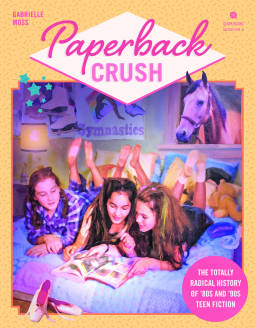
Paperback Crush by Gabrielle Moss

The Totally Radical History of ‘80s and ’90s Teen Fiction

Paperback Crush is a fascinating and funny look at American teen fiction from the gap between Judy Blume and Harry Potter. Moss divides up the books by themes, and looks at how areas such as romance, friends, school, and fear sparked off a whole range of books aimed at the young adult and middle grade market. There’s plenty of focus on how well the books actually dealt with big (and small issues), but Moss writes with a witty, light-hearted tone too, combining nostalgia, light mocking with hindsight, and some actual analysis of how the trends worked and fitted into the framework of young adult fiction that came before and afterwards.

As someone who is both British and too young for these books’ heyday, the real selling point was the ‘Terror’ chapter, as I was a great lover of first Goosebumps and then, even more intensely, Point Horror (Moss’ point that the students at Salem University from Diane Hoh’s Nightmare Hall series should’ve just dropped out felt like a ‘oh, right, they should have’ moment, because I did not think that at the time of reading them). However, the whole book was an enjoyable read, a quick look through a kind of book that shaped a lot of people’s lives and have had an impact on the young adult fiction of today. Moss’ tone makes it funny and engaging, but Paperback Crush is also an interesting look at how these often flawed books did deal with topics that some may assume only modern YA does. Plus, it has a lot of pictures of hilariously bad paperback teen novel covers with witty commentary.

What If It’s Us by Becky Albertalli and Adam Silvera

What If It’s Us is a YA novel by two well-known authors that combines classic romcom tropes with a realistic sense of teenagers navigating life. Arthur is in NYC for the summer and it’s living up to his dreams. Ben has lived in New York all his life and has recently broken up with his boyfriend, who he’s also stuck in summer school with. When Arthur and Ben meet by chance in a post office, it isn’t clear whether the universe is trying to get them together or ruin things between them.

What really sets What If It’s Us apart is the way that it both embraces romantic tropes—such as someone only being in the city for a limited time—but also gives them a realistic spin, showing how life can seem like a musical or a comedy when really it is just life, full of ups and downs. There is a sense of uncertainty throughout the book as to what will happen with Arthur and Ben which powers the narrative and shows how it is difficult to expect good or bad with confidence. The supporting characters are endearing, particularly Ben’s best friend Dylan, and the book is a great light read that gives complexity to its teenage characters.

Broken Things by Lauren Oliver

Broken Things is a gripping YA thriller about friendship and how things are more complicated than they seem. Anyone on the internet can read about how Mia and Brynn murdered their best friend Summer in the woods, in a way similar to the fan fiction the three of them wrote as a sequel to the fantasy novel The Way into Lovelorn that the author left unfinished. The thing is, Mia and Brynn didn’t do it. Five years later, they’re no longer friends and they’re not doing well. A chance discovery leads them back into the mystery and soon they must confront the past whilst looking for the truth not only of what happened to Summer, but about their friendship with her.

It is a clever, moving young adult novel that combines the tension of the truth about Summer’s murder with exploration of the characters of Mia, Brynn, and Summer. Their obsession with Lovelorn – particularly Summer’s – is shown as a way of coping with their lives; the world of fandom is not demonised, but rather shown in different lights, and the focus is really on the real world, rather than the fictional one. Particularly fascinating is Brynn, who fakes a drink and drug problem because rehab is the only place she feels safe, away from the people accusing her of murder and away from the truth of her feelings for Summer. Broken Things has a classic wrongly-accused-and-must-find-the-real-killer narrative, combined with engaging characters dealing with real problems.

In some ways, Broken Things is about looking beyond what you can read on the internet. The initial story of the murder sounds a lot like something you might read on Buzzfeed or Tumblr as an unexplained mystery, and then the novel goes on to expose the impact of that happening to innocent people. It is the kind of novel that you can’t put down because you need to know what actually happened, but also need to know if the characters can move on.

Astroturf by Matthew Sperling

Astroturf is a wicked, modern novel about sock puppet accounts, steroids, and using identities. Ned is a web developer who broke up with his girlfriend a few months ago and lives in a tiny bedsit in London. Naturally skinny, his world is changed by his trainer’s suggestion that he try using steroids to bulk up a bit. Suddenly, Ned feels more energised and like he’s found a secret to revitalising his life. He becomes obsessed with an online forum for steroid users, hashing out a plan that may bring him immense success, but that requires him to delve into the world of online accounts, pharmaceutical suppliers, and fake identities.

Sperling does a clever job of making a funny novel about sock puppet accounts, something that in the modern world can do a lot of damage to real people online in very serious ways, but in the novel they are defanged by using only the steroid forum world rather than a larger political and social online sphere. It is clear that many of the characters are meant to have questionable views, but the novel looks at how Ned uses and becomes involved in these fake identities in an immoral way that doesn’t need to feature offensive views for shock value. Indeed, it is a book that doesn’t rely on shock tactics, though it clearly could have, but instead creates a kind of concise mundanity to Ned’s progression. Ideas of masculinity are unsurprisingly explored and it is interesting to see how much of Ned’s accounts’ personas are built with comedy masculine traits.

This short novel is a book to read in one sitting if possible, telling a complete tale without a huge number of twists and turns that satirises internet culture and how men interact with it. You could imagine it as a dark comedy sitcom, with a slacker-type main character who finds a cheat code for getting somewhere, but it turns out that cheat code isn’t the steroids themselves but the online community.

The Lady’s Guide to Petticoats and Piracy by Mackenzi Lee

The follow up to The Gentleman’s Guide to Vice and Virtuea romp across eighteenth-century Europe as Henry Montague’s Grand Tour goes awry and he finds himself getting into scapes and adventures alongside his sister and the guy he’s secretly in love with—finds Felicity Montague, Monty’s sister, on a quest to get a formal education in medicine. However, chances for women to study medicine in the eighteenth-century aren’t forthcoming, and Felicity ends up on a scheme to meet and work with one of her heroes who is about to marry Felicity’s estranged childhood friend. To pull this off, she must work with a mysterious woman with an agenda of her own who wants to travel to the wedding as Felicity’s maid, but as with the previous book in the series, this is only the start of a journey that crosses countries and the sea.

Again, Mackenzi Lee shows how historical YA fiction should be done. Felicity is a powerful main character, deeply flawed like her brother, desperate to achieve her dreams. She even is forced to confront her own internalised misogyny and to realise that there are things outside her experience that she needs to learn about and consider. Johanna and Sim are both varied and interesting characters who contribute towards Felicity’s personal reflection as well as the exciting narrative, and in general Lee endeavours to show female characters finding different ways to fight back.

The playful approach to history found in Gentleman’s Guide is continued here, with some details changed for plot reasons as highlighted in an author’s note after the text, but this one feels more cuttingly historical in some ways, possibly due to greater reflection on oppression and continuing themes picked up in the earlier book. Have no fear though, there’s plenty of pirates and schemes and sea dragons to keep the adventure going too.

Fans of the first book will probably love this one For anyone else, this is a book for people who love female figures in history and would like a fun, exciting novel about fictional ones, particularly women involved in science, nature, and piracy. Aimed at young adult readers but great for anyone looking for a light, exhilarating read, it is charming but also manages to provide reflection on the situation and treatment of different people, then and now. Felicity will be a hero for many people.

Bridge of Clay by Markus Zusak

Bridge of Clay is the story of five brothers and five animals, told non-chronologically as one of them, Clay, must build a bridge. The Dunbar brothers live, fight, and grieve together, living without parents but with a selection of animals including a mule called Achilles. When their estranged father who disappeared walks back into their house and asks who will help him build a bridge, only Clay accepts. Tied up in Clay’s mind is love and sadness, and a burning sense of what happened to his mother. Matthew Dunbar, the responsible one, narrates the story of the brothers and their parents from past to present.

The novel is written in Zusak’s memorable style, weaving in ideas of storytelling and repeated motifs and wordplay as well as a lot of Homer references. It is long and perhaps a little confusing at first, but once you’ve got used to the timeline and characters, it becomes a lot more rewarding. Many of the characters are intriguing and unusual, particularly the boys’ mother Penelope and Clay himself, though some of the brothers feel less sketched out than others. The relationships in the book are equally compelling, with a lot left to inference rather than stated. It is a novel to think about, both whilst reading and afterwards (which is unsurprising to anyone who has read Zusak’s earlier The Book Thief).

Bridge of Clay is an unusual novel that plays with storytelling and unreliability, but at its heart is about a dysfunctional family and the impact of how they all cope with tragedy. It frequently makes the reader think and keeps ambiguity even through its detail; it’s less of a light read and more something to get stuck into.

The Corset by Laura Purcell

The Corset is a gothic historical novel that unfolds a strange narrative of a girl who seems to be able to kill with a needle and thread, and the woman who visits her in prison and hears her story. Dorothea is a young, fairly well-off Victorian woman whose now-dead mother instilled a belief in charitable work in her. During her visits to Oakgate Prison she meets Ruth Butterham, a sixteen-year-old girl accused of murder. Dorothea wants to test her theory about the shape of a person’s skull determining their life and morality, and Ruth seems perfect. Instead, Ruth starts telling her story and Dorothea finds her belief stretched and a chilling connection with her own life.

Purcell’s The Silent Companions was a creepy tale of a young widow, but The Corset goes even further to create a classic gothic story that highlights injustice and being a victim through the use of menace and possible unexplainable phenomena. Moving between the perspectives of Dorothea as she visits Ruth and considers marriage to escape her father, and Ruth’s story of the strange power of her sewing allows for Purcell to highlight the similarities and differences between the two women. Madness, revenge, and different kinds of imprisonment run throughout the narrative and it also plays with perspective, leading to a satisfying ending again in a classic gothic style.

The Corset feels like a natural successor to late eighteenth and early nineteenth gothic novels in its combination of a strange unfolding narrative of death and revenge and its use of this narrative to expose oppression, imprisonment, and kinds of oppression. It is likely to be another popular gothic read from Purcell, with hints of Sarah Waters’ Affinity in subject matter and a main character whose name makes it impossible not to think of Middlemarch.

Ghost Wall by Sarah Moss

Ghost Wall is a subtle and unnerving novel about a girl forced into a summer of experimental archeology by her abusive father. Sylvie is seventeen and is spending her summer at a recreated Iron Age camp in Northumbria, as her father—who is obsessed with recreating the hardship of Iron Age life—works with an archeology professor and some students to live like people might have in the past. Sylvie and her mother live in the shadow of her father and his anger and rules, but in the heat of the summer and the bare landscape near Hadrian’s Wall, his beliefs might be turned into something else, something inspired by the bog girls who were forced into sacrifice many years ago.

This is a short novel that creates a strange and tense atmosphere through description and detail. Sylvie’s life is depicted through her perspective of the events at the camp and how she knows about foraging and survival, in contrast to the three students who are on the trip. Moss weaves in tensions around misogyny and class to the narrative, which is centred around abuse by those closest to you. At the same time, it is about Sylvie being aware that there is more to life that what her father is trying to force her to be, hints of coming of age with the backdrop of an unusual and difficult childhood.

Ghost Wall is a compact novel that tells a small story featuring a small cast of characters staying in a camp in the wilderness. It also spans many hundreds of years, telling a story of force and coercion that hasn’t changed much. Its structure—short and descriptive with a sudden conclusion—might not appeal to everyone, but this is one for people who are interested in trying to know the past, but also depict a more modern day experience in fiction.

Normal People by Sally Rooney

Normal People is a novel about complicated connections, feelings, class, and modern millennial life. Marianne and Connell grew up in the same small town in Ireland, seemingly very different people. But they start to connect, and then when they end up going to the same university in Dublin, their complicated relationship continues to weave its way around their lives and their own personal issues.

The third person narrative moves between Connell and Marianne’s point of view, sometimes to devastating effect as it displays tiny misunderstandings in their relationship and how people, even those who feel deeply connected, can talk and act at cross purposes. The chapters jump forward in time, giving the length of time between each part in a way that feels strangely conversational and real. As with Rooney’s earlier Conversations with Friends, the narrative is mostly focused on interpersonal relationships, arguments, and detail about human emotion and messed up people. Underneath is a strong current of class, money, and politics, as well as mental health.

Again, like Rooney’s debut novel, Normal People is a book about millennials that will appeal to millennials, or at least a book about being flawed and moving from your late teens to early twenties without direction. It is a melancholy book, but also one that makes you hope for better communication, for the world to be better.