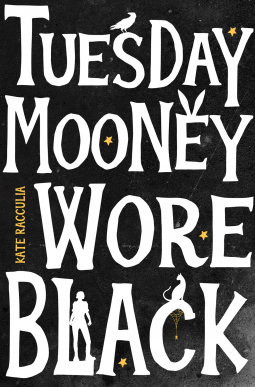
Tuesday Mooney Wore Black by Kate Racculia

Tuesday Mooney Wore Black is a novel about what happens an eccentric billionaire creates a game for people to try and win his fortune after his death. Tuesday Mooney is weird, a woman who wears black and works investigating donors for a hospital. She’s closed off even from her closest friend Dex, who works in finance but really loves karaoke and performing. When Tuesday finds out about the game, she can’t help but be drawn into the puzzle, but as well as the game, there’s the mysterious eldest son of a wealthy Boston family who had a strange connection to the dead man to investigate, but who also seems to have teamed up with Tuesday to try and solve it all. Surely everyone can’t find what they’re looking for in the game?

The novel was a surprise, something that was a lot more fun and gripping to read than it seemed it might be. Tuesday is a notable protagonist, but it was the supporting characters—Dex, Archie, Dorry—who felt most interesting, and it was good to get insights into their lives and thoughts as the novel unfolded. The narrative follows the playing of the game, but beneath the quirky surface of the unraveling secrets and weird characters, there’s an undercurrent of emotion, looking at grief, coping methods, and finding and being yourself. The writing style is light and readable, and it’s the kind of book that allows you to escape into the story and characters.

Full of revelations and a literary reference game around Boston, this is a book that makes a good light read, with an enjoyable plot and characters. In some ways, it feels like it takes some of the elements of a YA novel, like character and detail, and transport them into an adult novel where the characters are still a bit lost, but just no longer as teenagers. Its quirkiness might feel a bit forced to some, but it’s a good testament to people being who they want to be. 

Akin by Emma Donoghue

Akin is a novel about unlikely travel companions looking for answers and for similarities and compromises that will get them through the present. Noah is a retired professor in New York, about to take a trip to Nice—where he was born—for his eightieth birthday. Just before he leaves, he gets a phone call that will change everything: his eleven year old great-nephew who he’s never met needs a temporary guardian, and Noah is the closest kin to Michael who is available. Suddenly Noah and Michael find themselves together in France, clashing over everything, but Noah ends up on a quest to work out the mysteries behind some old photos taken by his mother and Michael might be able to help point him in the right directions.

Donoghue takes a short space of time—the trip to Nice—and fills it with the present and past in a way that works well, as Noah thinks about family across generations and the history of Nice during the Second World War but the narrative stays firmly in the present day. There are a lot of details that make it thoroughly modern—from the realities of what children see on the internet to how technology can help solve old mysteries—but it also has a sense of the past and how people are shaped by it. The mirroring of this not only through Noah’s family history but through Michael’s—with his mother in prison and questions around his dead father—shows that family and history can be varying categories, but still with similar connections and dangers. The writing style makes the novel very easy to get into and it is more gripping than expected as the trip unfurls.

Akin is often very much about the personal—about specific relatives and about two people trying to compromise being forced together—but also tries to keep an eye on larger issues at stake. There perhaps could have been more made of the class issues that are important undercurrents to the novel, but as it is through Noah’s perspective, it seems purposeful at times that he often doesn’t realise how different his and Michael’s lives are not from an age perspective, but a class one. It is a book that ultimately tries to be uplifting and to show that people can have more in common or find more ways to relate than might be expected, and one that you could imagine being made into a film.

The Confession by Jessie Burton

The Confession is a novel about a woman looking for answers about her mother, and discovering not only secrets but ways for her own life to move forward. Rose Simmons is looking for her mother who disappeared not long after Rose’s birthday. A gift from her father points her towards Constance Holden, a reclusive novelist who needs an assistant, for answers so Rose hatches a plan to escape her own life and find out about her mother. And three decades previously in 1980, Elise Morceau meets Constance Holden on Hampstead Heath and they fall in love, but when they end up in Hollywood where Constance’s book is being adapted, things start to fall apart.

Burton uses a classic trope of telling both stories at once to unravel the stories of Rose, Elise, and Constance, drawing comparisons between characters and building up the emotional stakes. Unusually for this style of novel, both plot lines are engrossing in different ways, and feel a lot more focused on the emotions and characters involved than any revelations that are offered to either the reader or the characters. Particularly notable is the dynamic between Rose and Constance, which though built on Rose’s initial lies becomes something that allows Rose to finally find a mother figure right when she needs some guidance. Elise feels less realised, but it starts to become apparent that this is part of the storytelling, in a book that is partly about an author writing or not writing elements of her life, and how people tell themselves stories to get through life.

The Confession is a surprising book that does more than expected, looking at being a mother, finding yourself, and how you tell the story of yours and others’ lives.

Bone China by Laura Purcell

Bone China is another atmospheric historical gothic novel by Laura Purcell, suffused in superstition and illness. Hester Why arrives at Morvoren House in Cornwall to take up a lady’s maid position with secrets surrounding her flight from London. What she finds there isn’t an escape, however, but a strange situation: Miss Pinecroft, sitting in a freezing room full of china, unwell and looking older than her years. An old servant obsessed with fairies and a mysterious ward add to the weirdness. And forty years previously, Louise Pinecroft and her father move after consumption ravages their family, hoping that the sea air will provide the answer to her father’s experiments on ill convicts, but the new maid tells her tales of fairies and the dangers they pose.

It is exciting to have a historical gothic novel that focuses on contemporary medicine that is set during the Regency and before rather than the usual Victorian setting. The tension between scientific ideas, passed down knowledge, and otherworldly magic provides a good backdrop for a novel also about the power structure of servants and those above them and the different things that keep people locked up, whether literally or not. These concepts of power and imprisonment fit well with actual gothic novels of the period in which the book is set, and the genre is used well to start to explore these (though it would’ve been interesting to see Hester’s reliance on alcohol and laudanum developed further). There are some threads that don’t feel fully explored in the novel, but this does allow it more ambiguity and gives space for mystery.

Fans of Purcell’s other novels will likely enjoy this one, which uses similar gothic tropes but also engages with the period of the earlier gothic novels (with references to Wordsworth, Byron, and the Prince Regent serving as reminders to this). It combines medicine and superstition in interesting ways and offers a morally complex point of view character who proves that the gothic isn’t just a genre centred around helpless, innocent women.

A People’s History of Heaven by Mathangi Subramanian

A People’s History of Heaven is a novel about friendship, strength, and a fight for home as a group of young women fight to defend the slum they live in. Heaven is a Bangalore slum scheduled for destruction, but for five girls on the cusp of adulthood, it is the place they have been and become themselves. Banu knows how to build and create beautiful things but isn’t good at school, Padma wants to keep studying though first she needs to keep her mother in a job, Rukshana has carved out her version of womanhood and fell in a love with a girl in a tree, Joy isn’t sure what the future holds for a transgender Christian convert, and Deepa dances better than the rest of them but is treated differently due to her blindness. Despite their various circumstances, families, and religions, the five are a tight knit group, and they’re not going to let their home go without a fight.

The novel moves between their lives, past and present, using the first person plural to give a sense of their connectedness, an entity that celebrates one another and fights together. As much as it is about Heaven (the slum), it is also about how these girls have grown up and become who they are in that moment. The characters are vibrant and memorable, and Subramanian’s writing really creates a vivid picture of them and their lives. It makes you constantly want to know more about these characters and what might happen to them beyond the confines of the novel, but also carefully weaves together the stories to build up the narrative.

A People’s History of Heaven is a joyous and surprising novel that celebrates variation whilst not shying away from some of the realities that people face. It is the kind of book you can’t help but recommend to people or give as a gift to someone looking for something new and fresh.

In the House in the Dark of the Woods by Laird Hunt

In the House in the Dark of the Woods is a literary historical fairy tale that blends New England colonial morality with a strange magical game. A young woman leaves her man and son behind to go into the forest and pick berries, but she loses her way and her shoes. Or so it seems. She finds help in the woods and ends up in a house with a woman called Eliza who cares for her, but she knows she should return home. However, returning home might not be exactly as she thinks, and the horrors of the forest are not all they seem.

It feels important to go into this short novel with an awareness of the blurb or premise, as this sets up the right expectations of a style (eerie nature descriptions, uncertainty, confusion) and narrative (not something to be trusted). At first, it is mostly the kind of horror of being in a magical forest and not knowing what is going on, but as the book progresses it becomes both a weird dark game and, through clues about the characters’ pasts and depictions of literacy and the treatment of people, a New England gothic that highlights the horrors people can do. It isn’t really about witches, but does feel very much about the ways witches are tied to morality.

The novel is one that some people will find creepy and something to think about once the final pages are over, and others will find confusing and too ambiguous. Hunt does well to keep it moving forward and making sense as far as it is meant to, but also to give it a very unreal feeling that is why people are calling it a fairy tale as well as a kind of horror story. It calls to mind Angela Carter more than anything more New England and fans of books that are more allegorical or ambiguously unreal will want to give it a read.

Lie With Me by Philippe Besson

Lie With Me is a novel about a first love and looking back at the past. A chance encounter in a hotel makes Philippe, a writer, think back to his teenage years in the 80s and the secret love between him and his classmate Thomas. Philippe reflects on how he was then and how Thomas saw him, particularly how Thomas saw that they were destined to go in different directions in life.

This short novel is lyrical and reflective, self-consciously about writing and memory. Its length gives it a real focus, with the sense of being told a very specific story from someone’s life rather than a wider narrative, and this brings it an intimacy that suits the love story and personal reflection at its heart. Comparisons with Call Me By Your Name and the fact the English translation of this French book is by Molly Ringwald will bring added interest to this short novel that can be read in one sitting, and you could imagine it as a film, with a backdrop of French countryside and 80s fashion.

Car Park Life by Gareth E. Rees

Car Park Life is a book about car parks. Not any old car parks, but the car parks found with supermarkets and other chain stores in retail parks. Yes, really. After something of an epiphany in a Morrison’s car park that car parks might be something more than they seem, Rees sets on a journey to explore car parks, on foot, and look at the landscapes we ignore, battle for spaces in, and dash across. There’s litter, wildlife, dodgy deals, fights, and a whole lot more, as Rees travels through car parks and also highlights the strangest news stories about them.

In its essence, this is very readable psychogeography combined with Brexit and capitalist horror, all covered in a wry and mocking veneer. Rees knows he’s just walking around car parks looking for meaning, but that doesn’t stop him doing it. The book is strangely fascinating, even to someone (like me) who doesn’t drive, and for whom car parks are always approached on foot. At times you might think ‘oh, another Sainsbury’s car park, fascinating’, but actually that feels like the point: these places should be so mundane, but so many things—sex, drugs, violence—happen in car parks. The ending brings together a bit of the environmental future with the fact that looking at car parks raises more questions than it answers, and leaves the reader open to taking what they want from it: an amusing tale of obsession, a chance to muse on what a landscape feature says about capitalism, or a bleak look at the country.

Part story of a weird obsession, part look at neoliberalism and capitalism through a psychogeography lens, and part satirical image of modern Britain, this is a book that forces you to think about car parks and why so many strange things happen in them. And it can’t help but make you think about the major car parks in your life, too.

The Art of Dying by Ambrose Parry

The Art of Dying is a historical medical mystery about unexplained deaths and medical rivalries set in Edinburgh, the follow up to The Way of All Flesh by husband and wife writing team Ambrose Parry. Will Raven and Sarah Fisher are back, with Will now Dr Simpson’s assistant and Sarah trying to expand her position giving medical help to the doctor despite the limitations placed on women. Dr Simpson’s reputation is in trouble after one of his patients died in circumstances that other doctors have claimed are suspicious, but looking into this causes Raven and Sarah to uncover a lot more mysterious deaths and find some unlikely possible causes for them. At the same time, Raven continues to evade his pursuers and worry about his own nature, whilst Sarah has new troubles to worry about.

The first in the series was most interesting for its look at class and gender in the period, and the sequel certainly focuses on the latter, looking at the position of women in society and in the roles they can take. Once again, anaesthesia plays an important role in the novel, with Simpson’s focus on chloroform still present, though there is slightly less of the medical focus as in the first one (or at least it feels like there is). The mystery narrative is unravelled using a good trope that allows for a few twists, and a wide cast of characters are kept up (though it feels very much like a book in a series for not resolving a number of side plots).

Historical mystery fans will likely enjoy this follow up, which combines a range of interesting characters with some real historical inspiration and a dark series of murders. Not one for the squeamish, but for people who like some historical research alongside the mystery.

We Hunt The Flame by Hafsah Faizal

We Hunt The Flame is a gripping young adult novel that explores the light and dark in people and forging your own identity. Zafira is the Hunter, a mysterious figure who hunts for food in a magical forest no one else can navigate, but no one would care how she feeds her people if they knew the Hunter was female. Nasir is the Prince of Death, forced to obey his father the sultan and kill on order. Though very different, they both find themselves on a similar mission: to retrieve magic from a dangerous island; Zafira for the people and Nasir for his father. And though Nasir has been ordered to kill the Hunter, they both end up part of an unlikely gang, all untrusting but united in a common goal, and then it turns out they have a bigger enemy than any one of them.

As someone who doesn’t tend to read fantasy (but saw someone raving about this book), We Hunt The Flame was a revelation: a fantasy novel that is carefully woven to dig deep into character and motivation, and without excessive or unnecessary world-building. Moving between Zafira and Nasir’s perspectives, the narrative is fast-paced and balances surprises with emotion. Both of the protagonists are engrossing characters, with Zafira learning that people’s morals and lives aren’t black and white whilst she looks to who she is outside of the ‘Hunter’ legend, and Nasir battling with the fact that emotion and relationships with others might stretch beyond who he’s been told to kill next. The coming together of the whole crew doesn’t feel forced and works well, leaving an intriguing mix of characters for the second part of the duology.

This is a novel that is really centred around its characters and the ragtag band of fighters that they form. It also emphasises the importance of taking control of your own identity and how that might not always be an easy task in relation to the society or rules you live with. At the same time, it is a fun fantasy story with a lot of banter and characters learning to work together.