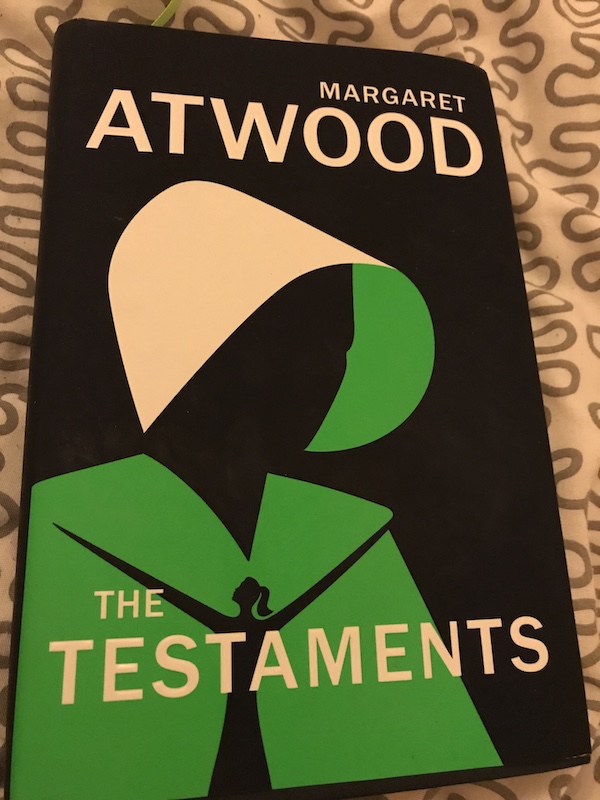
The Testaments by Margaret Atwood

The Testaments was a surprise in some ways, and not at all surprising in others. As a sequel to The Handmaid’s Tale, it is positioned as containing the narratives (‘testaments’) of three more characters, women tied up in some way with Gilead and a particular point in its history. Most of the plot is standard dystopian fare, and it goes over many of the things found in The Handmaid’s Tale but with more of a focus on Wives, Aunts, and other elements of the power structure that aren’t Handmaids. One of the narratives is by a character who has a lot more power and knowledge about the regime, which gives more context to Gilead and gives the book quite a different feel to its precursor, which slowly unveils elements of Gilead rather than assuming readers are already aware of most elements.

At this stage it is worth saying that I’m not a huge fan of The Handmaid’s Tale. I read it (multiple times) for my AS Level English Literature coursework, found the writing annoying and too obvious, and then reread it last year and came to the same conclusions. I think Atwood has written better things, and better dystopian fiction (the MaddAddam books are at least occasionally more subtle than the puns and concepts in Gilead). I was therefore surprised to discover that I got quite engrossed in The Testaments, with the writing style less grating and the movement between three different narratives providing tension. Initially it took some time to get into the world of the books again, and it was hard to know at first if I was missing a lot from not remembering The Handmaid’s Tale well enough, but after a while I settled into it.

The story is predictable and clearly written to provide elements of hopefulness in light of how prescient The Handmaid’s Tale is sometimes thought as being in relation to the modern day. This doesn’t stop it from being a gripping read, perhaps partly because I wasn’t invested in how good it was as a sequel but just interested to see if I liked it more than its precursor. However, after finishing it, it does seem a bit too neatly tied up and lacking in the kind of dramatic moments that at least make The Handmaid’s Tale hard to forget. The Testaments is bonus material to The Handmaid’s Tale which fleshes out more wider context and how society works and has a narrative which makes a decent read but doesn’t really do anything interesting.

My favourite non-2019 books I read in 2019

It always feels unfair to only document my favourite books I read during a year that came out that year, so I’m also listing my favourite catchily-named-non-that-year books, as I did last year and the year before. This year my comments on each may have become a little more facetious, as the actual books got more heavy-going.

Paul Takes the Form of a Mortal Girl by Andrea Lawlor – The version I read was technically published this year, but seeing as it was published before it’s going here. This is Ovid for the modern day: a 90s LGBT culture shapeshifter story with a picaresque vibe.

The Arsonists by Max Frisch – Thanks to watching Philosophy Tube this year, I discovered not only works of philosophy, but also some more-modern-than-my-early-modern-degree plays, and this one had me sat up reading it in one go. In short, don’t play with fire.

Les Miserables by Victor Hugo – I live-tweeted my response to reading the book I had never read due to irrational dislike until the BBC adaptation tempted me to give it a go. On here because it was actually an enjoyable, if occasionally digressive, experience.

No Exit by Jean-Paul Sartre – I said I’d got into 20th century plays (that aren’t just Rosencrantz and Guildenstern Are Dead).

The Myth of Sisyphus by Albert Camus – Yes, really. Was it not a year for the absurd?

To Save Everything, Click Here by Evgeny Morozov – I keep recommending this or bringing up concepts from it to everyone so it has to go on here. Why finding tech solutions to everything isn’t always the answer.

Hello World by Hannah Fry – My year really was all existentialism or technology. Fry’s account of how algorithms shape our world and what we can do about it is engaging and deeply interesting. Plus it helped me shape some of the articles in our online Digital Wellbeing course.

Radical Technologies by Adam Greenfield – Another one, I know. Each chapter is about a different technology and how it has or might change our world, and it is surprisingly possible to even understand the chapters on blockchain and cryptocurrency (mostly).

Wilder Girls by Rory Power

Wilder Girls is a dark YA novel that combines a kind of lockdown tension with body horror and female relationships. It is a year and a half since Raxter School for Girls was put into quarantine after everyone there was slowly turned by the Tox, become wild and strange and having their bodies morphed in different ways. Trapped in the school’s boundaries on an island off Maine, they wait for a cure and live under the new rules forged by those remaining. When Hetty’s best friend Byatt disappears, she’s determined to find her, but the horrors of their situation don’t just seem to be the feral animals outside the fence also taken by the Tox.

Rory Power takes the mysterious outbreak trope and uses it to explore the bonds between teenage girls—friendships, romance, power struggles—whilst implying a lot about the darkness not only within people, but that might come from the outside when disaster strikes. This is a different kind of book set at a girls’ school, and it is not one for the squeamish, with much of the horror being around what happens to their bodies and the violence of what they must do. The tension is gripping, and the narrative is more focused on the here and now than on explanations or deep exploration of characters’ pasts; it is easy to see from this how it could be adapted into an (admittedly pretty dark) film. The romantic subplot and the depiction of Hetty and Byatt’s friendship are two elements that make it more than just a kind of shock horror story, and though some people might not like the ambiguity of the ending, it suits the outbreak narrative to not have a neat conclusion.

This is visceral YA fiction, real in its character relationships and bloody and dark in its content. It combines some of the best thing about young adult novels with cleverly used body horror, and though it will make some readers wish there was more explanation, it is a thrilling read.

My favourite books of 2019

That time again: for reading through lists of books and thinking ‘oh yeah, I did mean to read that this year’. My list seems shorter this year, possibly because I read a lot of decent books that came out this year, but not that many which count as favourites (and you can see the Spite List for the other end of the scale). My favourite books that came out in 2019, in order of when I read them (links to full reviews where written):

Fiction

A Thousand Ships by Natalie Haynes – Another female retelling of the Trojan War, but this time epic in scope and style.

Water Shall Refuse Them by Lucie McKnight Hardy – Eerie heatwave coming of age gothic set in 70s Wales.

Patsy by Nicole Dennis-Benn – Set between Jamaica and America, this novel tells the story of Patsy and her daughter Tru and their struggles with identity, sexuality, and finding a home.

Frankissstein by Jeanette Winterson – Winterson’s retelling of Frankenstein to feature AI, gender, and what is life and death – not always nuanced, but interesting.

On Earth We’re Briefly Gorgeous by Ocean Vuong – Lyrical prose about telling your story in Vuong’s debut novel, about trauma, addiction, and growing up.

This Is How You Lose the Time War by Amal El-Mohtar and Max Gladstone – Two rival agents fall in love across the battlegrounds of time in this short novel that seems to have made a lot of people fall in love with it and its two female protagonists, ‘Red’ and ‘Blue’.

Meat Market by Juno Dawson – If you’ve read her previous novel Clean, you won’t be surprised that this is a sharp, sometimes shocking look at the fashion industry, abuse, and teenage models, aimed at but not only for a YA audience.

Birthday by Meredith Russo – Part of this made me cry on a plane, but it’s okay because it has a happy ending – a YA novel about Morgan and Eric, best friends whose love story is told through their shared birthday each year.

The Nickel Boys by Colson Whitehead – A tense novel about a reform school’s corruption and abuse, combining the history of a real institution with a well-plotted narrative.

Red, White & Royal Blue by Casey McQuiston – What would happen if the son of a female US president realises his rivalry with the Prince of Wales might not be about dislike after all? Everyone raved about this feelgood read and eventually I overcame the monarchy aspect to agree that it is very sweet and funny.

Nonfiction

Underland by Robert Macfarlane – My real surprise of the year was enjoying this account of subterranean travel and thought as much as I did.

The Creativity Code by Marcus du Santoy – What AI can (and can’t) do with creativity, but written in a way that is pretty accessible.

No One Is Too Small To Make A Difference by Greta Thunberg – Must be on so many lists, but it really is powerful and short enough to just give to everyone to read.

Mindf*ck by Christopher Wylie – The story of Cambridge Analytica, from the inside. Brings it all together in a terrifying way (I should add that’s the actual title, I didn’t censor it).

The Spite List

Or, the worst books I read in 2019

I didn’t do a proper spite list last year, but I had to do one this time if only for 3 and 5 on this list. Do not fear, my favourite books of the year (both published this year and not) will be following soon to get past the negativity, but for those who prefer spite, here it is. The books I didn’t get on with, in order of when this year I read them:

Microserfs by Douglas Coupland – I used to be really into 90s American fiction, and I currently read a fair bit about tech companies, so I thought this would be up my street. Instead, it turned out to just be boring. Microsoft employees…get fed up of working for Microsoft. Some of it could’ve been amusing with hindsight if I was overwhelmed by how much I didn’t care about any of it.

Miracle Workers by Simon Rich – The premise – two angels need to stop God closing down Earth – sounded, again, like something I might like. The execution, again, was boring, and possibly too amused by its own concept.

Fall, or Dodge in Hell by Neal Stephenson – Here begins the real spite part of my list. I wrote a review of why I didn’t like this one, but basically, it is far too long, the second half is almost unreadable, and the ideas could have been just as interesting in a fraction of the space. Also I would argue it doesn’t deserve the title at all (but maybe that’s because the title is what made me interested in it). Apparently I shouldn’t have trusted books about any kind of afterlife this year.

The Club by Takis Wurger – I picked this up due to my inability to not read books that promise to be about shady things at Oxbridge (or other elite universities). The few reviews of it should’ve warned me, but it was both not a very interesting example of that not-really-a-genre and used a handful of outdated slurs and ‘no homo’ moments for seemingly no reason (other than presumably avoiding the inherent homoeroticism of all ‘shady things at elite university’ novels).

Find Me by André Aciman – I also wrote a proper review of why I didn’t like this one, but the tl;dr version is: what was the point of this other than trying to cash in on the popularity of Call Me By Your Name and failing? The narratives just feel aimless and I wasn’t sure why I was meant to care.

Foul is Fair by Hannah Capin

Foul is Fair is a gripping teenage revenge thriller based on Macbeth set in an elite LA world. Jade Khanjara and her three best friends Mads, Summer, and Jenny are powerful and dazzling, rich and always there for each other. When Jade’s drink is spiked at a party and she is attacked by a group of boys from a different school, the four know that these boys will face no consequences unless they take matters into their own hands, and they scheme a plot to bring them down. Jade has to disguise herself, go into their school, and rip them apart from within, using their muddled conscience Mack to enact the violence.

This is a vicious and dark book, combining the danger of teenage horror and thriller books with the revenge violence of Kill Bill, and taking the control back from fate into the hands of teenage girls who know how to do damage. Jade and her best friends are the heart of the book, ruthless and clever, though the story is about what they do rather than focusing on who they are. The narrative is clearly Macbeth in many ways, but also Capin takes it in different directions, playing around with Jade’s role in particular, and there’s a lot of potential for people who study and love Macbeth to look at how Foul is Fair plays with the original. On the other hand, you don’t necessarily need to know Shakespeare’s play to get into the novel, which has been compared to a range of TV series based variously around revenge, violence, assault, and teenagers.

The writing style is unusual, giving Jade a specific voice and combining elements from different genres, and the use of character feels quite cinematic, where certain shorthands or details are shown to build character rather than more in-depth depictions. The pace of the narrative and events match the sense of time in the play, and bring a sense of unreality which suits the novel as a revenge fantasy. Foul is Fair could easily be adapted into a TV series or film (TV series would allow the space to give Jade’s friends space for their characters too, and it would be good to see more of Mads, Summer, and Jenny and their privileged yet complex lives).

Foul is Fair is gleefully dark and vicious as it depicts teenage girls having the power to enact bloody revenge. Take heed of content warnings and be aware that some people are going to find the violence too much or too unrealistic, but this is a book worth picking up if you’re interested in Macbeth meets Heathers with a scheming, diverse quartet enacting vengeance.

Oligarchy by Scarlett Thomas

Oligarchy is a sharp, dark novel about rich teenagers, eating disorders, and the secrets of a boarding school. Tash is the daughter of a Russian oligarch and has suddenly been sent to an English boarding school. The wifi use is restricted, the hierarchies are strange, and everyone is obsessed with looks and eating even though they can barely get on Instagram without surreptitious means. She ends up part of the group of troublemakers, all willing to go further than the rest, but when one of them, Bianca, vanishes and the school seems weirdly inept at dealing with the eating disorder epidemic, it seems there could be more at play.

The first things to know about this novel are that it is very much focused around disordered eating in various ways, and that it is a kind of twisted adult novel rather than the YA title some people might assume from a very brief summary. Coming into the book with the right expectations seems important, as then its blend of fantastical and deeply cutting will be making points and exploring darkness rather than seeming in strange taste. The third person narration is mostly around Tash’s perspective, with a side plot of Russian-backwater-to-riches and a shady aunt who lives in London that you almost want more of. In general, the book is more focused on small details and dark, witty moments than the overall pace of narrative, and these are what creates its tone, taking both teenage peer pressure and power abuse in boarding schools to particular heights for effect.

Oligarchy is an in-your-face novel that won’t be for everyone, a dark look at body image and how the internet can exacerbate mental states around things like eating disorders that also manages to be witty and strange.

Mindf*ck: Inside Cambridge Analytica’s Plot to Break the World by Christopher Wylie

Mindf*ck is the story of Cambridge Analytica as told by Christopher Wylie, the whistleblower who helped to break the story of what happened when data was used to manipulate people with targeted Facebook pages in the name of election and referendum campaigns. The scandal around Cambridge Analytica is something most people are aware of at some level, but the book details the sheer worldwide scale of the work the company was involved in and the key players involved in getting and using people’s data. It starts with how Wylie ended up involved in working with data for political ends, and concludes with the realities of being a whistleblower and his manifesto for better tech companies and use of data.

There are a lot of books about technology and politics around at the moment—unsurprisingly—but this one stands out as being direct from someone deeply involved in it, covering a lot of content without delving too far into technological points or jargon, and also being a kind of memoir of how someone who is more of an outsider could be helping Steve Bannon reach the minds of Americans. It is fascinating in its content, but also in how Wylie presents himself, and the people he knows and knew. Wylie’s concluding manifesto about ethical design and regulation for tech companies serves as a useful introduction to the more positive side of the current technological moment: the potential for doing better in the future and finding ways to break the current potential for things like the use of data by Cambridge Analytica.

For people already interested in books about tech companies, politics, and the future of the two, Mindf*ck gives a specific insight and a chance to think about how everything with Cambridge Analytica unfolded. For those who are newer to the topic, it is engaging and written in a style that doesn’t need tech knowledge, but only an interest in what Wylie might have to say, good or bad. The memoir aspects look at whistleblowing on a personal level and in general it is a fascinating, at times horrifying read.

Royals by Emma Forrest

Royals is a novel about a fast, unlikely friendship, about finding someone who believes in what you can create, and about the tragedy of living too fast. Steven is eighteen, Jewish, probably gay, into fashion, and lives in the East End of London. When he is beaten by his father on the day of Charles and Diana’s wedding, he ends up in hospital, where he meets Jasmine, an heiress who tried to kill herself. Drawn together by their interest in fashion and faded Hollywood stars, they begin an intense friendship, becoming inseparable despite their differences. But lurking behind Jasmine’s quirkiness and frivolity lies more, and maybe her and Steven’s schemes and plans aren’t meant to be.

The early 80s setting of the novel is vividly depicted (though the odd Americanism does distract a little) with a distinctive style, drawing somewhat from Hollinghurst’s The Line of Beauty but more obsessively focused on the two central characters. It took until the end to realise that it was carefully crafted to present a very short space of time with what seems to be a meandering narrative until you see where it was going. The novel has a lot of focus on identity—on defining or not defining things, on how different identities interact—which makes it feel more like it is doing something fresh and exciting, not just another story about someone working class meeting someone very rich.

This is the kind of book where you want to immerse yourself in its aesthetic for a moment, but also remember that the point is that it isn’t all as rosy as dreaming of living like that might make it seem. It feels aimed at both the millennials who enjoy the 80s vibe without having experienced it, and those who remember the names dropped throughout. Royals is a stylistic jump into a fictional summer filled with real detail.

The Private Joys of Nnenna Maloney by Okechukwu Nzelu

The Private Joys of Nnenna Maloney is a funny, fresh, and touching novel about a teenager growing up and wanting to know more about herself, whilst her mother learns how to share with her daughter the past she’s been trying to ignore. Nnenna Maloney is nearly seventeen and lives in Manchester, where people are always wondering about Nnenna and her white mother Joanie. Nnenna wants to connect with her Nigerian heritage, but Joanie doesn’t want to talk about the father Nnenna has never known, or deal with the fact that linguist Nnenna might want to study in Paris. And people around them are also probing their own identities, amidst the backdrop of Manchester and everyday life.

This is a novel brimming with sparkle, but also delving deep into questions of race, family, identity, sexuality, and class in a witty and tender way. Nnenna is a great teenage protagonist, torn between her love for her mother and her desire to go against what her mother wants to become her own person, and her and Joanie’s relationship is carefully crafted to capture their closeness but also the ways in which Joanie can’t quite understand what Nnenna faces due to race and also how her anxiety relates to this. The supporting characters are memorable, from the mental health and dating struggles of a gay black man to the hints of a burgeoning relationship on the edges of Nnenna’s friendship group, and the characters are tied together nicely as the plot moves forward.

Heartwarming and hard-hitting, this is a novel you can really get invested in, that looks at how people’s identity changes at formative times in their life. It is refreshing to have a novel set in Manchester that looks at how real people live and captures the ups and downs of growing up.