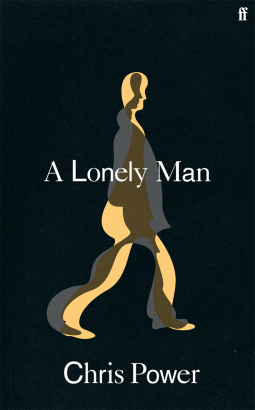
A Lonely Man by Chris Power

A Lonely Man is a novel about a writer in Berlin who becomes drawn into the life of a stranger he meets in a bookshop, who may or may not be being chased by Russians. Robert lives in Berlin with his wife and two daughters, where he spends his time trying and failing to write a follow up to his debut book of short stories. At an event in a bookshop, he meets Patrick, who seems drunk and unpredictable, but after he helps Patrick out, they meet for drinks and Robert discovers that Patrick is a ghostwriter for a recently-dead Russian oligarch. Robert doesn’t believe Patrick is really in danger, but maybe his story could give Robert so much needed content for a novel.

The atmosphere of this novel really drew me in, with a vividly described Berlin and a real sense of this British man who still sees the novelty of living there (he does know much German, much less than his Swedish wife). At first, it was hard not to be like ‘oh great, another novel about a writer struggling to write another book’, and I think this feeling would’ve been worse if I knew that Chris Power is also known for writing a book of short stories, but after a while I got more engaged with the narrative, especially the way it stays mundane whilst also having underlying threat. 

The narrative is broken up by sections that Robert has supposedly written as he turns Patrick’s story into fiction, which both unfold the story (unreliably of course) and bring up questions about what is the truth and what writers can write about. It was quite apparent this was what the novel was going to engage with seeing as quite early on it becomes clear that Robert’s short stories were mostly just anecdotes from other people he fictionalised. This did make the ‘novel about a struggling writer’ stereotype a little more palatable, as it brought up some questions about what people write about and even by implication if writers should write so many books that just fictionalise people they know (and, indeed, themselves).

Though I did enjoy reading A Lonely Man for the Berlin setting and the low level tension, it didn’t do enough to subvert or play with the kind of novel it is, especially with a writer protagonist. There was a momentary flirting with having an affair which I didn’t see why the novel needed, especially as most of the other narrative elements felt controlled and very much like they’d all been purposefully chosen for symmetry and comparison throughout the novel as a point about how writers turn stories into something better for fiction. Overall, I appreciated the execution (the sections of Robert’s writing about Patrick were a bit dull, but necessary for the concept) and the atmosphere as a low key literary thriller and it had quite a noir feeling that I think people will enjoy.

Hot Stew by Fiona Mozley

Hot Stew is a novel about Soho, gentrification, sex work, and disparities, as Mozley follows up her debut novel Elmet with something similar in some ways and very different in others. It follows a range of characters who are all slightly interconnected, from the women who work in a brothel that takes up part of an old townhouse that the owner wants to tear down to a privileged young man who needs to reevaluate his love life (and whose father is the townhouse owner’s lawyer). As a woman goes missing and others start to fight to keep Soho as it was, it seems the area itself is ready to put up a fight.

People who read Elmet might find this one a little different, not only from the central London setting rather than the Yorkshire countryside, but also the range of points of view in the narrative and the writing style. I found Hot Stew easier to get into reading than Elmet, as it felt like it was trying less to be ‘literary’ and moved quite quickly between different characters. It was clever how the overall story came together through the different characters, though after finishing the novel I’m still not quite sure what some of the plot lines are meant to bring to the overall atmosphere and messages of the novel, which focuses on sex, power, and gentrification. And finally on the ‘comparing it with her debut’ train, this book and Elmet both have a very black and white morality that paints good versus bad at least in terms of the main conflict.

The latter point I don’t necessarily mind, as the novel was about how the old Soho was being lost due to gentrification, and there was a clear message against the wholesale conversion of somewhere with history into something new and expensive. Mozley also covers in passing a range of other issues, mostly with some eventual connection to sex work (there’s a very blatant Game of Thrones rip off that tries to say something about the approach the show took towards sex work and sex scenes), and there’s some interesting things going on (one of my favourite elements was the relationship between Precious and Tabitha, who both live in the brothel and are more supportive of each other than anyone else in the book), if occasionally they don’t seem to go anywhere.

Hot Stew has a great atmosphere and again Mozley writes a location with a real sense of place (and a kind of anticapitalist sense of place at that). I found it readable and the characters engaging, though I didn’t quite feel it all came together for me.

Bright Burning Things by Lisa Harding

Bright Burning Things is a novel about addiction and recovery, as a single mother tries to create the life she wants for her son. Sonya was once a stage actress in London, loving the thrill of the stage, but now she’s back in Ireland, a single mum to Tommy. Her, Tommy, and Herbie, their rescue dog, form a close knit trio, but Sonya can only keep it up by drinking bottles of wine each night, and things are starting to slip from her as she burns the fish fingers and feels like she loves Tommy too much to bear. When her neighbour seems to be spying on her and her estranged father turns up with an ultimatum, Sonya has to try and work out how she can keep Tommy.

This is a powerful look at alcoholism and its impact, especially on a small family without a lot of outside support. Written from Sonya’s perspective, the narrative doesn’t shy away from difficult emotions, and particularly the time Sonya spends in rehab is very raw, with her not sure what has happened to Tommy. There’s still a lot of unanswered questions by the end, especially around Sonya’s family and past as her father doesn’t want to tell her what really happened and she doesn’t find out exactly what Tommy experienced, which people might find frustrating but gives it a sense of reality. Given the type of story, you do almost want to know what would happen after the narrative itself ends, as you become quite invested in Sonya’ recovery.

It is probably important to go into this book knowing it is about alcoholism, as addiction is a topic that might be difficult for some people to read about, but it is an intimate look at someone trying to recover and to look after their son, even in somewhat unconventional ways. The book also exposes the ways in which people don’t get enough support when they’re struggling and how it can be assumed that people have family members or close friends who can provide that support. Bright Burning Things is a gripping and readable book that deals with important topics.

The Disconnect: A Personal Journey Through the Internet by Roisin Kiberd

The Disconnect is, as its subtitle suggests, a ‘personal journey through the internet’, or a collection of interconnected personal essays about technology and culture. From personal experiences of using and working in social media (most notably as the social media presence for a cheese brand) to a list of vaporwave tracks, and from depression and insomnia to Mark Zuckerberg’s bland outfits, Kiberd takes us on a funny and sad journey about living on the internet.

Being only a few years younger than Kiberd, this very much felt like a book aimed at people like me, who grew up using things like MSN Messenger. The style is one often found in the best online essays, combining disparate references and self-deprecating humour with deep looks at specific things (one of the essays is a very in-depth look at the energy drink Monster) and weird stories of existing in the modern world. I was hooked quite early on with references to Mad Men and Mark Fisher’s Capitalist Realism and the first section of the book was my favourite, with essays going through a dual personal and big scale history of the internet and looking at the figure of Mark Zuckerberg and Facebook’s ethos (though I enjoyed the whole book).

I’m not sure what it says about me that the most insightful part of the book for me was the chapter about vaporwave, a genre of music I spend a lot of time thinking ‘I should find out what that actually is’ and never doing so (now I know!). The Disconnect does sit alongside a lot of the other tech-related reading I’ve done, both in terms of the personal side of books about social media and big tech companies and in terms of internet history and the impact on our lives (I feel it’s a particularly good companion to Gretchen McCulloch’s Because Internet, which looks at internet language and also the ‘phases’ of people on the internet).

Anyone who is fairly well-versed in internet culture and also likes questioning and reflecting on what these technologies are actually doing to our lives is likely to enjoy The Disconnect. It’s tech writing infused with the personal side of the internet, and if that sounds like a selling point to you, you should read it. Anyway, I’m off to listen to Floral Shoppe.

Bullet Train by Kōtarō Isaka

Bullet Train is a thriller with a dark comedy edge, about a train full of killers battling to make it to the end of the line. On the train from Tokyo to Morioka is Kimura, a man hunting revenge on a sadistic schoolboy, Satoshi, who threw his son off a roof and is also on the train. Unbeknownst to them, also on the train are killer duo Tangerine and Lemon, tasked with delivering a suitcase and a kidnapped son back to a famed gangster, and unlucky assassin Nanao, who is on a job to steal the suitcase. What unfolds as the train travels between the stations is a complicated web of double crossing, confusion, and violence.

This is a book with the vibe of darkly comic action film, especially with elements like the unluckiness of Nanao and constant assumption that Satoshi, aka The Prince, is an innocent schoolboy (he has the vibe of Five from Umbrella Academy), which makes it an enjoyable thriller about immoral people battling to survive. The narrative cuts between the main characters, sometimes jumping minutes back in time to give multiple perspectives, and this also gives it a cinematic feel. Despite being a long book, it is fast-paced with twists and tension leaving you wonder what could happen next and not sure who you should root for.

A ‘locked train’ thriller about killers fighting for their lives and a suitcase, Bullet Train is gripping book for fans of thrillers that don’t quite take themselves too seriously and the kinds of films where gangsters and shady types find themselves all accidentally up against each other. It’s not something I’d usually pick out to read, but I’m glad I did (on a whim because I’ve read some Japanese novels recently).

Gay Bar: Why We Went Out by Jeremy Atherton Lin

Gay Bar: Why We Went Out is a fusion of memoir and cultural history as Jeremy Atherton Lin charts the gay bars he’s visited, their importance in his life, and the wider history of gay bars as spaces in cities like London, San Francisco, and Los Angeles. Split into sections that broadly cover different locations that he’s lived or gone out in, the book looks back both through a personal lens and a historical one, thinking not only about gay bars as a place, but also about the cultural around them and how ‘gay culture’ has evolved.

Starting this book, I expected more of a history of gay bars, but the subtitle is important: it’s more about that personal ‘why’ and how places impact a person. Jeremy Atherton Lin weaves his life throughout, notably a romance that starts on a night in Soho and reflects on being a mixed-race man in gay spaces. The memoir element is enjoyable, giving a sense of being out with him in these places and bringing together a topic that otherwise might seem disparate (so the focus is on the gay bars that he’s been to, not all the ‘best’ examples, whatever that could be). There’s something great about people’s personal experiences with LGBTQ spaces, like you or a friend are describing how places have been important to you, or you’ve met someone in a bar explaining the history to you.

It’s a weird time to be reading a book like this, when people haven’t been able to go out in a long time mostly, and that adds to the yearning sense of losing history as many gay bars close. There’s a good underlying criticality and reflection about some of the issues around gay bars, from race to what rules spaces impose, but ultimately it is about one person (well, at many points, two) and their experiences in gay bars, and that gives it a lot of heart.

Queer edited by Frank Wynne

Queer is an anthology of, as its subtitle states, ‘LGBTQ writing from Ancient Times to Yesterday’, with a range of poetry and prose starting with Homer and Sappho and ending with current writers. Frank Wynne has collected together works from authors with various experiences and identities, originally written in different languages, and these are complete or in extract, with short biographical notes about the author before each one. In the introduction Wynne gives the criteria for inclusion: the authors had to be LGBTQ and the texts had to be addressing gender and/or sexuality in some way.

The anthology is an impressive endeavour, particularly in the range of (mostly post-20th century) translated texts alongside those written in English. As Wynne discusses in the introduction, there’s no way of being definitive, but the range given by the translations was refreshing. The book starts with a lot of familiar touchstones (Homer on Achilles, Sappho, David and Jonathan, Shakespeare’s sonnets, Anne Lister’s diaries), which are useful for people exploring LGBTQ literature from a more introductory viewpoint but not so exciting otherwise, so it was good that it quickly moved into a more diverse range of writers. It was a chance to read some writers I’d heard of but not read, and discover others for the first time.

My main issue with the anthology is the context given for the authors and their works. I found the biographical notes gave some useful details, but there was no context given for the piece(s) in the book. The contents notes when the given text is ‘from’ a larger work, but the section for the author does even use the word ‘from’, never mind giving context about what is happening in the wider work or how the poems or short story might fit into the author’s writing more generally. For example, I went into reading the Radclyffe Hall story assuming it was an excerpt from The Well of Loneliness (which I’ve read) as that was the only text mentioned in the biographical note, but then realised it wasn’t. Maybe some people prefer texts out of context, but personally, I needed to know if I was reading a short story or an except from when I started reading, to know if I needed to ‘catch up’ or not.

One thing I would’ve liked (other than more context) would’ve been some excerpts from plays; Wynne states in the introduction that these aren’t included because they’re meant to be spoken (as song lyrics aren’t because they should be sung), but I think that reading plays can be very important, especially for getting to experience the works of LGBTQ writers regardless of your circumstances for getting to the theatre. However, the anthology already has a lot in it, so I suppose space was an issue as well.

This collection is a really useful way to experience a lot of LGBTQ writing at once, and it’s nice to have a range of more recent writers in there. It’s particularly useful for discovering new writers and I can see how it would be good to flick through, see what you felt like reading, and then go away to discover more of that writer’s work. As someone who doesn’t often feel like reading short stories I enjoyed the chance to read some by authors I’ve read novels by, and to discover some new poets as well, though the earlier (mostly pre-20th century) part is perhaps more useful to people who’ve not already tried to read as much of the classic literature that isn’t so straight and cis already.

Nightshift by Kiare Ladner

Nightshift is a novel about obsession and chasing a life that might not really exist. Meggie has a humdrum day job in an office, a boyfriend who wants to move in together, and is trying to do a literature degree, but when she meets mysterious Sabine at work, she starts to want something else. Changing her hours to the night shift as Sabine does, Meggie tries to adjust to the new world, with a different set of coworkers and a chance to get closer to Sabine, but will she find herself or keep losing things?

Ladner puts a slightly different spin on the ‘female obsession that may or may not be friendship and/or sexual’ story, using the concept of the night shift, a slightly otherworldly London, and two main characters not from England. The novel, though short, moves through different phases, from Meggie’s initial need to get closer to distant Sabine, then throwing away elements of her past life, and then what happens as Meggie tries to live this new night life. There’s a vague framing device looking back with hindsight which brings the conclusion to the book, but doesn’t answer every question, which suits the narrative’s style. The atmosphere created works well, at times drug-fuelled and occasionally moving quickly over some of the more self-destructive moments, but with a lingering melancholy especially by the ending.

What let down the book a bit for me was the fact it was very predictable and felt too similar to other books in which a young woman becomes obsessed with another woman. It was refreshing that Nightshift went further to explore sexuality and Meggie’s attraction to Sabine, as often that element is left unspoken or as something that awkwardly comes up once and is then passed over, but the general narrative arc felt all too expected and a lot of the later ‘revelations’ about Sabine just felt like staples of the subgenre.

An enjoyable short read with a dark current underneath, Nightshift is another voice in the conversation about female friendship, sexuality, and obsession, but doesn’t really add anything new to it. There’s some interesting thoughts to be had around the way it presents London as the setting for the story, with different areas suggesting different things, and it’s a novel that’ll probably appeal most to people who like both the obsession element and novels that comment on London itself.

Skin by Kerry Andrew

Skin is a multi-layered novel about a hunt for a lost father, set in the ponds at Hampstead Heath and in Irish loughs. In London in 1985, Matty’s father Joe disappears, and nobody will explain what happened. Over the summer, Matty searches for Joe at the Men’s Pond, where Joe may have been last seen, and discovers the freedom of the water. Fourteen years later, Matty travels around Ireland in a campervan, wild swimming in loughs and trying to follow up a lead that might unravel the secrets of the past.

I didn’t really know what to expect from Skin, but picked it up as I’d read Andrew’s previous novel, Swansong, and I found myself enjoying this one more. Matty is a compelling character (with a few too relatable elements that were well-written, but going into would be giving away too much about the book’s twists, which at least some readers won’t expect) with a believable lack of direction and compulsion to find out what happened to Joe. The motif around wild swimming, identity, and body was nicely done, and as someone who has never had an urgent to swim outdoors before, it did make me almost want to give it a go (despite the endless drowning imagery). The narrative has some twists and turns, with elements of other genres coming in at times, and it was woven together well to make a complex story. I was glad the ending wasn’t as bleak as it could’ve been, perhaps due to connecting with Matty as a character, and I felt the novel balances the literary, folklore elements with the character-driven narrative well.

Skin turned out to be a book I didn’t know I needed but I did, one which combines loss, journeys, gender, sexuality, and water in inventive ways. I’m not usually a fan of books where a character goes off into the Irish wilderness to look for something, but in this case I’ll make an exception, and I found the scenes at the Hampstead Heath ponds really evocative. Matty is likely to stay with me for a while.

The Girls I’ve Been by Tess Sharpe

The Girls I’ve Been is a tense YA novel about a seventeen-year-old ex-con artist who gets stuck in the middle of a bank robbery with her ex-boyfriend and her new girlfriend. For twelve years, Nora had to live a life of deception, as her con artist mother needed her to play the part when tricking criminal men—until her mum felt for one of these men. Then, Nora had to use her skills to escape, and since then, she’s been living as close to a normal life as possible. After a charity event, she meets with new girlfriend Iris ex-boyfriend and now best friend Wes to deposit the money raised, but suddenly, a man pulls a gun, and they’re in the middle of a heist. In such a dangerous situation, can Nora keep all her secrets, even as she puts her skills to the test?

I didn’t know what to expect going into the book, but it turned out to be immediately gripping and multifaceted. On the one hand, it plays out like a classic thriller as Nora tries to outsmart the bank robbers to allow her and her friends to escape, but with constant flashbacks to her past as the many different girls of the title. On another level, it’s a novel that looks at trauma, what makes people who they are, and building your own family, going deeper than you might expect from the blurb. Nora has, expectedly from the concept, had a terrible life in many ways, and has had to try and rebuild things with the help of therapy, her sister, and finding friends. Both Wes and Iris have their own traumatic lives, and Iris especially is given chances to prove her ability to be useful in sticky situations, as well as being a character with a chronic illness (endometriosis).

Surprisingly, the love triangle element is actually much more of a found family situation, with the tension at the start being down to Wes not knowing the two of them were secretly together rather than him pining to have Nora back, and it’s nice to have Nora’s bisexuality acknowledged but not made a big deal of. Due to the mostly very condensed settings of the action in the ‘present’ of the novel (which until near the end is entirely over a few hours during the robbery), it may seem like a lot of information comes out at once, but it suits the genre, and in general the book feels like it looks beyond the action and thriller elements to actually consider the impact of things like Nora’s childhood and some of the pace of revealing secrets during the heist.

Engrossing, sharp, and readable, The Girls I’ve Been was refreshing and more complex than expected, combining the enjoyable larger than life elements of a thriller (like quite how good at cons Nora is) with a look at the trauma of being a child crime prodigy type figure that has horrific things happen to them and that they have to do. It’s certainly for the upper end of the young adult age group (and plenty of adults too), and it’ll be interesting to see the film that’s being made of it, because the book really drew me in.