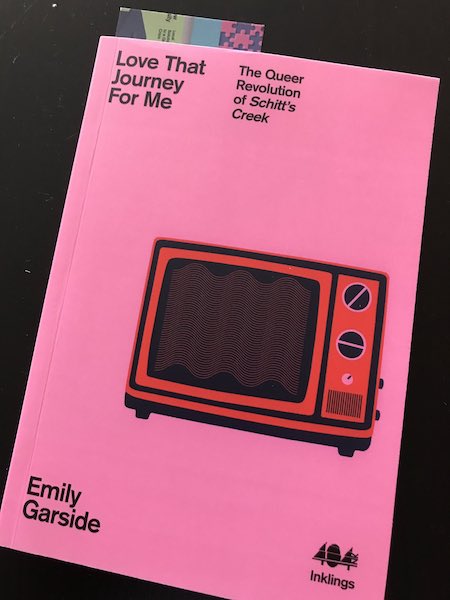
Love That Journey For Me: The Queer Revolution of Schitt’s Creek by Emily Garside

Seeing as I’m writing this having stayed up too late reading the whole of this book at once, and I was already a big fan of Schitt’s Creek, this review might be a little different to normal. Love That Journey For Me is a bitesize look into TV series Schitt’s Creek, exploring its portrayal of queerness across relationships, fashion, culture, and safety and thinking about the impact of it at its particular point in TV history.

The first book in 404 Ink’s Inklings series, this is a light and yet also deep short book that feels like a real work of love. Garside analyses the character arcs, tropes, and subversions across the six seasons and draws out potential references and the importance of them. For me, one of the best parts was the chapter looking at Cabaret and the role (possible pun unintended) it plays within Schitt’s Creek, as well as how Schitt’s Creek presents a particular production of Cabaret. I also liked the situating of the show within the history of LGBTQ representation on mainstream US/UK TV, really bringing home the point that the show is meant to be a town that doesn’t recreate the prejudices of real life, but shows a different world.

It’s a hard book to put down once you’re reading it, both if you’re a fan of the show and want to think a little more about it and if you like reading things about pop culture where you can really feel the author’s care for the work. Not something I’m used to reading in such a format (the small size really works and I think being readable in one sitting is great), so it’s great to see it published as well.

The Hierarchies by Ros Anderson

The Hierarchies is a novel set in a world divided into humans (Born) and robots (Created), where a doll designed for sex dreams of more. Sylv.ie is an AI robot, a sentient creation designed as a sex doll, who is owned by her Husband and must obey him. From the one room she has, she can see out into the garden, watching the comings and goings of him and his wife and child, and longing to see and experience more. Rebellion may be possible, but what is the price that Sylv.ie will pay for freedom?

Told from Sylv.ie’s point of view, the novel has similarities with other dystopian fiction, but also takes a fresh look on how humanity constructs itself as in opposition to artificial intelligence and what kinds of intelligence and emotion there are. The world it depicts is full of hierarchies, not just the titular ones which are the rules that Sylv.ie must follow, but also human-made systems of power and privilege. The setting doesn’t feel overblown or overwrought, not full of neologisms and references that are never explained, but instead focuses on Sylv.ie’s story and her attempts to navigate both the emotions and the world that she isn’t meant to have. Short chapters compartmentalise the book and along with the narrative voice do give a sense of seeing the world in a different way.

As you might expect from a book about what might be termed sex robots, The Hierarchies does contain a fair amount of sex and sexual assault, so it’s worth being aware of that before going into it. I’d say my initial reaction was that it was a cross between The Handmaid’s Tale and Klara and the Sun, though those comparisons (the latter book I really liked, whereas the former I’m not such a fan of, especially not the style) perhaps simplify this one too much. You can see how it could be a episode of Black Mirror too, and that might be a better comparison, looking at the ways that technology and humanity intertwine and the emotional cost (in this case, the AI emotional cost) of this.

If you like dystopian fiction, this is definitely a book worth reading, and the short chapters made it easy to get through. The plot is straightforward and gripping, focusing on Sylv.ie’s journey to discover the limits on who she can be, and I enjoyed how it pushed at technological questions through an unusual lens.

Variations by Juliet Jacques

Variations is a collection of short stories about trans lives in Britain, exploring experiences from London in the days of Oscar Wilde’s trial to 2010s media and internet culture. The stories are all written in different formats and styles, taking inspiration from real life events and material, and are presented chronologically, though some are retrospective and looking back at the past. 

From a metafictional film script to an academic paper, Jacques finds innovative ways to tell stories and reflect on how trans voices can be heard. Though this is a short story collection, it feels a lot more than that, with everything feeling connected and part of a complex, multi-faceted narrative to explore histories and how they are told. It’s unlike any collection I’ve read before in terms of the format, and I found that so enjoyable that I almost wanted to draw out the reading process, letting anticipation build for what would come next.

The stories themselves are quite visceral, exploring identity and hope, friendship and community, but always with an edge of biting commentary. In particular, the final piece in the book, a trans man explaining his experiences with being in the public eye through a series of blog posts, feels particularly immediate, possibly because I had just seen another modern day article attacking trans people this morning so the ‘history’ was very much part of the present.

It’s hard to pick out favourites from the book, but I’ll have a go. I found the format of the film script for “‘The Twist'” highly effective in telling multiple narratives and showing the tension at play when cis people set about depicting trans people’s lives, even when adapting an apparent memoir. “Standards of Care” uses a more conventional diary format to tell an emotional and touching story of a trans woman from Norfolk finding community and “A Wo/Man of No Importance” stands out through the way it situates its characters amongst the famous figures of the 1890s, looking at ideas of how famed and not-so-famed history can collide.

I had high expectations for Variations, but Jacques’ use of the different formats for the stories and the way it follows broader narratives about trans life in Britain made it surpass those expectations. Often I find short stories even leave me wishing they were longer or not engaged, but these ones felt like they were exactly what they needed to be. It is the variations within it, as the title suggest, that bring the most joy: the multiplicity of voices explored through the characters and formats, and the different ideas and inspiration you can take from these.

Three Rooms by Jo Hamya

Three Rooms is a novel about a young woman looking for stability in 21st century life as she drifts through a transitory year. In autumn 2018 an unnamed narrator moves into a rented room in a shared university house in Oxford, ready to take up a temporary research assistant position, but she spends most of her time scrolling Twitter and watching one of the only people she’s met do things on Instagram. When the contract ends, she finds herself in London, living on someone’s sofa and doing another temporary job at a society magazine. Once again, she feels disconnected, and as politics rolls on in the background, she considers what she can do next.

Told in the first person in a literary style with very few named characters, Three Rooms is the sort of book some people will love and others not get along with. I enjoyed it, with its clever look at privilege, class, and race, and the complications of these as the narrator takes up temporary jobs doing things from a rarified world, straddling the line between having no money and still having the ability to get a temp job at a posh magazine. I also liked the engagement with books, from the stuff about Walter Pater and Instagram to a glib commentary on modern novels which feels like it’s pointing out this book could be classed as another of them.

As it’s set at a very specific time and has a lot of politics and current events run through it, at times you do feel like there’s a bit too much Brexit going on, but that is also important to the general look at the Oxford and London worlds that provide the backdrop for a lot of the people ruling those decisions. As a fleeting first person novel, there aren’t really answers to the issues raised, but more a look at a version of millennial existence.

I have lived in both the locations in the novel in vaguely similar circumstances, which made me drawn into the character and narrative perhaps more than I might’ve been, and there are a lot of little details that bring these locations and the protagonist’s existence to life. Three Rooms presents a clash not only between sides in political issues, but also between ways in which someone can be privileged and not, and between real life and the internet.

The Final Girl Support Group by Grady Hendrix

The Final Girl Support Group is a novel about what happens after the credits roll, when the final girl has escaped the first narrative but things aren’t over yet. Lynnette survived a massacre over twenty years ago, and lives a carefully guarded existence full of rules and escape plans. She also attends a support group for other “final girls”, the last survivors of massacres who (mostly) killed whoever was trying to kill them. When one of the group doesn’t show up, Lynnette knows this means her fears have been realised, but with so many killers and their fans out there, it’s hard to know who to look out for and how to protect all of the final girls.

Having read a couple of Grady Hendrix’s other horror novels, I was intrigued to see how this one would play with the horror genre. What the book does is use and deconstruct the slasher genre, but also looks at how it is influenced by real life crime, with each of the final girls’ stories having been turned into a film/franchise, to varying success. The chapters are intercut with documents from the pasts of the women who were final girls, providing some insight into what happened to them but never quite giving away everyone’s full story (which I found frustrating occasionally, but that made me question if there is some need to hear the gory details about horrors, real or fictional).

This all sits alongside Lynnette’s narration, showing someone whose trauma has turned into a survivalist mentality. She’s a complicated narrator, at times difficult to like but also giving the book a unified story that I think I enjoyed more than I would’ve enjoyed multiple perspectives for this one. The action starts early on, and the book combines horror and thriller so the pace is quite fast, with occasional digressions into the past. There’s a good range of clues and red herrings throughout, with a sense that you’ve got to be thinking in the genre, and the final showdown comes together nicely (well, maybe ‘nicely’ isn’t the best word…).

There’s also a side plot (well, it’s more of a theme than a plot) around ‘murderphernalia’ and the general obsession with killers, which serves as both part of the plotline at times and also brings an interesting message at the end as Lynnette tries to highlight the need to remember the victims, not the killers. The horror genre itself probably doesn’t help the issue, and the self-aware element of the book is engaging, though doesn’t stop it also just being a decent tense horror novel in a slasher/thriller vein.

As with Hendrix’s other books, this is horror which takes a specific concept/trope and runs with it, and it’s enjoyable to see what is done with the final girl trope and the question of whether or not the killer dies at the end of the film/book. 

The Great Mistake by Jonathan Lee

The Great Mistake is a historical novel about the transformation of a city and a man, and the unravelling of his death. Andrew Haswell Green is shot outside his New York City home in 1903, an old man known for his work transforming New York. A detective investigates what happened, and if it really could be a case of mistaken identity, with Green apparently unsure why the man was there to shoot him. Alongside this story runs another, that of Green’s life: growing up on a farm, looking for opportunities, and meeting Samuel Tilden, who would be a lifelong friend and source of great longing.

I’d never heard of Andrew Haswell Green, and only found out from glancing at a couple of reviews before starting to read The Great Mistake that he was a real person. The novel feels like an attempt to fictionalise some of the gaps and strange events in his life, though I don’t know what is from historical records and what is imagined or elaborated upon. The structure—cutting between the ‘present’ of 1903 as he is murdered and the case investigated, and his life in not always chronological order—brings tension to the latter narrative, which sometimes is bogged down with details of construction and industry in the later 1800s, even though there’s not really a huge case to solve so to speak. The book is more of a slow burn, rather than something with fast-paced revelations.

The central character’s attraction to his best friend, a relationship defined by longing and Green’s idea of restraint clashing with any hope of anything more happening, brings another dimension to the novel. It’s frustrating to see something play out as it must have for many people, with a sense nothing could ever go anywhere between them if they want to keep their positions in society, and their hopes of greatness. The dissatisfying, understated tragedy of it gives the book its own sense of the restraint that Green holds up as an ideal, frequently showing his feelings but not quite dwelling on them.

Combining the history of New York with the story of a change and murder, The Great Mistake  is a novel ideal for historical fiction fans who like the fictionalisation of real figures in clever ways, or looking beyond the famous landmarks or moments to see what made them. It’s an understated tragedy that can be a bit slow at times, but also does draw you in.

Man Hating Psycho by Iphgenia Baal

Man Hating Psycho is a collection of short stories that in many ways are the anti-short story, or at least anti-something. From a Labour activist group chat gone wrong to a take on an apparently “‘inverted’ psychogeography’, the thirteen texts look at modern London, technology, relationships, and people trying to be subversive.

The chaotic cover and blurb drew me into the collection, despite being someone who doesn’t always gravitate towards short story collections unless they’re doing something a bit different or telling a wider story. I’d say in some ways Man Hating Psycho fulfils both of these categories, with stories that feel like a fresh take on the form and an overarching sense that it’s saying something biting about modern life and London. It certainly kept me gripped throughout, never sure what the next piece might bring, and enjoying the fact most of the stories didn’t end with a clever conclusion, as it feels a lot of short stories have to, but something more like a freeze frame or fade out.

The first piece, ‘Change :)’, is an ideal opener, a story in group chat form that depicts a modern political moment and an amusing technological fail. Other stories that stood out to me personally were ‘Pro Life’, a slice of teenage life going off the rails, and ‘Married to the Streets’, the previously mentioned take on psychogeography and changing London. One or two of the others were a bit long and meandering for my tastes, but I enjoyed the narrative voices and style throughout, and the little cutting barbs directed at various topics.

For fans of short stories and also people who are more ambivalent towards the form but want to try something different, Man Hating Psycho is a gleefully spiky collection that shows the mostly downs of modern London.

Afterlove by Tanya Byrne

Afterlove is an unconventional YA love story about not being separated by death. When Ash Persaud falls in love with Poppy, the girl she met on a school trip to the local wind farm, it seems the world has opened up for them, but then Ash dies not long afterwards. However, Ash doesn’t leave Brighton, but instead is called upon to join a team of local reapers, pointing souls towards their journey to whatever comes afterwards. Ash is desperate to see Poppy again, but it’s not so easy when one of them is dead and the other alive.

This is a fresh novel that shows a whirlwind romance and then a story that takes a very different approach to teenage love and loss, focusing on the afterlife, fighting for someone, and what really matters. The book really comes in two parts, and they are notably different: the ‘before’ section focuses on Ash, on her relationships with those in her life, and her falling in love with Poppy, and then the ‘after’ section is more about the rules of being a reaper and Ash and Poppy getting to see each other again. Ash and Poppy’s story starts as a fun first love tale after Ash’s repeated disappointments with other girls she’d met (it’s great to see her supportive best friend looking out for her) and then becomes something different, with higher stakes but still whirlwind emotions. It’s cute, but also when you step back from the story an interesting look at relationships and youthful love and how you view the future.

Afterlove combines a contemporary lesbian love story with an afterlife plotline and a Brighton setting to make a quirky book that a lot of readers will enjoy. The characters, including Ash’s new reaper friends and those from her ‘life’, are vivid and interesting, though due to the narrative format it did feel a shame to no longer see into the lives of the latter supporting characters later in the book. There’s a fair amount of YA that features death in similar and different ways, but this one handles it in a quirky way that gives it a romcom feel without lessening the reaper/afterlife element.

The Passing Playbook by Isaac Fitzsimons

The Passing Playbook is a young adult sports romcom about a soccer-loving trans teenager who has to fight for his right to play on his school team. When Spencer moves schools to Oakley, the most liberal school in Ohio, after trouble at his previous school, he wants to focus on football and finding his feet, and not telling people he’s trans. It’s going great—new teammates, a guy who might be something more—until an Ohio law about birth certificates and a rule from the league sees him benched for every game, and Spencer has to decide whether to publicly fight for his rights or not.

This book is such a breath of fresh air in how it treats Spencer: he has a supportive if sometimes too overprotective or not quite ‘getting it’ family, a trans best friend from summer camp to talk to, and within the narrative, he gets to come out to people by telling them himself, which is often not the case in YA novels set in schools. The story is centred around him fighting for what he wants, but with a wider underlying plot around the importance of fighting for rights for others too, like supporting a classmate who is arguing they should push for gender neutral bathrooms.

The romance has arguably the heavier plotline, with Spencer’s love interest Justice being a gay kid from a not-well-off conservative Christian family for whom a soccer scholarship is his means of escape, but it’s still sweet too. Everything comes together in a feel-good way (there’s actually a comment about whether Spencer and Justice like musical comedies and feel-good made for TV movies respectively, which is kinda what this book is a combination of) which makes it good for readers looking for a book that isn’t focused on the trauma or flaws of the protagonist, but on him still growing as a person by realising he wants to fight for his and other people’s rights.

Having high school sports trans narratives is crucial at a time like this, when restrictions on trans teens’ right to take part in sports are happening and are in the news, and the fact the sport is soccer rather than American football (being British I have to make that distinction) possibly gives this book a more international appeal. The book has a powerful message, but more importantly, it’s fun and shows a regular teenager living his life, albeit in a romcom universe where things work out a little more smoothly. It’s good to have complex narratives in YA, but it’s also good to have books like this that provide a feel-good yet gripping experience.

The Woman in the Purple Skirt by Natsuko Imamura

The Woman in the Purple Skirt is an unsettling novel about obsession, in which a woman who visits the same park bench every day is being watched. There is a woman in a purple skirt, a distinctive woman who seems to follow her own routine, sitting in the park every afternoon whilst children try and elicit a reaction from her. It becomes apparent that someone—the narrator—is watching her, but they want to actually know the woman, and so a strange descent into the world of the woman in the purple skirt begins.

This is a book that immediately drew me in, through its unsettling atmosphere and strange sense of observation. In some ways, the narration at least to begin with isn’t different from other books introducing a quirky character, but it quickly becomes apparent that something is going on with the narrator, who is the one actually watching the titular woman. You’re forced to join in the observation, watching what the narrator does, but unable to see any more. A lot of the suspense comes from not knowing why the narrator is obsessed with this woman, but also not quite being sure the rules of the game either.

For a book that raises so many questions, it is hard to put down, and as it’s quite a short novel, it’s quite easy to get lost in the world of the woman with the purple skirt until you emerge on the other side. I really enjoyed its distinctive atmosphere and the strange obsession at its heart.