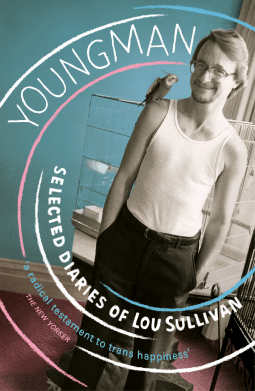
Youngman is a selection of the diaries of Lou Sullivan, gay trans man and activist, from the age of 10 until his death aged 39. They are placed in chronological order, separated into where he lived but otherwise without interruption, and the book reads as a first-hand account of Sullivan’s life, particularly around sex, love, and fighting to live the life he wanted.
Particularly powerful are the things Sullivan says that sound obvious and straightforward now, but at the time were radical and vital for changing the ways in which trans people related to gender and sexuality and were seen by other people. His exploration and affirmation of being a gay trans man, and the importance of being a gay man amongst men, come out (pun intended) particularly well through this selection, and his insights could be useful to people who don’t really understand how gender and sexuality can be deeply entwined, but also one doesn’t necessarily mean something about the other. Even with the sadness of Sullivan’s death, this is a deeply celebratory book, showing a man fighting to live on his terms and enjoying sex and community throughout his life, and the diary excerpts create an intimate picture that a lot of people will get something from.
Deep Wheel Orcadia is unlike anything I’ve read before, a sci-fi novel in verse about home, belonging, and place written in the Orkney dialect with an English translation. The plot follows the meeting of Astrid, who returns to the titular space station after art school on Mars, and Darling, who is fleeing her past and has ended up in the far off reaches of space, but also a cast of characters across Orcadia as they try to keep apace with the changes around them.
I found the form ideal for the setting and narrative, with the verse and the sci-fi combining well to make the world-building concise and leaving plenty of ambiguity in this glimpse into the world of the space station. The short poems, occasionally getting longer to play out a big scene, move quickly between characters and situations and I found the pacing a lot more suited to me than a lot of sci-fi, leaving me wanting more rather than feeling like I’d been told too much. There’s probably a lot of different ways to read the book with its dual text, and though I settled into reading each page first in the Orkney and then English, I could imagine trying out different ways in the future.
The exploration of gender and love in this world was a real highlight, and I also liked the fact that a lot of the story was about a character returning from the “big city” (aka Mars) to their childhood home and perhaps looking for inspiration that won’t come. There’s a lot of stuff in Deep Wheel Orcadia that feels timeless, and in general it is a book that transcends things. I want to think more about Astrid and Darling and I’ll undoubtedly be rereading this a few times and probably picking up more and more each time.
Stay Another Day is a Christmas-set romcom in which three siblings find themselves back together in their family home, but things can’t just go as expected. Twins Fern and Rowan are home from their respective unis for Christmas, with Fern bringing her boyfriend to meet the family and Rowan’s best friend Syd along so they’re not alone for the holiday. Younger sister Willow’s eating disorder means she dreads Christmas, and the siblings’ parents seem to be hiding something. When Rowan recognises Fern’s boyfriend, it becomes even more clear that Christmas will not be a quiet affair for the McAllisters.
A cosy Christmas story that still tackles big issues like eating disorders, mental health, and the impacts of bullying, this book was exactly what I expected from Juno Dawson. It’s lighter than books like Clean and Wonderland, but it still has the zinger lines, messed up characters, and frank discussion of stuff that actually affects people alongside the Christmas drama and cute moments. The chapters move between the three siblings’ perspectives as secrets are told, feelings are dealt with, and the holiday season keeps happening regardless. There’s a nice narrative style for doing Christmas Day as well, which cleverly averts it from being the sort of Christmas story where the actual day is ruined by the drama.
In terms of the characters, there’s a lot to enjoy, with Rowan, the overdramatic gay brother who has put up too much of a shield to protect himself, and his best friend Syd, non-binary and dealing with a lot personally yet still full of sympathy for Rowan and for Willow, immediately standing out. I also really liked Willow and I feel there could definitely be a sequel that focuses on her and what she does next. Another key part of the book is the exploration of Fern’s boyfriend Thom’s bisexuality, which feels especially important as the book isn’t about him coming to terms with it, which has already happened, but about his life now and also partly about how other people react to it.
Stay Another Day gripped me from the start, with Dawson combining her trademark wit in the light of serious subjects with family drama and Christmas tropes like being stuck in a broken down car in the snow. It’s a fun read that becomes hard to put down and I could definitely imagine accidentally staying up too late reading this around Christmas. It’s ideal for fans of Juno Dawson’s books or anyone who wants a slightly more real and varied festive romcom.
Lemon is a Korean literary mystery novella about the impact one murdered teenager has on others around her, as the aftermath is shown from three perspectives. Around the World Cup of 2002, Hae-on was murdered, and the case was never solved. Her sister, her classmate, and her friend all feel the impact of her death in the following years, but it’s clear it holds a different place in each of their lives.
The novella is told in short sections in which you have to work out who is talking from context, and I liked the twisty, not always clear nature of the narrative, with some of the later sections shedding more light on what came before. The mystery at the heart of the book is interesting, but perhaps more interesting is the importance of class and how different characters are treated, especially as Hae-on’s sister discovers more about the boy who was originally accused of the murder.
This book is a fleeting thing, showing the aftermath of the murder of a high school student and the different perspectives people can have on one person. I liked the fragmentary structure and atmosphere and the novella tells a gripping story that leaves you thinking.
Under the Whispering Door is a novel about death and love, as a man who was a self-assured workaholic in life gets a chance in death to explore more of who he could be. When Wallace Price meets a Reaper whilst watching his own funeral, he’s taken to a strange tea shop, Charon’s Crossing, where ferryman Hugo helps souls cross over once they’ve died. Rather than making peace, Wallace finds himself with more purpose, new friends, and even falling in love.
This book combines some more philosophical exploration of death and grief with some witty banter and forming of friendships. The plotline is quite predictable, though it was relieving to have a (slight spoiler) happy ending as I found myself invested in the characters (and, indeed, staying up too late to finish it). Hugo in particular is an interesting character, and not an almighty wise one, but someone trying to help people however he can. As someone who drinks a lot of tea I also liked the tea element of the plot, so though maybe the whole ‘the perfect tea for everyone’ thing is a bit twee.
The concept of someone who wasn’t so good in their life getting a chance to consider this in death is a classic one, and obviously this brings comparisons with The Good Place, though in this case there’s less about morality and more about dealing with death. This is explored through some side characters in different ways, though in the protagonists there’s more about protecting others and getting the chance to improve things even after your death.
Surprisingly considering the subject matter, I found this a light read with romance and friendship, but also an interesting fantasy-type premise. It’s more about human connection than deep philosophical ideas about death, but it explores interesting concepts and has a fun family dynamic too.
Focusing particularly on the importance of community and localised responses, The New University considers the position of universities in the UK today and where things might go next. Using the emergence from the pandemic response as a starting point, James Coe uses the lenses of work, opportunity, place, and relevance to think about access to universities, their position within communities and the country, and how research can be funded, in order to put forward a proposal for the ‘new university’, or an updated way of working.
I read this as someone who works in a non-academic job in a university, so I found a fair bit of it quite similar to the sorts of things you would typically hear from people within a university, but there are some interesting points to be found within it. The question of how a university fits into the place it is in, and its perceived relevance to various communities, is a crucial one and the chapter on that provides a starting point for thinking about if universities really do bring local benefits and if people see that they do. The section around needing flexibility in admissions, especially post-pandemic when they did start to happen in some cases for admissions and might be quickly rolled back, was another interesting chance to rethink something that has otherwise been seen often as quite straightforward, in terms of getting grades, even with some consideration of school and local area context.
As a quick take on where universities might go next and deal with various crises, The New University is a chance for people to think about higher education in a slightly different way. For a lot of people already thinking about the current state of universities or their many flaws, the book won’t necessarily offer much new, but it could be eye-opening to people who’ve not really thought about universities in terms of community and place before.
Reprieve is a novel that combines horror with an exploration of people and social dynamics, as an unlikely group try to compete in a full contact haunted house escape room. In 1997, four contestants take part in Quigley House, a controversial full contact horror experience that you must make it through collecting red envelopes and not shouting the safe word, ‘reprieve’. However, in the final cell, a man breaks in and kills one of the contestants. Combining the stories of some of the people there that night—an employee who encouraged her cousin to take part, a hotel manager drawn down a questionable path, and a gay international student looking for belonging—with testimony, it turns out that who is to blame might be more complex.
I was drawn into this novel by the distinctive, bright cover and the blurb, which sounded unique and intriguing, and it did not disappoint. From the start, which opens with a transcript about what happened that night, you have questions, but the book doesn’t focus just on exactly what occurred, but sets up the backstory of some of the main characters, exploring their lives and motivations that led them to being at Quigley House that night. In particular, Kendra, a teenager who loves horror, has just been uprooted to Nebraska, and feels out of place in a majority white area but has her cousin to rely on, and Jaidee, a Thai student who goes to college in Nebraska to look for his former English teacher who he has a crush on, had intriguing stories, exploring not just choices and motivations, but race and fitting in.
The combination of the tension of the horror side of the book, as snippets are given of the team working through the cells of Quigley House, and the exploration of the characters, especially around racism and fetishisation which comes out through Kendra, Jaidee, and Leonard’s stories in different ways, works very well, making a complex yet gripping novel that shows that horror as a genre isn’t so simple. There’s some interesting questioning of horror tropes too, and around the representation of non-white people in horror, especially black characters being killed, and what this might mean for black horror fans.
In general, the book doesn’t shy away from depicting uncomfortable situations, not in terms of horror (though some people might find the Quigley House scenes scary), but things like culpability when a man’s downward spiral becomes manipulated by someone else, or when someone tries so hard to be white. What’s clever is that the horror house elements almost become a reprieve (yep…) from the complexity of the lives of the characters, because jump scares would be easier to unpick than racism, prejudice, and complicity.
To quickly summarise Reprieve, I’d go for ‘come for the full contact haunted escape room, stay for the complex social commentary’. It’s impressive how well crafted this book is in terms of structure and the ways the characters connect, though fans of straight ‘horror’ might be disappointed at the lack of twists and turns.
Never Saw Me Coming is a thriller set on a college campus, as a girl plotting to kill someone finds herself in danger when a string of murders occur. Chloe is a first year student who looks normal, likes parties, and is taking premed classes, but she’s also part of a secret clinical study of young psychopaths run by the psychology department. She’s also plotting to kill Will Bachman, another student at the college. However, when other people—rumoured to also be part of the study—start being murdered, Chloe might also be under threat, and she might have to try and find some allies in the other study participants.
I was drawn in by the campus setting, and it works well by giving a typical backdrop to a very atypical situation. The book is split into chapters, either narrated by Chloe or third person narration focused on a few of the other characters, which feels typical of this kind of thriller, especially when you’re not sure who to trust as everyone is manipulative or lying in some way. This structure occasionally gives some nice payoffs too, and insight into how the characters view each other. The actual plotlines are quite straightforward, but they are gripping and a bit of ‘true crime podcast’ type vibe to them (I assume, I don’t do true crime podcasts).
I will say that I can’t appraise the “psychopath” stuff or anything said about the study or those involved as I don’t know anything about psychology, but it did feel like it did the serial killer thriller thing of making a lot of bold pronouncements about types of people (and occasional stereotypes about mental health). The study is, for a lot of the plot, more of a conceit than something that is looked at in depth, however, and mostly it’s an escapist campus thriller with some antihero characters.
As ever, I find it hard to read a thriller with this kind of American setting without mentioning Point Horror, and as I loved the ‘Nightmare Hall’ books back in the day, I was hoping on an up-to-date, possibly a bit less trashy update to those, and Never Saw Me Coming did deliver on that, as a book that plays on the stereotypical college girl with Chloe and also goes for rich frat boys as well. Not necessarily a nuanced book, but a ridiculous serial killer thriller with a college setting.
The Transgender Issue is an insightful book that reclaims the term ‘the transgender issue’ to explore what it means to be trans in Britain today, how we got here, and where we can go from here. Each chapter explores a different area of life, considering work, healthcare, the prison system, and community, and builds towards a call for solidarity and a focus on trans liberation, rather than rehashing the same ‘debates’ in the media.
I’ve heard so much about this book even before it’s out, and there’s a reason why: it is a well-explained and engaging deep dive into trans life in Britain, focusing both on politics and theory and on practical action and everyday realities. Faye considers both issues that impact beyond trans people to other marginalised people and issues specific to trans women, trans men, or non-binary people to draw out the importance of solidarity across issues whilst still paying attention to the specific needs of particular people, for example trans people of colour or sex workers.
The dual focus on uncovering the present and past of trans life and on the vital nature of solidarity and trans liberation for the present and future makes The Transgender Issue a powerful book that is for trans and cis people alike. It will open up the eyes of many people to look beyond the ‘debates’ popularised in the media and think about the practical and political work we can do for the future to make life better for everyone.
Tell Me I’m Worthless is a gothic horror novel in which the haunted house is fascism and nobody is safe. Alice, Ila, and Hannah once went to the abandoned house in the city that backs onto the woods, the one nobody goes near, and only two of them made it back. Three years later, Alice is haunted by the trauma of what happened and by a man in a poster covering a stain she can’t bear to see, and Ila has gone down a gender critical path to deal with what she saw. Maybe all that Alice and Ila can do is reunite, despite hating each other, and return to the house to confront it and what happened to Hannah and them.
From hearing about this book and hearing the author read an extract of it at an event, I knew I needed to read it. Tell Me I’m Worthless is horrifying and unyielding trans horror, a darkly, strangely hilarious exploration of trauma, complicity, and the creeping rise of fascism, and a clever take on the haunted house genre. It’s also quite difficult to describe as it leaves you breathless and disoriented, having just gone through the onslaught of facing up to truths about radicalisation, extremism, and what people might think with someone (or something) allowing it.
One of my favourite elements of it was the treatment of the gothic, especially the haunted house, and the combination of it with the political and the social. In this way, the book follows on in tradition of the gothic novel, and it particularly reminds me of the images of the old ruined house around the time of the French Revolution and how these were used in gothic novels, often preying on prejudice around ideas of degeneracy and irrational thought. The house is a place and a character, a manifestation of English fascism, but it is also inside each of them, and some of the horror comes from the fact that it isn’t just inside the house that is dangerous. Indeed, the very category of safety is questioned, looking at how safety for one person often comes at the expense of less safety for another, one house must be destroyed to make space for another, etc, and that fits in so well with the two (human) protagonists and how they reflect and distill each other.
The book also updates the horror genre in delightful ways (and utterly horrific ones), with the unforgettable use of ‘the old racist singer in the poster is haunting you’ as a new version of ‘the eyes in the painting are following you around’. Horror writing is maybe the genre I’ve enjoyed the longest, and this was the literary poetry horror I didn’t know I needed, with sharp jibes at culture mixed in with skin-crawling and brutal moments that show us that maybe the real horror was inside us all along. The entwining of gender and horror was crucial too, with both gender and the haunted house being about context and place, always morphing but always there.
There’s plenty more to be discussed about Tell Me I’m Worthless, but it’s better just to say preorder it, read it, pay attention to the content warnings at the start, and use it to see how horror can expose the real world through the supernatural and make you scared of a poster. It feels like a rusty nail through the head, but somehow in a good way.
You must be logged in to post a comment.