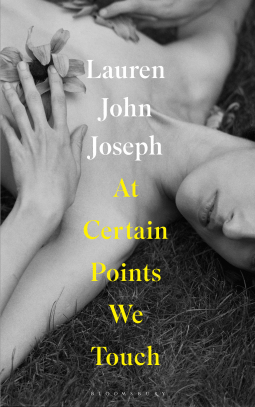
At Certain Points We Touch by Lauren John Joseph

At Certain Points We Touch is a novel about remembering the past, doomed love, and a millennial stumble through friendship and cities, as a writer tries to tell the story of their dead lover. A trans writer living in Mexico realises that it is the anniversary of the death of a man they loved, and starts to write the story of them, together and apart, and the messy, toxic, desperate affair they had.

This is a masterful novel, sharp and clever, that explores how we tell stories and what millennial queer life is like, almost haunted by the ghosts of previous queer culture in London, San Francisco, and New York. At times it feels like an older novel, but then it throws in modern references and muses on the longevity of digital culture, and you remember that this is recent. In fact, the parts about digital preservation were some of my favourite bits of writing in the book, musing on how a MySpace profile could endure if civilisations couldn’t.  

You know from the start that it is building towards Thomas James’ death, and you really understand how the narrator wants to hold off getting there and telling a death they weren’t there for as much as they want to unfold the story. The book is also a knowing wink towards writing and autofiction, considering what is memory and story even when something is meant to be ‘what happened’, but this is combined with exploits and community and stumbling into things whilst young in ways that stop it just feeling like a book about writing a book.

With an almost haunting sense of the recent past and grief, At Certain Points We Touch is a novel that really paints a portrait, not just of the narrator’s lover, but of the narrator themselves, of cities and bad rooms, and of growing up as a millennial and traversing different kinds of culture and community.

At Least This I Know by Andrés N. Ordorica

At Least This I Know is a collection of poetry that explores belonging in a range of forms: nation, race, sexuality, family, future, and more. The book is split into sections – ‘Where I begin’, ‘How I have grown’, ‘What I have lost’, ‘What I have given’, ‘He that I love’ and ‘Where I will burn’ – and I really liked how this took you on a journey through the poems, enacting journeys of the poet and also giving a sense of going deeper into issues of belonging and self.

I knew I was going to like the collection from the first poem ‘November 16th, 2014’, which is a perfect opening for it: a moment at border control, encapsulating fear and desire for a place to belong, and a poem that almost makes you laugh and cry at once. From there, the collection moves on to images of family, like being passed photos around and told stories, and then onto growing up and queerness, loss, and place. 

I really liked the use of repetition in many of the poems, used to various effects, for example in ‘By the seashore’, one of my favourites in the collection, in a way that really gets across how certain details can become entwined with grief and traumatic moments. Also, the repetition (and variation) in ‘These pyramids are houses for the dead’ stood out to me, especially with the font size changes, and the poem has such a powerful sense of place and what people can lay claim to.

I also like the understated love poetry in the collection, especially ‘We are young and still have time’ and ‘It had been so long’, which both have a beautiful sense not only of tiny moments of love, but also time, the seeming unreality of it and maybe how queerness impacts that, changing the effects of looking back or thinking of a future.

In short, I loved this collection, which captured me from the start, with its wit, phrasing and powerful simplicity combined with explorations of all sorts of things that make up a person and make them feel like they belong somewhere. Occasionally I had to pause reading at the end of a poem to think ‘damn, that’s good’.

(Note: Thanks for 404 Ink for the proof copy – the book is out now via their website)

Bitter by Akwaeke Emezi

Bitter is the follow up to Emezi’s Pet, a prequel that explores the world of Bitter, Jam’s mother, and her choices as a teenager between staying safely in her special school for the arts, Eucalyptus, or fight for the city, Lucille. Outside of Eucalyptus, an activist group fights for a better city, against the injustices that billionaires and officials create and perpetuate, but Bitter feels unable to leave the sanctuary of her school, after a traumatic childhood, and wants to focus on her painting. But her friends are drawn to the fight, and when Bitter’s art takes an unexpected turn, she finds herself at the centre of the action.

Pet was such a powerful book, a young adult book that felt wise and yet deeply readable, and I also like Emezi’s other books, so I was excited for this one. It is quite different to Pet, with some of the teenage drama that wasn’t in the previous book and with a focus on types of action and how to achieve change. I really liked the characters, who all have distinct interests and lives (though Blessing didn’t get much of a role beyond being Bitter’s best friend), and I liked how it gave background to Pet whilst also being very different to it. It has more of an older feel than Pet in some ways, with the characters being slightly older and the focus being on their action and their futures, and slightly more of a YA fantasy feel, especially in the second half of the book, whereas Pet was harder to define.

The focus on art and protest in Bitter and ways in which characters found and built community were powerful, though it is interesting that in the end, violence and power do get the change Lucille needs, even if the characters fight against using violence. I didn’t find that Bitter gripped me in quite the same way as Pet, but I liked that it was different and it has more of a coming-of-age feel, as Bitter works out her place in a flawed world.

The Cuckoo Cage ed. by Ra Page

The Cuckoo Cage is a collection that reimagines British folk heroes into new everyday superheroes, fighting against modern evils with the spirit of older community action. The short stories from a range of writers take the idea of the superhero and combine it with direct action and some of the mot pressing issues in Britain today, like food poverty, racism, and inequality. Each story is followed by an afterword that goes into the historical figures that inspired each story, offering context to the stories but also introductory history to some of the key action taken in the past against injustice and tyranny.

I wasn’t sure what to expect from the collection, but its distinctive conceit drew me in, and I liked the near-future setting of the stories, which all seem to be set in the same universe (adding to the comparisons with more traditional superhero comics and films). There’s a lot of creativity in the kinds of powers the new superheroes have and the ways in which the original folk figure comes through, particularly through ideas like being able to topple statues using portals or create political memes through mind reading politicians, and the stories are gripping and fun, showing the heroes in action rather than just describing what they might do.

One of the real highlights of the book is the sense of timeless protest that comes from the conversation between the short stories and the afterwords, giving readers the chance to think about how history is told and how we might view figures that the establishment didn’t want to give credit to, whether real people or folk figures symbolic of a larger movement. The only one of the figures I already knew about was Martin Marprelate, and I enjoyed the way that the pamphlet culture of the 16th century was turned into online memes of the modern day in the story ‘The M & Ms’, showing how there’s always more ephemeral forms that can move faster than the pace of established stories and news.

Unlike a lot of superhero stories, which feel like an attempt to tell you that the world is okay and will be saved without action, The Cuckoo Cage reimagines superheroes as direct action whilst paying tribute to the history of this action in Britain. I think its combination of history and social realism with fantasy will appeal to a lot of people, and I liked the way that it felt like the stories came together by the end, as people might expect from superhero narratives these days that are part of the same universe. Clever and insightful, this book might inspire people to look deeper into alternative narratives and think about how, even without superpowers, action can be taken.

All The White Spaces by Ally Wilkes

All The White Spaces is a historical horror story about isolation, selfhood, and the impacts of the First World War, as a young man sneaks onto an Antarctic adventure. Jonathan Morgan stows away on the ship of famous adventurer James ‘Australis’ Randall, hoping to chase the Antarctic dreams of his two older brothers who died in the war. With the support of family friend Harry, he has to prove himself amongst the ship’s men, but as they reach their destination and disaster strikes, the crew find themselves fighting to survive the Antarctic winter in a place that seems beyond all maps, and fighting against a force that wants them dead.

Historical adventure isn’t a genre I would usually read, but the horror elements and trans man protagonist drew me in, and I’m glad they did. This was an incredibly eerie read, deeply immersive and haunted not only by a supernatural force and Antarctic isolation, but the profound impact of the First World War upon those who survived it. Split into sections based on the expedition, the novel starts slowly, building up a picture of the characters and the plans before things start to go very wrong. I did find it hard to keep up with the large cast of characters early on, maybe because this isn’t the sort of narrative I’d usually read, but I managed to keep up enough to still enjoy it, and slowly some of the main characters became apparent.

The horror is a clever combination of the mind and some kind of supernatural force, with ambiguity around what exactly is going on, and it really captures a terrifying sense of whether people are being driven mad by the situation or whether something is out there after them. There’s also a lot about masculinity in the book, not only through Jonathan getting to live as the gender he is, but in the ways all of the characters deal with different things, like reputation and betrayal, as well as emotion.

Set in a horrifyingly harsh landscape, All The White Spaces explores human nature whilst providing a tense, slowly-unfolding story of a fight for survival against something unknowable.

Delilah Green Doesn’t Care by Ashley Herring Blake

Delilah Green Doesn’t Care is a queer romcom about a woman who has to return to her hometown for her estranged stepsister’s wedding. Delilah lives in New York City, trying to make it in the world of photography, and staying at arms’ length from everyone. When her stepsister Astrid, who she’s never gotten along with and tries to avoid speaking to, asks her to be the photographer for her wedding, Delilah needs the money, so she finds herself back in Bright Falls, facing memories of her father’s death. At the same time, Astrid’s best friend Claire is trying to manage co-parenting with her ex and keeping Astrid happy during her wedding. When Claire and Delilah run into each other after years, sparks start to fly.

This is a romcom that deals with quite a lot of character stuff whilst also building up the romance, especially around Delilah and Astrid coming to terms with their childhood and how they see each other, and Claire working out how to put herself first and give her almost-teenage daughter (and previously unreliable ex) room to grow. The premise is a classic romantic comedy one, with someone forced back into a place they left for a wedding, and some pre-wedding activities giving structure and chances for the protagonists to see each other. The chapters move between the two main characters, giving both perspectives, and Delilah in particular is a flawed character, too quick to just try and get a rise out of someone rather than really engage, and who has to learn to give people another chance.

I particularly liked the way that Delilah built up a connection with Claire’s daughter, teaching her about photography, as it made the book feel like it wasn’t an ‘oh, also I’ve got a child’, but the love interest actively taking an interest in them. Astrid’s fiancé being terrible, and therefore the wedding that sets up the plot being a bad idea, is a classic trope, and the book, perhaps unexpectedly from the premise which might sound like it’s more of a ‘character escapes from conservative little town and has to go back’, shows queer characters realistically uniting to help stop the awful cishet guy. There’s a few questionable actions by characters which aren’t really dealt with, but that tends to be true of most romcoms, which typically need to be read with a dose of ‘that was discussed properly by the characters later’.

With a sequel about Astrid on the way for people who want more of these characters, Delilah Green Doesn’t Care is a fun romcom about two women reaching their thirties and working out where they are and what they want next. It’s easy to get gripped by it and stay up too late reading it, which tends to feel like the mark of a good romcom novel, and the chemistry is good. A book that does what it says on the tin, whilst letting the characters be vulnerable and grow.

28 Questions by Indyana Schneider

28 Questions is a novel about what makes relationships, as two women meet as students, fall deep into friendship and then in love. Amalia moves from Australia to Oxford to start as a first year music student and is still dealing with the culture shock and the work when she meets Alex, another Australian in her third year. They quickly become best friends, asking each other questions and learning more and more about each other, but Amalia starts to realise they’re both maybe feeling the pull of attraction. A romantic relationship might be perfect, or it might change things forever.

Spanning across four years, three at Oxford and then one once Amalia has graduated, 28 Questions uses the idea of it taking 28 questions to fall in love to structure the book, with each chapter named after a question that will occur. The premise sounds a bit like a romcom, and I did see it being marketed as a ‘queer When Harry Met Sally‘ (a film the book references a few times, around ideas of friendship and sex), but it is less of a romcom than a coming of age type book set at university, exploring love, sex, and relationships as well as music and art and what is highbrow or not. One book it actually reminded me of in some ways is The Lessons by Naomi Alderman (which is funny because characters talk about Alderman’s Disobedience in the novel), as it has a similar sense of complicated love story entwined in Oxford, though 28 Questions is much more focused on the love aspect than the ‘can Oxford students function as humans’ part.

All of the dialogue in the book is written as if a script, with name tags for who is speaking, and though it’s an unusual conceit, I didn’t find it hard to get into, but I imagine it’ll put some people off. There’s also a lot of classical music and opera throughout, which I don’t know much about, but I enjoyed the vibe and some of the discussions about music, and thoughts about creating things and enjoying art more generally. There’s a lot of Oxford detail in this, which I appreciated, and it depicts the insular, pressure cooker feeling well, though I expected more follow through around this later in the book, as it felt like there were things Alex was hiding.

The relationship between Amalia and Alex shows the complexity of feelings, and also how something that sounds good on paper might not work out when people’s actual tendencies and emotions come into play. I liked some of the conversations and the way intensity was shown, and how Amalia expected certain conversations to go, or expected certain types of combative discussion due to being at university. The book captures very well some of the experiences of university and trying to find out who you are whilst also feeling pressure to do well and seem clever, but also how this bleeds into relationships and where lines might be between finding and losing yourself in them.

I really enjoyed 28 Questions, particularly through some of the ideas it explores and the fact it depicted a university experience similar to my own, though I did keep expecting there to be slightly more drama or things later revealed in the plot. I also liked the fact it takes the Oxford student obsession/love story plot and tells it with two women, both quite similar rather than a typical class or other divide, and there’s some good lingering tension between them. If you like university-set stories about messy love and friendship, then this one is worth a read.

Sticker by Henry Hoke

Sticker is a a memoir told in 20 stickers, as Henry Hoke explores growing up in and being from Charlottesville, having a disabled parent, and sexuality all through the lens of particular stickers. From stickers never had to those more ubiquitous, each chapter using the sticker as a starting point, as Hoke explores childhood, violence, and legacy.

This is the first book from the Object Lessons series that I’ve read, and it was not what I might’ve expected, not a history or philosophical look at an object, but using the object in question to explore personal history and emotion. In particular, the book explores being from a place known for white supremacist violence, whose name became a byword for a fascist terrorist attack. Seeing as stickers are often used by neo-fascists to spread hate, this adds a layer of complexity to the idea of the object covered in the book: stickers are not just a site of childhood joy and sometimes pain, but also part of something larger. This is also true of other elements of the book, like not being able to have a sticker for giving blood if you’re a man who has sex with men, and it’s clever how Hoke manages to explore so many emotions and experiences organised around stickers.

The book’s cover, with the unicorn and rainbow stickers, might not make it clear how much this book engages with what I don’t want to call ‘the darker side of stickers’, but the elements of stickers that go beyond something cute to adorn notebooks with or give to a child. The concept of the book makes me wonder what objects you could view your life through and where objects have a lot more complexity than you might first think (so maybe I need to read more of the series). If you like reading short memoirs with overarching themes or structural conceits, Sticker is a book to give a go, particularly if you’re interested in reading about experiences of being a white queer person in Charlottesville and consider how people are privileged or see things in certain ways.

To Paradise by Hanya Yanagihara

To Paradise is an epic novel that explores ideas of health and illness, race, nationhood, and family across three different times and many different characters. Starting in an alternative universe version of America in 1983, the first section explores the structures that exist in the Free States, a part of America that seems to have more liberal views and allows same-sex marriage, but that doesn’t stop a wealthy young man from having to fight for who he wants to marry. The next section moves to 1993, in which a Hawaiian man hides the troubles of his upbringing from his lover against the backdrop of the AIDS crisis. And then the third section takes us to 2093 and a world full of pandemics, in which a scientist’s granddaughter tries to understand where her husband is disappearing to in a strictly controlled world.

A lot of people (myself included) will be anticipating this after A Little Life, and To Paradise is very different in some ways, but also similar in others, particularly in some of Yanagihara’s themes and locations and the general ambiguity and complexity around some of the moral issues. The book is in three distinct sections, and I like the fact that these are separate, making it clear where you’re at and also making them resonate with each other but not completely link. The third section is a lot longer than the other two (it takes up half of the book) and probably the one that stood out most to me when reading, combining the narratives of a woman and her grandfather, with the latter told entirely in one-way letters.

The first section has a distinct vibe, a kind of high society romance and love across class barriers, but it raises a lot of issues and questions around power, class, and race, and the failings of a seemingly utopian place that is still prejudiced, racist, and rigidly structured. Stepping back from the immediate narrative to notice this makes it richer, and I enjoyed the hints of hindsight in the narrative voice combined with the somewhat ambiguous ending (which is teased about in the third part). I wasn’t really sure what to make of this section whilst reading, and I think it benefits from considering as part of the whole book and in relation to the other sections.

The second section is quite different again, split into two parts exploring a Hawaiian man’s life in New York City with his older lover, as he hides his complicated past and watches people get ill and die, and then his father’s story, looking at identity and the colonisation of Hawaii through the eyes of a man with a mysterious illness. The first part was more of a snapshot, feeling quite brief, but the second part brings a rich narrative whilst also eventually unfolding the childhood of the protagonist from the first part.

As I already mentioned, the third section stood out most to me, almost immediately drawing me into the story of someone living in a future-America where many pandemics have ravaged the world and things seem to have taken a dystopian turn. The chapters in this section move between the 2093 narrative and an earlier one featuring the grandfather character as he tries to balance his high-flying scientific career with his husband and son, who are unsettled by moving to America from Hawaii and by what the scientist is up to. The story is told very well, and there’s a lot of interesting moral complexity throughout, raising questions about what should be done to control viruses, but never at the expense of focusing on the human elements. The general dystopian setting isn’t overdone, as some can be, and there’s an interesting moment of reflection in one of the letters about what a dystopia even is.

Some people might feel that this is three books in one, but personally, I felt that they gained a lot by being together as one. In particular, the first and the third sections benefitted from each other by twisting around ideas of utopia and dystopia, marriage and freedom, and what it means to be known as a part of a family (the latter is also very important in the second section). I think if the book was just the third part, I would enjoy it less than I did, because it would feel too clearly like a COVID-19 take on dystopian fiction, rather than the larger exploration of a lot of themes that To Paradise is.

Though the third section of the book can hit close to home at times, To Paradise isn’t trying to destroy the reader as A Little Life is, but instead paints a complex vision of people looking towards paradise, towards something better, and realising that they cannot help or protect others. It explores divisions in societies and violence towards groups of people, but also divisions and tensions within different kinds of family units. The length and format will probably put some people off, especially if the start of the first section leaves you wondering where the book is going, but actually the epic nature of the book worked well for me, weaving in a lot of questions and things to consider. It’s not perfect, but it is quite an experience.

Wahala by Nikki May

Wahala is a tense and biting novel about what happens to three friends when a glamorous newcomer joins their group. Ronke, Simi, and Boo have been friends since university, three mixed race women now in their thirties and dealing with life and love. When Simi’s childhood friend Isobel appears, at first the others are unsure, but soon it seems like her whirlwind of money and style might improve all their lives. However, cracks start appearing in their friendships and relationships with their partners, and secrets from the past are coming back.

The book focuses on all three of the protagonists, with each chapter following a different one of them as they are drawn deeper into Isobel’s world. The concept of the outsider who starts tearing apart a friendship group is a classic one, and this is a great example of the trope, with plot points all coming together and the reader knowing early on that Isobel is trouble, but being powerless to do anything but watch it happen. Sometimes stories with that kind of reader powerlessness frustrate me, but this one was carefully done so you trust that the plot is going somewhere.

The main characters are interesting, all at quite different points in their lives and dealing with their different relationships to their British and Nigerian heritage. Ronke was the most suspicious of Isobel, which made her engaging, and her hope throughout the novel was powerful. Boo’s story was frustrating in a cleverly written way, as a part-time stay-at-home mum deals with having someone encourage her to spice up her life, but this makes her feelings of resentment for her husband and child harder to deal with. Simi’s narrative was perhaps less thrilling, but gave a chance for exploration of the conflicts she faced at work and with her family, and also about a woman who does not want to have children.

There’s a lot of issues explored in the novel in different ways, from dark comedy to more serious consideration of race and class (especially in the treatment of Ronke’s boyfriend Kayode), and the book cleverly combines the plot with these elements. Wahala is a chance to plunge into the lives of three friends (like Isobel), and root for them to make it through without ruining their lives (unlike Isobel).