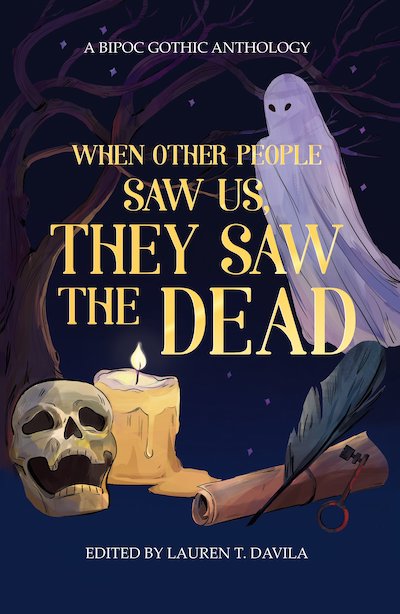
When Other People Saw Us, They Saw the Dead is a collection of gothic stories by BIPOC writers, exploring ghosts, witches, death, curses, and dreams amongst other things. As the title might suggest, a lot of the stories deal with death in some way, from ghosts and memories to legacies and escape. Some of the stories explore colonisation and gentrification, self and belonging, and all the while there’s a sense of considering who gets to tell gothic stories.
Some of my personal favourites were: ‘The Mountain Air’, a strange tale of a trip to a cabin that gets weird; ‘We Have Always Lived in the Projects’, an unsettling look at gentrification (with a fantastic title); the very real horror of ‘Headmaster’; and ‘The Candlemaker’s Daughter’, which tells a familiar story in a different way. I enjoyed that the stories varied in length but were generally on the shorter side, meaning there was lots of variation and they were generally tight and concise. It’s a great collection for diving into atmospheric stories and exploring a range of modern gothic set across various places and time periods.
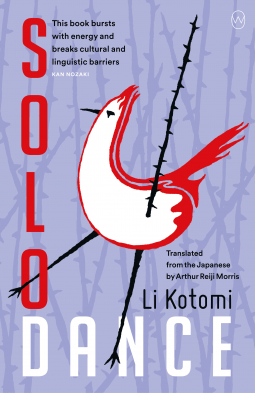
Solo Dance is a novel about a Taiwanese lesbian in Japan, struggling to find hope in her life whilst working an office job and dealing with mental health issues. The protagonist is in her late twenties, reinvented and renamed herself when she moved to Japan after university in Taiwan, and lives a double life: in the office, everyone is talking about marriage and children and their position in the company, whereas she also goes to gay clubs and meets other lesbians online. The narrative moves between her present and her past as she searches for belonging, thinks about queer literature, and faces everyday homophobia.
Translated from Japanese, this short novel is a sad one, occasionally bittersweet, with the protagonist’s trauma and mental health playing a crucial part in the book, and sexual assault and suicide part of the narrative. Despite this, there’s also beauty, both that she finds in the world and in her interests, especially in her connection with literature. I hadn’t heard of most of the books and writers referenced in Solo Dance, so I’m excited to explore those too, especially Qiu Miaojin who plays a vital part in the protagonist’s construction of herself. The experiences of queer people in different countries is an underlying theme, explored through the protagonist’s experiences and her travels, and the people she meets, and I found this a powerful part of the book.
This is no light read, with a pretty depressing plot and tackling a lot of serious issues, but I found it engrossing and read it quickly, especially drawn in by the protagonist’s use of literature to explore self and culture and the exploration of queer life for an outsider in a country.
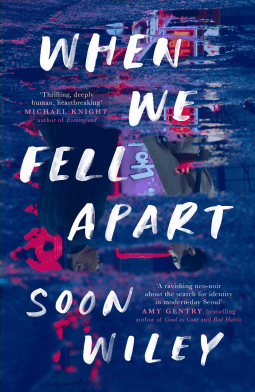
When We Fell Apart is a novel about belonging and family, as a Korean-American man in Seoul tries to find out the truth about his Korean girlfriend’s suicide. Min grew up in California with an American father and Korean mother, but has moved to Seoul to try and search for something intangible. When he met Yu-jin, a university student with a powerful father, their relationship seemed perfect, but when she suddenly takes her own life, Min ends up on a trail to work out the truth, discovering that he didn’t know Yu-jin as well as he thought.
This is a layered book, set up like a murder mystery, but really about the multitudes within people and how they appear different to different people. Each chapter alternates between Min’s present point of view and Yu-jin’s in the past, showing Yu-jin’s journey from small town to Seoul, and her discovery of more than that path her parents set out for her. Her relationship with her roommate So-ra is particularly important, and seeing glimpses of the ways that Yu-jin puts up different barriers and acts with different people highlights her longing for yet inability to do and be exactly as she wants. Min stays fairly mysterious, even more of an outsider in the city and discovering he wasn’t even really aware of everything going on in his relationship, but also making friends with Yu-jin’s Japanese roommate.
The main characters all show different kinds of outsiders in Seoul, also depicting a lot of the city with an outsider’s perspective as well, and the book explores ideas of how people manage being an outsider and where cultures do or don’t have room for it. The narrative unfolds slowly, less of a fast paced mystery than a slow unfolding of layers. It would have been quite different if it was just from Min’s perspective, more focused on a mystery of power and secrets, but the inclusion of Yu-jin’s point of view as well makes for more of a melancholic tone, seeing a character find joys beyond her family’s plans and expectations, but not know how to include them in her future. The characters’ relationship to time, particularly to thinking about present and future, brings out something interesting, with Seoul seeming to represent a present for both Min and Yu-jin that they don’t quite seem to see beyond.
When We Fell Apart is a slow burn kind of mystery that focuses on character relationships and perspectives, more of a literary look at outsiders in Seoul than the thriller-esque pursuit of the truth suggested in some ways by the blurb. It builds up an intriguing picture of characters who seem to purposefully only see things in certain ways and their ties to each other.
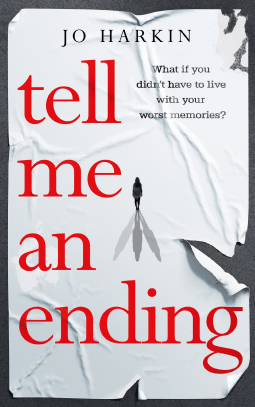
Tell Me An Ending is a novel about erasing memories, getting them back, and what memory means for grief and identity. Memory clinic Nepenthe has been deleting specific memories for clients for a while now, for clients both knowing and who forget even having the procedure done. Suddenly, these unknowing clients are getting emails saying they are entitled to reinstate a memory they had deleted if they want. The novel follows Mei, William, Oscar, and Finn, all affected by memory deletion, and Noor, who works at the clinic, as they explore their own pasts and the reality of Nepenthe.
The concept of this book is fairly similar to other stories—it in fact references the film Eternal Sunshine of the Spotless Mind quite a bit—but it explores different circumstances, especially traumatic ones, and the reasons behind people keeping or deleting memories. The chapters move between different characters, with a lot of focus on Noor who works at the clinic and is trying to work out what her boss has been up to, whilst dealing with a heartbreak that is intricately tied up with her job. The Nepenthe side of things, as found out through Noor, is fairly interesting, but quite straightforward, with unsurprising twists. The other characters, who we see trying to deal with their current lives and also decide if they want their memory back, allow the novel to cover other ground, particularly around what people do with traumatic memories, or different kinds of memories that might impact our lives.
The book is quite long and can be slow at times, though also some of the characters you wish you could delve a bit more into, as a lot of the book is taken up with what they are doing. In particular, Oscar and William’s stories both pose interesting questions about trauma and memory, whereas Mei’s narrative is more around parental influence and what kind of troubles actually need deleting, or actually need other kinds of support and autonomy. The other story, with Finn and his wife, was a bit slow and didn’t really go anywhere, not quite exploring enough at the end to counterbalance with the other characters.
A near-future dystopia that focuses particularly on the importance of memories, but also considers if deleting various kinds of memories is actually the best option, Tell Me An Ending is an enjoyable read, though it did drag a bit for me.
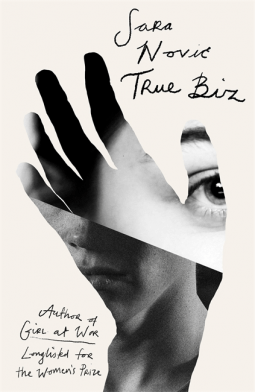
True Biz is a novel about River Valley School for the Deaf, where a new student learns to find her place and the headmistresses struggles to keep the school and her marriage going. Charlie has never been around other deaf people before, but when she transfers to the school, she learns the language that was kept from her, makes new friends, and develops her understanding of Deaf culture. Her new friend Austin deals with the birth of his baby sister, who is hearing, and the school’s headmistress February tries to manage threats about the school’s future whilst keeping her worries from her wife.
I loved Nović’s Girl at War so I wanted to read this one, and I’m very glad I did. Told from the perspectives of a range of characters, mostly the three protagonists with occasional moments from somebody else, and interspersed with information on American Sign Language and Deaf history as Charlie learns it, the book immerses you in the lives of the characters, and as a hearing reader I found I learnt a lot whilst following the characters’ journeys. There’s more of a focus on character, with a coming of age element particularly with Charlie, rather than narrative, with the book more of an episode of the characters’ lives rather than a distinct start and finish.
Charlie’s story was particularly engaging, exploring the development of her anger and sense of her own self as she deals with an implant that doesn’t work as it should and realises what she missed out on by having sign language and Deaf culture kept from her. Her political education comes both from history lessons and from other people, and the book really shows the importance of community and sharing history to fight for your rights. The other main story in the book, February dealing with her aging mother, failing to communicate with her wife, and worrying about the school and students, was also good, though didn’t really come to a particular ending. The other characters had less space in the book, but I liked that there was a range of characters and hints of their stories too.
Emphasising the important of other people and shared culture, True Biz is a character-focused coming of age story that has a powerful message about disability rights and Deaf community.
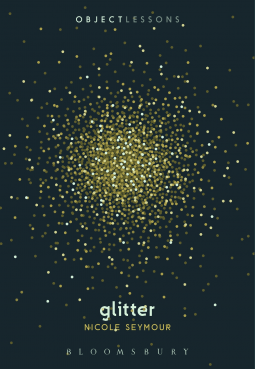
Glitter is, well, a book about glitter, part of the Object Lessons series that explores an everyday object through particular lens. In this one, Nicole Seymour explores the uses of and connotations behind glitter, thinking about its environmental impact, its position as a symbol of frivolity, and ways it is seen as hard to get rid of. She also considers how it has been used in products like glitter pizza and beer, has become a symbol of protest, and is important to depictions of gender and sexuality.
This is the second of the Object Lessons series I’ve read, and I really like how these short non-fiction books take different approaches, sometimes exploring the history of an item or its societal impact, sometimes charting personal histories, and sometimes looking to culture or the future of the item. In Glitter, the titular substance is defended against its haters, whilst acknowledging the environmental impacts of plastic glitter, and also considered in what it can stand in for.
I particularly liked the way that the book concludes by thinking of glitter as more of a colour or an idea, rather than just a physical item, and how this might allow its rehabilitation in the face of ecological crisis. The fact that ‘glitter’ is sometimes a colour (e.g. as a text colour) reinforces this and I found it a very interesting point. I also enjoyed the tensions between ecological and societal elements, and also the connotations involved with different kinds of aesthetics, and these felt like good frames to view glitter through. Both of the Object Lessons books I’ve read now have felt like reading queer history (and future) through an object and I really like this approach, so I’d definitely read more in the series.
The Odyssey is a novel about a woman working on a cruise ship whose avoidance of life and the world on dry land is tested by an employee improvement programme. Ingrid works in rotating roles on a huge cruise ship, where all training comes through her tablet and she might be called up to do almost anything. On her days of shore leave, she gets very drunk wherever they’ve docked. When the ship’s strange captain Keith, who thinks himself some kind of guru, picks her for an employee mentorship, suddenly Ingrid faces up to some memories. At the same time, the ship seems to be falling into disrepair.
I was intrigued by this book as it was pitched as similar to Ballard’s High Rise, which it is in some respects, with the closed off cruise ship gradually decaying, though The Odyssey is much more focused on one person’s mental state than the cruise ship itself. It explores Ingrid’s regimented life on the ship, and her memories of the past, including her husband and her alcoholism, and you watch as she makes various decisions (including having her finger cut off) as she tries to reconcile these. The first person narration feels similar to other books focused on a narrator with a strict regimen who is trying to avoid the past or their lack of a future, though the setting does make this one feel different.
One thing I was disappointed by was the fact that the cruise ship setting isn’t really explored as much as you might expect, especially not as things start to turn weird and twisted. I would’ve liked more of it, whether the Japanese obsession of the captain or what was going on with some of the other employees Ingrid knows, as it is a distinctive and unusual setting for literary fiction.
The Odyssey explores an alcoholic character whose avoidance of their past and future has led them to live a permanent present on a strange cruise ship. The protagonist is interesting and the narrative voice is readable, though as it’s quite short, I felt there could’ve been a bit more of the weirdness.
Concerning My Daughter is a novel about a woman whose thirtysomething daughter moves back in with her, bringing along her girlfriend and forcing the mother to face up to what she wants for her child. Translated from Korean, the narrative follows a woman who works in a care home, where she looks after a patient with dementia whose has no family but was well-renowned when younger. When the woman’s daughter Green needs to move in with her, bringing along her girlfriend Lane, the woman finds it hard to be civil, wanting her daughter to get married and have children. Her fears are complex, revolving not only around the life she had, but on the treatment of her elderly patients without children to fight for their care.
This is an intriguing book, very simple in narrative and premise (traditional, homophobic mother struggles with how to deal with daughter), but also powerful in how it shows the impact society and tradition can have on viewpoints, and the intersection of different kinds of crises (in this case, care of the elderly and homophobia). It can be painful to read at times, repeating the protagonist’s obsession with her daughter not having a ‘real’ relationship, and the depiction of the care of the elderly can be brutal, but there’s also tenderness underneath, for example the glimpses of Green and Lane’s relationship even only through the eyes of someone who won’t accept it.
A lot of the key elements of the book are things that cross over many cultures and countries, particularly in terms of changing kinds of families and how various groups of people (including older people and LGBTQ people) outside of a traditional norm are treated. Some people might not like the simplicity of Concerning My Daughter and other people might find it too difficult to read the mother’s perspective and her inability to listen about what kind of life her daughter wants to read, but it’s a powerful look at a character struggling with the position of different women in society and how love can make people misguided.
Devil House is a novel about a true crime writer who finds himself tangled up in a web of what story he is telling. Gage Chandler had a hit debut true crime book, and subsequent movie adaptation, to make his name, and then more books that were less successful. His latest opportunity is to move into the ‘Devil House’, the location of murders in the 1980s that seemed to be part of the Satanic Panic, and use his techniques for uncovering the story to write his next book. However, as he writes and explores what happened, true crime starts to get less clear for him as a goal.
I’ve not read anything by Darnielle before (and heard about one Mountain Goats song, though I’ve heard of them a lot) so I didn’t know what to expect going in, other than the lurid cover that is perhaps a bit of misdirection (though it is very Satanic Panic). The novel is broken into different sections, moving between Chandler’s narrative of researching and writing, the story of the Devil House, and some other parts woven in too. Until quite near the end, it’s not quite clear what is going to happen, and the ending wasn’t what I expected, but I enjoyed how it played out for the most part (I didn’t quite get the Arthurian digression, though I do like Arthurian stuff and on reflection I can kinda see the point).
As a novel, it is mostly a commentary on true crime, writing, and obsession, and I thought the stuff about true crime was very interesting, though as someone who doesn’t read or watch the genre, I don’t know much about levels of fictionality and fact in it. Ideas of what is a ‘good’ narrative and how you turn the messy truth into something gripping are very intriguing, and the book does play with that by luring you into thinking you have a nice narrative, though the actual ending of the whole book is perhaps a little underwhelming because of it all. I liked the experiment of this novel in terms of the layers of narrative and the different stories you are told, though, as with true crime, you almost wish all the stories could be wrapped up a little more neatly.
Portrait of a Thief is a heist story wrapped up in the tale of five Chinese-American students carving their own futures, as they race to try and reclaim sculptures for China. Will Chen is an art history student at Harvard who wants to make a difference. When a powerful Chinese company offers him fifty million dollars to put together a heist crew and steal five sculptures from various galleries, he would do it without the money, just to bring the art back to its creators. He puts together a team, of his sister Irene, who can talk anyone into anything, his best friend Daniel who is applying to med schools, Irene’s roommate and street racer Lily, and Alex, an MIT dropout working for Google though she’s feeling lost. Together, despite lacking any experience of stealing art, they try to work out how they can get in and, most importantly, get the art back out.
I love heist films and I love stories of university students doing illegal/questionable things, so this book immediately appealed to me. I like how it feels like a literary twist on the heist, more focused on the characters and their often haphazard attempts to pull heists off than being a simple slick display, and I was drawn into the characters’ interpersonal relationships, particularly Irene and Alex’s dynamic. For a heist story, you saw a lot of the characters’ thoughts and motivations, and though as there’s five main characters these can sometimes feel a little overemphasised, that still felt fitting with how heist films need obvious dynamics and roles.
The focus on reclaiming art felt like a great frame for the book (though I did expect some comment on the repeated appearance of the Sackler, as another important issue in the art world) and though this kind of book isn’t necessarily going to go into great depth about issues in museum and gallery collections, it brings together both interesting social and political questions and reflections on the characters’ own senses of self and morality. Importantly, it’s also just fun, with a inexpert crew of young twentysomethings doing relatable things like using a Google Doc to plan it. Sure, it’s ridiculous, but so are most heist films.
Portrait of a Thief is the trashy literary heist book I didn’t know I needed, maybe particularly aimed at people who love both the Ocean’s films and The Secret History, but also with a look at cultural imperalism and diaspora. It’s not perfect, but I was holding my breath to know what would happen, and I loved the character dynamics. I would not be sad if there was a sequel, either.
You must be logged in to post a comment.