Yo-yo Heart by Laura Doyle Péan

Translated and introduced by Stuart Bell

Yo-yo Heart is a poetry collection that tells the story of the aftermath of heartbreak, a personal diary after a split with a girlfriend. Split into five ‘days’ that correspond to phases in the grief and emotion of the narrator, the poems chart how everyday moments intersect with emotion and also explore the political behind such grief. Laura Doyle Péan opens the collection with a prologue about the process of survival, healing and vulnerability, ending with the memorable manifesto “allowing oneself to be vulnerable / is a political act” and they suffuse this throughout the book.

The collection is translated from Quebec French and the translator, Stuart Bell, also introduces the book to discuss the translation and the poetry itself. I particularly appreciated the discussion of some of the original French and where it has specifically Canadian and political elements, meaning that as I was reading I could have a sense of the original text lingering underneath even without having it on the page. There’s also short explanations of key pop culture references, which poetry collections have been doing more and more, and in this instance it allows for some Canadian references to be explained for readers from other countries.

The short length and powerful imagery of the poems as they move through each section makes this a hard-hitting collection, showing how healing mental processes take time even as the parts claim to be individual days. The use of space in the collection, both around words and also poems, adds to this, as well as to the initial isolation of the break up. The way images are expressed (in translation, of course) brings wit and sadness, for example in lines like “cooking soothes Ricardo tells me / i cut off the carrot ends / just like you have / all contact”.

Day 3 has some particularly memorable elements, starting with the poem containing the collection’s title and having a poem that explores grief for the personal whilst political injustice, especially borders and imprisonment, go on in the world. The way that the entire collection, not only through this poem, emphasises that personal and societal sadnesses occur at the same time and it can be a political act to be able to express yourself is a highlight of the book. Also in Day 3 is another of my favourite set of lines in the collection, “in pastel gel pen I have written / invitation cards / to all my demons / to the monsters under my bed / where I’m going / you are going too”.

Yo-yo Heart is a book that will stay with me for a while, thanks to the use of sparse imagery, emotion, space, and politics throughout a narrative of heartbreak and slow healing. It is in a style I love and I really enjoy collections that tell a full story using any style of poetry.

Idol, Burning by Rin Usami

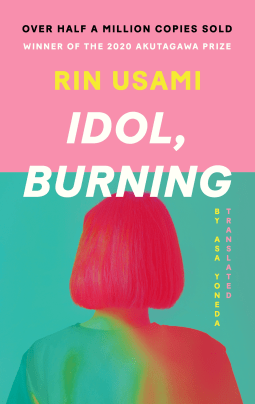
Idol, Burning is a novella about a Japanese high school student whose obsession with a celebrity sustains her until he is accused of hitting a fan. Akari struggles at school, but she is dedicated to her oshi, Masaki Ueno, who is part of pop group Maza Maza. She runs a successful blog about him, is part of his fan club, and buys all of his merchandise. When news comes out that he has hit a fan and he faces backlash online, Akari’s obsession is threatened.

This short book, punctuated by blog posts and internet comments, explores teenage obsession and fandom culture, particularly in the Japanese idol world. From Akari’s perspective, the narrative combines her obsessive following of Masaki with what is going on in her life and her difficulties with school and work, especially as she devotes her time and energy to being a fan. The celebrity scandal element is never fully explained, as Akari never really knows what happened, which means the novella is centred much more around the experience of being obsessed, rather than reality, and you get the sense of Akari’s isolation from anything outside of her passion. 

As the book is short, there’s not a huge amount of plot (and the ending isn’t as dramatic as I expected), but it really focuses in Akari herself and it’s an interesting consideration of teenage experience versus how it might seem from the outside.

Sewer by Jessica Leigh Hester

Sewer is another book in the Object Lessons series, exploring sewers as they impact our daily lives though mostly unseen and considering what we should do to improve them for the future. Rather than focusing just on the physical sewers, the book also looks a lot at blockages like fatbergs and wet wipes and considers what human consumption and use does to these practical structures.

The Object Lessons series is always, as far as I’ve seen from the ones I’ve read, interesting in some way, with each book taking a particular direction with the object in question. Though Sewer cites Robert Macfarlane’s Underland, this book doesn’t take that approach of focusing on the physical underground spaces in our imaginations and reality, but considers sewers in their sanitation purpose and what happens when they are blocked, both in terms of the people who work in them and what it is that causes those blockages. Not necessarily a particularly savoury topic for a book, but it was certainly something different and it’s useful for thinking about what you personally put down the drain and how your actions are part of a collective whole (which is basically the message of the book).

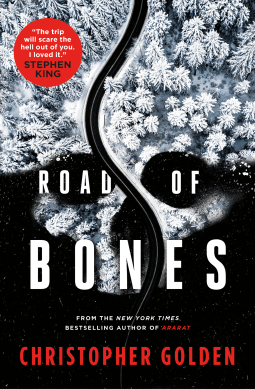
Road of Bones by Christopher Golden

Road of Bones is a horror novel set in the Siberian wilderness, as a man set on making a documentary about the Kolyma Highway finds himself pursued by uncanny creatures. Felix “Teig” Teigland needs a win, after constantly losing money on his work, and he’s brought his friend Prentiss as cameraman and companion along to the harsh environment of Siberia in the desperate hope of making a documentary series people will love. The highway is also known as the Road of Bones, where Stalin’s prisoners worked and died to build the road, but Teig has found a guide and has a plan to document whatever they see. However, when they reach the town they’re aiming for, it is suspiciously empty.

Without wanting to give away too much, this is a book that both does what it sounds like—creates horror around being in a very cold place where something unnerving is happening—and doesn’t do what I expected from the title and early focus on the highway. It opens with Teig and Prentiss starting out their journey, giving backstory to why they’re there, and then follows them as they meet their guide and head on. From the documentary setup and the focus on the Road of Bones, you might expect more about history and the prisoners, but actually the book is much more about ethereal, unnerving creatures and folklore, with the highway more of a minor player.

There’s plenty of chill, both in terms of cold and the creepy situation, and Road of Bones is definitely atmospheric, with a tense feeling of otherworldliness and uncertainty about what will happen. The pace is fast and you get a classic story of a group of people fighting to get away from somewhere, but the blurb and start seem to set up for quite a different kind of horror.

A Little Resurrection by Selina Nwulu

A Little Resurrection is the first full-length collection by Nwulu, with poems that explore places and spaces, race, and navigating your position in the world. Some of the poems form parts of sequences woven through the collection, like the ‘Conversations at the Bus Stop’ and ‘Repatriation’ poems, and others explore various facets of similar things, like the loss of a parent. 

I particularly enjoyed a lot of the imagery throughout the poems, with lots of lines and ideas that really stick with you (for example, in ‘My Dad’s Jacket Lives On in a Pop-Up Bar in Shoreditch’ and the final line of ‘Half-Written Love Letter’), and carefully sketched out human relationships like the “what if” of ‘Never Mine’. The engagement with space, particularly the modern reality of living in a city in ‘We Have Everything We Need’ also stands out, bringing in the global and climate impacts of having city convenience and inconvenience, and also the idea of which spaces are for who which runs throughout many of the poems.

Our Share of Night by Mariana Enriquez

Our Share of Night is a complex novel of dark powers, military dictatorship, and a powerful family, set across decades in Argentina. Gaspar’s father Juan has been at the whims of the Order for years, as a “medium” able to commune with the ominous Darkness and take part in bloodthirsty rituals. Juan is desperate to keep Gaspar safe from these people, partly his family, but the Order has a dark history and plenty of wealth and power in Argentina. Across decades, Gaspar, Juan, and others try to evade the Order’s plans, amidst political turbulence and changing times.

The book is split into various sections, each spanning a certain period of time, and this works very well in telling the story, from Juan on a road trip with young Gaspar to Gaspar’s mother in 1960s London to an article detailing the cover up of the deaths of political activists. Though the novel is pretty epic in length, the different sections break it up in a way that means it doesn’t feel too slow, particularly as it uses different perspectives. Again, these perspectives could make the book confusing, but I didn’t find this, and you end up quite invested in some of the characters (and horrified by others – the book really explores the dark side of humans confronted with power and malevolent magic).

As I would expect from having read Enriquez’s story collection The Dangers of Smoking In Bed, this novel combines malevolent magic and horror with politics and humanity, resulting in a rich book that I enjoyed more than the story collection, possibly because it felt so fully realised. I don’t always get along with a book so long and split into parts, but this one worked for me, with enough going on and some sections that are quite different to others, whilst others feel like a continuation of Gaspar’s story. I particularly enjoyed the flashback type section focusing on Gaspar’s mother that was set in London in the late 60s and 70s, as the way that the occult stuff was mixed with the hippy and counterculture stuff was really interesting.

Our Share of Night is a long novel that spans genres, looking at power and brutality in a real and supernatural context, exposing Argentinian history and relationships between children and parents. I enjoyed the weaving together of magic, horror, and real violence, which was powerful, but also the focus on characters, flawed and angry and secretive.

Stone Blind by Natalie Haynes

Stone Blind is a novel that tells the story of Medusa, from childhood to the aftermath of her beheading at the hands of a hero. With her two immortal Gorgon sisters, Medusa grows up feeling different, feeling weaker and more fragile than them. When Medusa is assaulted by Poseidon in a temple dedicated to Athene, Medusa bears the consequences, changed into someone more dangerous and more damaged, with the ability to turn any living creature to stone. But Medusa cannot live quietly, as a young son of Zeus on a quest to fetch the head of a Gorgon and aided by the gods will soon cross her path.

Haynes combines a multiplicity of voices to tell this story, weaving together the different narratives and perspectives of mortals and gods to question not only the image of Medusa as a monster, but roles of everyone in the story and the dangers of rage and revenge when directed at the wrong people. The short sections from various perspectives and with different tones work well, getting across the various strands that cause the narrative tension, and there’s a particular perspective which talks to the reader in a knowing way, highlighting the retelling aspect and the fact that readers may already know a lot of the story. It took a bit of time to get into and I found the pace a bit slow for me near the start, but as it went on it started to come together.

There’s a lot of Greek mythology retellings out there now (some also by Haynes) and this feels similar to others, with a knowing edge and focusing on the injustice of who is seen as a “monster” and who is seen as a “hero”. Fans of the genre will probably like this one as well, which looks not only at Medusa’s treatment, but also at women fighting against being forced to marry someone they don’t want to and the impact of immortals acting based on whim or petty jealousy. Personally, I think I’m perhaps not so engaged with the feminist retellings of Greek mythology now there’s been so many, so it took me longer to get into this one, but I liked the use of voice and perspective.

HellSans by Ever Dundas

HellSans is a dystopian novel about a country controlled by a typeface, HellSans, which gives most people bliss, but those who are allergic to it are persecuted, and where people have personal cyborgs called Inexes. Dr Icho Smith is a scientist working on a cure for the allergy, hidden away in a top secret lab. Jane Ward is CEO of the company who makes the Inexes and is close to the Prime Minister of the country. When Icho and Jane both end up on the run from their respective lives, their paths intersect, but with warring factions in the country, the situation is volatile.

I was drawn to the book by the title, and the typeface concept is certainly unusual. The structure is notable as you are told from the start that you can read the first two parts in any order, before a final third part. I read the book just in the order it came, and it would be interesting to see if it does give a different viewpoint to read part two before part one, as I understand why you could read it in either order, but also I’m not sure if it does have an impact. As with a lot of dystopian sci fi, there’s a lot to start off with that you don’t understand in terms of terminology and how society functions, but you gradually pick up on a fair amount of it (though it doesn’t really go into the history of how society got there, maybe to leave the reader guessing how likely it could be).

The plot is fairly straightforward, with government corruption, the demonisation of people with a chronic illness, and questions around cyborgs, sentience, and privacy. The ending has some interesting philosophical points and a fairly dramatic climax, though the later chapters of the book are a lot faster than earlier ones so it does feel quite quick. The layers of betrayal and hiding the truth are crucial to the book and, without wanting to give anything away, built into the narrative, which brings an additional element to it.

HellSans is a book with a lot to say, with plenty of clever elements (adjusting a sans serif font by adding serifs as activism is a nice touch), and even as someone who doesn’t read much sci fi I found the world-building worked for me, not being too heavy or tedious but giving a decent sense of what was going on. There’s a lot around treatment and cures to think about within it, but within the slightly ridiculous framework of a font that can cause bliss or pain.

Artemis Made Me Do It by Trista Mateer

Artemis Made Me Do It is a poetry collection from the dual lens of Artemis and the poet, exploring ideas of survival and trauma and using your own power. The collection is split into sections, alternating between Artemis and “the poet”, and combines text poems with elements of collage and tarot. I particularly liked the Artemis sections, which explore the various myths surrounding Artemis and how these can be useful in a modern context, thinking about how stories are told and how someone is viewed. I enjoyed the collage parts too, and I think the general witchy/tarot vibe will appeal to a lot of people. Some of the poems were less to my taste as I’m not so much of a fan of very short poems that feel like aphorisms, which were particularly prevalent in the “poet” sections, though I feel that the collection did work well from having both parts, weaving together the two voices in conversation.

Babel, Or the Necessity of Violence: An Arcane History of the Oxford Translators’ Revolution by R.F. Kuang

Babel is a historical fantasy novel exploring the importance of translation in colonialism and the ways in which power manifests both in academia and in the world. Robin Swift was taken from his home in Canton to England by a mysterious guardian after his mother’s death, learning Latin and Greek in preparation for the future his guardian has planned for him at Oxford’s Royal Institution of Translation, Babel. It seems a haven, a place where Robin makes a group of close friends and despite the huge workload, finds happiness. However, it starts to become clear that Babel may not be such a haven after all, and the implications of the translation work and the silver-working magic that translation allows have dark and far-reaching consequences.

The concept of this novel is fantastic, centred around ideas of translation and how they could both evoke magic (by having translations that have slightly different meanings, bringing in something extra) and be used as tools of power and colonisation. The dark academia type setting (being set in the nineteenth century makes it different to most of the popular dark academia books, but it definitely tries to expose the dark side of academia) will bring it a lot of appeal, and the narrative centres around four main characters, with Robin the protagonist but his friends Ramy, Victoire and Letty being crucial to the story, which makes it engaging despite the huge amount of heavy academic linguistic content.

Reading the book on Kindle I wasn’t quite aware how long it is, and I will say that you really feel the length. For me, it did drag at times, and though the length is partly due to the writing style and use of footnotes to elaborate, maybe the pacing didn’t quite work for me. In terms of the style, I really liked the third person removed narrative style, which matched the academic nature and allowed for a lot of context (it’s clearly a heavily researched novel). The footnotes I was less keen on, as a lot of them served to make obvious points and took you away from the story. It was clever, though, that they were used to explain the racist attitudes of people cited/mentioned as a sharp commentary on the people in the novel who believed in translation, but still saw the languages they needed for silver-working or trade as lesser and the people who spoke them very much so.

The language used to discuss race, class, and gender was at times strangely modern for a novel that was so placed in a historical setting, which occasionally felt too notable to be ignored, but in general the book engaged interestingly with the historical setting. It’s quite different to something like Jonathan Strange and Mr Norrell, which integrates magic fully into its historical setting, as in Babel the silver-working element, which is the only fantasy part, is more of a structure that impacts the workings of the country, but not in ways that make it particularly different than in real life. Personally, as someone who isn’t really a fantasy fan, I enjoyed this, and I was pleasantly surprised that the book was much more about translation and academia than magic.

The depiction of Oxford is an interesting one, with some brilliant commentary and satirical jibes atthe attitudes of different kinds of people within the University and an accurate depiction through the Babel institute of the kinds of workloads and the ways in which people end up cocooned from the outside world. Even though Babel is fictional, and Kuang’s opening author’s note explains a range of inaccuracies with the Oxford depiction specifically, it did feel pretty true to life. Occasionally there was too much day to day university stuff which slowed the pace down, but at the same time that is what people are probably looking for from something marketed as dark academia. What was perhaps strangest was that the changes to the realities of Oxford (like having a somewhat anachronistic commemoration ball with oysters served at it) were only explained in the author’s note, and not made a feature based on being an alternative history with the silver-working magic integrated into it.

There’s a lot to say about Babel, as it has a lot to say both in terms of length and content. Generally, it’s an engaging and insightful read that, as a fan of dark academia and not so much fantasy, I enjoyed. There’s plenty of other things I’ve not even gone into in this review in the book (like arguments about models of resistance and protest, violence and non-violence) and it combines the academic and conceptual concepts like ideas of translation, languages, and power with a good story about a group of friends finding their way at Oxford.