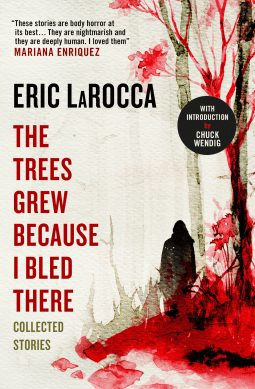
The Trees Grew Because I Bled There: Collected Stories by Eric LaRocca

The Trees Grew Because I Bled There is a collection of dark short stories by Eric LaRocca, exploring some of the more sinister side of human nature as well as trauma, body horror, and twisted relationships. From people having to make horrifying decisions about what to do with family members to blog posts detailing a cancer diagnosis, the stories delve into very human moments in weird and unexpected ways.

Having read LaRocca’s Things Have Gotten Worse Since We Last Spoke and Other Misfortunes and You’ve Lost A Lot of Blood, I wanted to read this collection, and it has a fair amount in common with the former book, in the way the stories have an ominous tone and generally explore strange dynamics between people, but also weave in queerness without it being the focus of the stories. As with any short story collection, there’s going to be stories some people prefer and others don’t, and for me I think my favourite was ‘You’re Not Supposed To Be Here’, a tale of two men in a park with their young son who suddenly meet some very odd strangers, as it felt like a classic horror film concept distilled into a short story. I also enjoyed the lingering body horror of ‘The Trees Grew Because I Bled There’ and the gradually unfolding darkness of the final story, ‘Please Leave or I’m Going To Hurt You’.

As with other LaRocca stories, these have some truly stand-out titles, and though I didn’t enjoy some stories as much as others, there’s a lot of gripping premises, weird goings-on, and protagonists making horrible choices to make this collection an enjoyable and occasionally uncomfortable (in a good way) read.
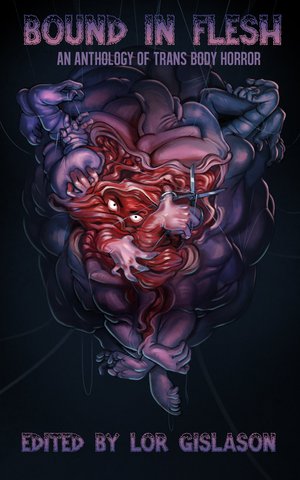
Bound In Flesh: An Anthology of Trans Body Horror, ed. by Lor Gislason

Bound in Flesh is a trans horror anthology that brings together thirteen body horror stories to explore the extreme limits of flesh, gender, and humanity. From people exploring their desires, as weird and body horrific as they might be, to those just looking to exist in a body, there’s a huge amount of variety in the stories in this anthology, despite the fairly niche theme of trans body horror, both in terms of plots and general vibes.

The opening story, ‘Wormspace’ by LC von Hessen, is a great way to set the tone, delving into weird desires and changing your body (and has a fantastic ending). One of my favourite stories in the collection is ‘The Haunting of Aiden Finch’ by Theo Hendrie, due to the way it uses the format of transition-charting videos to tell a horror story, one which is perhaps more slow burn and ominous than others in the book and with some creepypasta vibes. ‘Mama Is A Butcher’ by Winter Holmes takes a story of acceptance with a Frankenstein-type theme and makes it a friendship story, with the sort of lingering ending that you want from good body horror where the image feels seared into your head.

Though not all of them jumped out at me quite as much, there weren’t any stories that I didn’t like in the collection or any that I found too hard to get into. There’s some really great, twisted ways in which the stories use body horror as a lens to consider transness, for example if you are forcibly shape-shifted into the wrong gender, but also stories like the closing piece, ‘Looking For The Big Death’ by Taliesin Neith, in which the body becomes a different kind of place, something to desire death but also, it seems, resist it, and being trans is just a part of that complexity.

Trans horror is one of the best kinds of horror (of course) and this anthology shows some of the wealth of options for using trans writers using body horror as a way to tell stories, whether directly or not about being trans. There’s lots for body horror fans and lots for trans horror fans, and plenty to wince at in general.

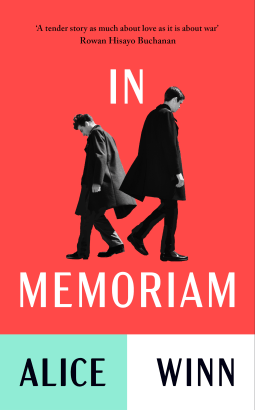
In Memoriam by Alice Winn

In Memoriam is a novel that tells the love story between two schoolboys-turned-soldiers during the First World War. For Sidney Ellwood and Henry Gaunt, when war breaks out in 1914 it feels far away from them at their boarding school, where their main problem is the fact they both believe their love for the other is unrequited. However, when Gaunt’s German mother asks him to lie about his age and enlist to protect the family from anti-German sentiment, he agrees, and finds himself at the front facing the horrors of war. Not long later, Ellwood joins him, and their world of schoolboy troubles seems miles away, even as more of their classmates turn up around them.

In many ways, this book is exactly as you’d expect, similar to other First World War novels and especially those that depict love stories. There’s lots of historical material woven into the plot, as the afterword explains, and a good amount of depiction of the complications around war, like fighting in one despite being against it. The move from schoolboys to soldiers and the varied ways in which the characters react to this is also very interesting, from Ellwood and Gaunt’s respective literary interests clashing with the realities of war to some of their schoolmates’ jovial reactions.

I had trepidation reading the novel as personally for me the combination of the tormented slow love story and the threat of death looming over everything doesn’t always make for a book I enjoy reading, but I did appreciate what the narrative did with the characters and the love story, managing to encapsulate horror and brutality, but also perseverance and small tender moments, making it less unrelentingly bleak and heartbreaking than I was expecting from the title and my assumptions. Thanks particularly to the characters and relationships, In Memoriam is likely to be popular with a lot of people. It is a love story that looks at war, class, and historical queerness, with a narrative that’s quite dramatic and maybe too neat, but still works for the genre.

Your Driver Is Waiting by Priya Guns

Your Driver Is Waiting is a novel about a ride share driver whose new romance sets off a dangerous chain of events. Damani drives for a ride share company to make enough money to care for her mother since her father died, trying to pay bills, and spends time with her friends. The city is filling up with protests by drivers and others against injustice. When she meets Jolene, a wealthy white woman who is an ally and cares about Damani, everything seems great, but as Damani tries to show Jolene the world she lives in, things go badly wrong.

This is a book that combines social satire and politics, particularly around what kinds of action people take and who that action helps, with a character focus that explores the varied life of Damani, who is torn in several directions but always has to return to the identity of ‘driver’ to keep existing in the world. The narrative starts quite slow and then builds up, reflecting the monotony of Damani’s days and then the whirlwind of everything that happens with Jolene. The depictions of working for a ride share company are good too, as you really get a sense of time and the desperation of needing pings on the app to actually make anything close to a living.

Through the narrative and characters, Your Driver Is Waiting explores axes of oppression and kinds of communities, particularly the coming together of people to build alternative communities to fight against societal structures in solidarity, and how other people don’t understand this. The way in which Damani thinks that Jolene’s points of connection with her—having read books, been to protests, and being queer—might bridge the large divides between them, and then her obsession with hearing from Jolene when they don’t gives the novel both emotional and political power, as structures impact personal lives.

Weaving together activism, romance, and fighting for the money to live, Your Driver Is Waiting is a gripping novel with satire and heart.Through the humour and anger, it shows how things are complex within and outside of activist spaces.

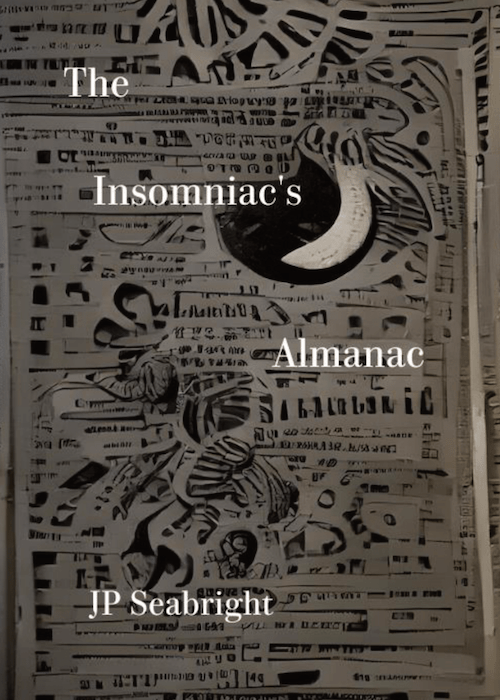
The Insomniac’s Almanac by JP Seabright

The cover of The Insomniac's Almanac by JP Seabright

The Insomniac’s Almanac is, as the name suggested, a book of poems for a year of sleeplessness, moving from January to December. The hybrid layout combines altered photographs of sleep with the poems, which are stark like the unsleeping night, and the whole collection has a real feeling of the middle of the night, of an uncertain time that people shouldn’t be awake for. Each poem ends with the sort of generic advice given to people with insomnia, really highlighting the gulf between clinical advice and the poetic exploration of dealing with insomnia.

One of my favourite poems in the book is ‘Cage & Kane’, the title a pun on the time, and the idea of being caught “between silence and psychosis” is a memorable image that lingers after the end of the collection. I also really enjoyed ‘Summer Night City’, which carefully paints a picture of a quiet, hot night, the sort of night you can’t help but feel the atmosphere of. This is a collection that feels like such a beautiful package, with the poems and images and general atmosphere all coming together to create a vivid portrait of insomnia and of the nighttime.

Note: as per the Kith Books page for the chapbook, “All proceeds from this chapbook will go to two charities that help provide that support: The Albert Kennedy Trust in the U.K. and The Trevor Project in the US”, and it is also possible to donate to other trans/queer organisations and still get a free copy, so take a look and donate!

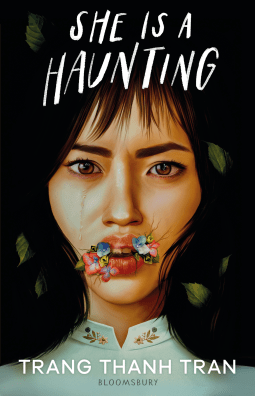
She Is A Haunting by Trang Thanh Tran

She Is A Haunting is a young adult horror novel that combines romance with haunted house horror and colonialism, as a Vietnamese American girl on the brink of going to college faces a building her family has history with. Jade doesn’t feel like she’s anything enough, has fallen out with her best friend, and wants to tell her mum she’s bisexual, if it wasn’t for the worry of how her mum will react. When her and her younger sister stay with their estranged father in Vietnam for the summer doing up an old French colonial house into a guest house, Jade is meant to be dealing with it, but instead, the house seems to be warning her and things feel very wrong. Her sister and dad don’t believe her, so with the help of Florence, who Jade has just met, she sets about making the house seem haunted, but the house has other plans.

The book is told from Jade’s point of view, with interjections focusing on the house, and you don’t quite know what is going on. There’s ghosts, there’s a romance with Florence, there’s Jade managing all her anger and family issues, and there’s a lot of dead insects around. Jade has plenty of complexity, a teenager about to go to college who has to face up to how she feels whilst also dealing with a haunted house with a dark past, and it’s interesting how she sees the other characters, particularly her dad. The story is tense and is creepy, with a claustrophobic feeling and a scary sense of not knowing if you’re in control of your own actions, though the ending doesn’t feel quite a resolution.

Queer horror is a great genre and She Is A Haunting combines a coming-of-age, caught between cultures story with an unsettling ghost tale that explores how a place can turn people against each other. For a young adult book, this is genuinely a pretty spooky horror novel that has very menacing undertones and some creepy bug moments. 

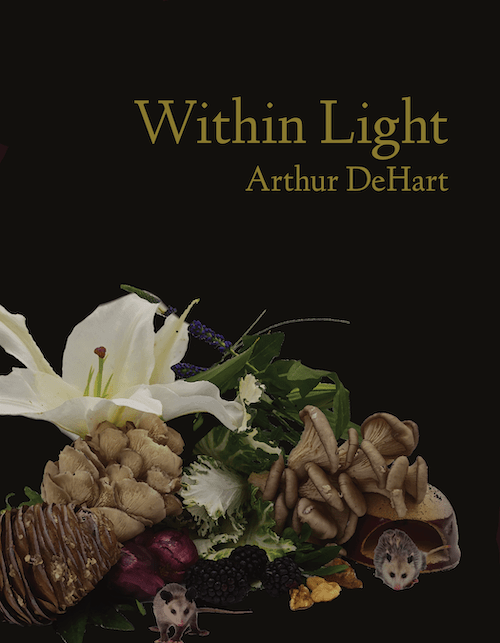
Within Light by Arthur DeHart

The cover of Within Light by Arthur DeHart: a black background with flowers on top.

Within Light is a collection of poetry that combines love and longing with the harsher realities that surround them. What particularly stands out when first reading is the love poems in the collection, in various forms, from the eye-opening point of ‘Catch Your Breath’ to the realities of ‘Dirt’, and also the tiny moments of love that are suffused throughout most of the poems, including those talking about mental health. It is a collection that doesn’t idealise love, but presents it as both mundane and life-sustaining, and also a method of queer people forming the lives they want to live.

I also enjoyed the poems about being a poet or poetry running throughout the collection, a musing on what it means to be a writer but also how sustainable it is, and the amount of wishing and hoping that comes along with being a poet (particularly as I too find myself ending up writing poetry about writing poetry too often). One of my favourite poems in the collection is ‘Sunday’, which reclaims the day from a religious past and offers a laziness that can come post-transformation, both of the narrator and of the day itself.

Within Light is a tender collection that still has raw moments, exploring what love can mean and what a poet can be.

(Within Light is forthcoming from Kith Books in March 2023)

White/Other by Fran Lock

White/Other is a collection that defies boundaries, made up of prose-poetry-manifesto-essay pieces that explore the treatment of those who are white working class “other” in society, combining personal and cultural essay fragments with discussions of the purpose and history of language and who is allowed what language.

Language is the thing that jumps out the most from the collection: repetition, fragmentation, and the importance and slippiness of meaning. The title itself sets this up, with a question that is returned to again and again: what does “white, other” truly mean in the categories of neoliberal society and how does that materially impact people’s lives? The lyrical prose that makes up a lot of the collection plays with language as it asks which words are allowed and how much which words are used matters. At the same time, there’s plenty of consideration of class and politics, because it isn’t just systems of language that are questioned and attacked.

There’s a lot in White/Other as it moves between topics and thoughts, an angry trove that uses poetry to ask what can be represented in poetry and whose voices can be heard. I enjoyed the fragmentary style that flows between ideas and the repetition and echoes that make powerful points about how people are perceived and represented.

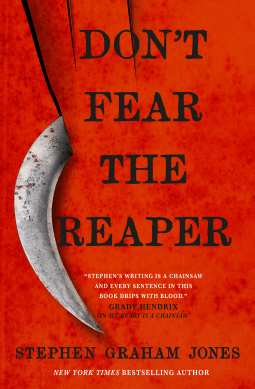
Don’t Fear The Reaper by Stephen Graham Jones

Don’t Fear The Reaper is the sequel to Stephen Graham Jones’s My Heart Is A Chainsaw, picking up four years after the events of the first book. Jade Daniels, now going by Jennifer, has been released from prison after what happened in the town of Proofrock previously, but unfortunately this is timed with an even more memorable sequence of events for the town, as serial killer Dark Mill South escapes his prison convoy and ends up in Proofrock. Jade has sworn off her slasher-film-obsessed past, but the deaths seem to be reminding her of something, and with her remaining allies in the town, she must fight through snow and blood to work out who is the final girl this time.

I enjoyed My Heart Is A Chainsaw, with its distinctive combination of horror film obsession and dark realities, so I was excited to read Don’t Fear The Reaper. Stephen Graham Jones has such a distinctive writing style, which occasionally I get lost in, but I found this one easier to orient myself even, even with a range of perspectives. At its core, the plot is fun and clever, playing with horror tropes as should be expected from a book series with a protagonist who overthinks them all, but also a bloody slasher story, with a lot of dead teenagers and some gory moments.

This one focuses less on Jade’s emotional wellbeing than the first, but shows her attempts to throw off her past and then realising that she still needs to harness who she was as well as who she now is. Unlike her loner self from the first book, by this point you can see the connections she has with people (it’s deeply sad that she believes that Letha is only her secret best friend, as if she doesn’t even want to admit that), but this all comes through the reality of her being in prison for some of the killing from the previous book for multiple years. 

What Stephen Graham Jones manages to do is create a horror sequel that really does engage with the aftermath of the first one and how behind the slasher tropes, there’s a likelihood that the hero still gets in trouble. This is stylistic horror with notable writing (it flows better for me than the first, maybe because it isn’t punctuated by Jade’s essays on slasher films this time) and a classic plotline of short time frame, bad weather, and lots of dead bodies.

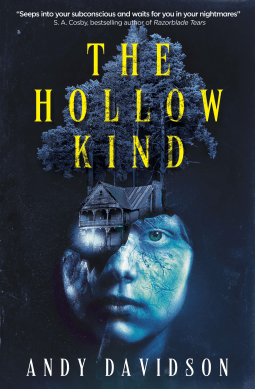
The Hollow Kind by Andy Davidson

The Hollow Kind is a horror novel about a family and the danger of inheriting seemingly cursed land. Nellie flees an abusive marriage with her son Max after finding out she has inherited her grandfather’s estate in Georgia. It is a falling down farmhouse and weirdly silent woods, once used for turpentine, and it offers hope for Nellie and Max, but the strange whispering voices and unsettling sense of ancient power suggest it is a place less safe than Nellie imagined.

The book is split between the “present” narrative of 1989 and an earlier one featuring Nellie’s grandfather and father, using the dual timelines to unfold the family secrets and the kind of gothic horror based on echoes of the past and inheritance of this terror. It is a pretty standard horror, with a few side threats from real men blurring the line between what is supernatural danger and what is very real life danger. Max is a mature-for-his-age horror child, and the relationship between Nellie and Max is a highlight of the book, especially how the book explores parent and child relationships and the complexities within them. The earlier parts of the book, with more subtle unnerving horror as you don’t really know what is going on to Nellie and Max and weird things are happening in the house, is perhaps scarier than the later more dramatic scenes, but the book does build up to a good climax that forces the family to face up to the generational horror.