Not A Book Review: my poetry chapbook is out tomorrow!

COVER

Syntax Error
Siobhan Dunlop

Title and author's name appear on black rectangles in commodore 64 text input format set against a field of white text on blue that spells out a repeat of the "Hello World" programme code

As the title says, this isn’t a book review, because it’s about my book! My debut poetry chapbook, Syntax Error, is out tomorrow from kith books. If you’re a fan of poetry, computer code, or living on the internet, you might enjoy it (and check out kith’s other books too)!

It is the result of a number of years of writing poetry relating to digital things, based on both my job teaching digital skills and various interests in digital things. There’s some definite inspiration from books like Several People Are Typing (especially the way that book plays around with the self in relation to chat app Slack) and also a lot of poetry I’ve read recently and tweets I’ve seen. It also pairs very nicely with the VERY ONLINE zine, which a couple of the poems in it were first published in.

Don’t forget, you can always check out my published poetry on the my poetry page – there’s lots of stuff there you can read online for free as well.

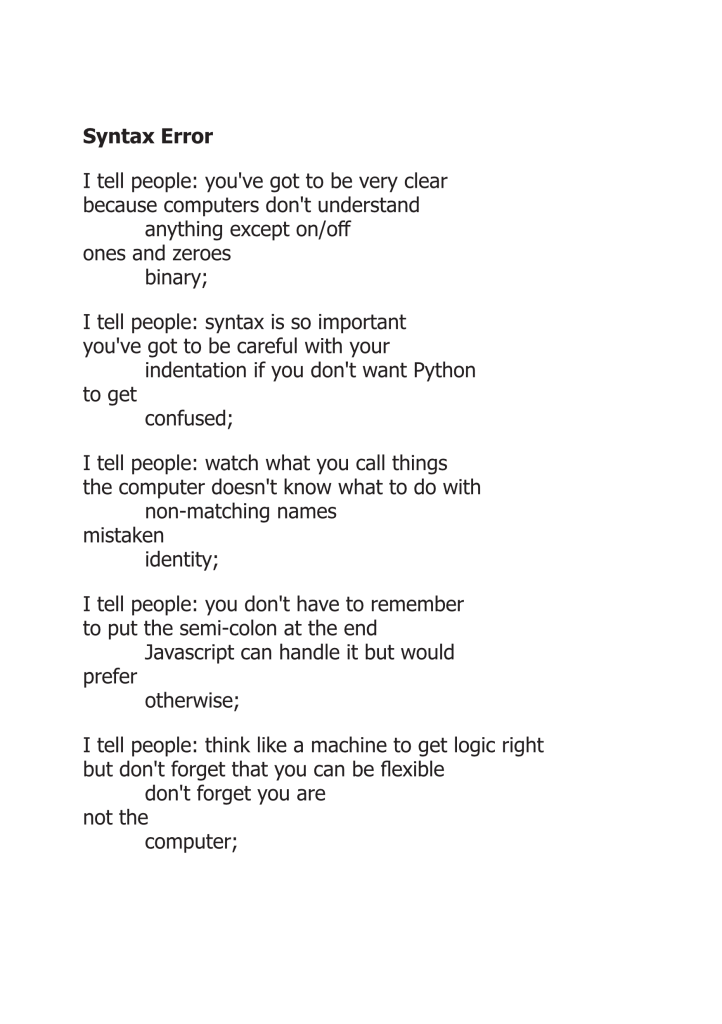
To finish up, here’s a little sneak preview of one of the poems:

Syntax Error

I tell people: you've got to be very clear because computers don't understand anything except on/off ones and zeroes binary;

I tell people: syntax is so important you've got to be careful with your indentation if you don't want Python to get confused;

I tell people: watch what you call things the computer doesn't know what to do with non-matching names mistaken identity;

I tell people: you don't have to remember to put the semi-colon at the end Javascript can handle it but would prefer otherwise;

I tell people: think like a machine to get logic right but don't forget that you can be flexible don't forget you are not the computer;

Learned By Heart by Emma Donoghue

Learned By Heart is a historical novel about Eliza Raine and her relationship with Anne Lister whilst they were both at school in York. As the daughter of a British father and Indian mother, Eliza stands out, boarding alone at school whilst her older sister is a day pupil. Her solitude is broken when a new student, Anne Lister, arrives at the school, throwing usual convention and routine out the window.

It isn’t surprising given the modern resurgence in interest in Anne Lister that Emma Donoghue has gone for writing a novel about some of her life, but it is interesting that the book takes a very different approach to the TV series Gentleman Jack by focusing not on Lister as the central character, but on Eliza. The book is from Eliza’s point of view as a schoolgirl, but is intercut with letters she is writing in adulthood, which is a nice way of bringing both the youthful love story and the reality of what happened to her later on without just making the narrative do a huge time jump. As I’ve already read a couple of books about Anne Lister, the plot was as expected, more about their deepening relationship than much actually happening, and the ending is quite quick, but the letter at the end rounds off the story. If it wasn’t based on a true story, there probably would’ve been more drama in the narrative, but most of the drama in this book comes from the gaps in the story afterwards, as told in part by the letters.

It is packed with detail and from Donoghue’s afterword, you can see the amount of research that went into it (as someone who lives in York and sometimes goes to King’s Manor for work, I did appreciate that it felt very accurate). I’m not a huge fan of historical fiction, but I appreciated that you didn’t feel like all the historical detail was piled on, and the afterword shows what was used in the narrative and where Donoghue focused on telling a story. The book is an exercise in imagining someone’s life who has far less documented detail than someone like Anne Lister, who wrote so much down and has therefore been written about and fictionalised a fair amount.

If you’re already interested in Anne Lister, this book is likely to be a fresh take on telling part of her story through the lens of another person. It is mostly a story about young love between outsiders, but also gives a glimpse into some of the whirlwind left behind Anne Lister. I found it well crafted, but as I’m not a huge historical fiction fan and I already knew what was going to happen, it didn’t quite grip me as it might others.

Sea Change by Gina Chung

Sea Change is a book about a woman who is stuck in a rut and friends with an octopus, but needs to try and change her life before she drifts away. Ro is in her thirties, works in an aquarium where she looks after an octopus who her now-disappeared dad discovered, and is struggling to deal with her boyfriend leaving her to go on a mission to Mars. She’s drinking too much and barely makes time for her childhood best friend, but when she finds out that the octopus, Dolores, is being bought by a rich guy, it becomes clear Ro can’t go on like this.

This is a book with a pretty weird premise—woman whose dad disappeared and ex-boyfriend left to go to Mars is friends with an octopus—but it tells a pretty down to earth story of someone hitting rock bottom and needing to change their life. Ro hides behind the past and the people who’ve left her or let her down, and the novel moves between the present and the past to explore the things that happened that have led her to this point. Though the novel doesn’t have a huge amount of plot, as this kind of narrative often doesn’t, and doesn’t resolve any of the big plot elements that run throughout, meaning that you can end up a bit ‘so what’ by the end, Ro is a gripping character and the unusual backdrop of the novel that is used to tell a story of a downward spiral brings something fresh to the book.

I chose to read Sea Change because of the weird sounding premise, and it does deliver on being partly about a friendship with an octopus. It’s easy to read and enjoyable, exploring a character needing to adapt to change, and though it could go deeper or have more going on, the sense of drifting through it does match up with Ro’s mental state in the book.

Bliss and Blunder by Victoria Gosling

Bliss & Blunder is a novel which retells Arthurian legend in a modern setting, placing Arthur as a tech company CEO and Gwen as his Instagram-famous wife, as a blackmailer and someone from the past both try and tear down Arthur’s empire by revealing hidden secrets. In the Wiltshire town of Abury, Arthur’s name is writ large, with his tech company and band of loyal men who work for him, but there’s secrets lingering, like what his wife has been doing, and why her childhood best friend Morgan hates both of them, and what to do with Arthur and Gwen’s wayward adoptive son, Mo. When Morgan returns to Abury, people are forced to revisit the past and things are about to get dramatic.

Bliss & Blunder is basically a modern AU (alternate universe) version of Arthurian legend, perhaps most recognisably Malory’s Le Morte D’Arthur. I’ve read (and written) a fair few classic literature modern retellings, and loved Malory as an undergrad, so I felt I needed to read this one and see what it does. In short, it does what it says on the tin: updates Arthur’s role to a modern tech CEO, rewrites many famous characters in various ways, and tries to find modern ways to explain some of the less straightforward elements of Arthurian legend (when I realised Gawain and the Green Knight was actually going to be a subplot, I was a bit impressed, as I’d assumed it would just be the pub name and that’s it).

The narrative moves between the present day of the story and the past, mostly the schooldays of Arthur, Gwen, and Morgan, but there’s plenty of the modern day story to move things forward. There’s a lot of characters, and in most other books that might be tricky to manage, but the thing is, because it’s based on something with so many characters (and a tendency to suddenly focus on one for a while), it does make sense, especially if you’re familiar with the source material. Arthur himself, though important to the plot, doesn’t really get as much of a focus as a character as Gwen and Morgan do, but generally the narrative has to move on characters pretty quickly to fit everything in (again, like in Malory, really, and that’s long enough). Morgan in particular gets a nice deep delve into her as a character, with a strong emotional core to what she’s doing and enough complexity to her feelings.

The actual plotline is pretty straightforward, following all the points you’d expect to tell a modernised version in which a tech company falls apart due to surveillance choices and treatment of employees and perhaps the most famous affair in literature is exposed (it can’t be a spoiler to say it’s Gwen and Lance, given that it’s both incredibly famous and in the book from the start). There’s fun subplots as well, bringing in other stories, but the story itself isn’t really what makes the book, as with most modern retellings, as you can tell that certain elements have to be used just to make it work. If you don’t know Arthurian legend, I don’t know what you might think of the plot, and the fact that some of the subplots can feel a bit random without knowing why that they’re based on (like Mo and Gal’s eventual plotline, and definitely Wayne’s).

The danger of a modern retelling is that people who know the source material will like some choices and dislike others. For me, I liked Galahad being a non-binary hacker who wasn’t actually treated that well at the company as it draws something interesting out about Galahad being different to the other knights from Malory (if anyone could be a token non-binary character, it’s probably Galahad), and I liked Mo, this book’s version of Mordred, and I liked how their plotlines came together. I enjoyed that Gwen and Lance’s relationship was translated into something still vital to them, but I also did wish we got more insight into Lance, and definitely into Lance and Wayne and the whole history between them, as that’s one of my favourite bits of Malory. The use of a tech company instead of knights of the round table is an obvious modern retelling option, but is actually fleshed out enough here that it works, and the use of conflict in Afghanistan as a backdrop for some of the characters having actual being soldiers was interesting, but I think both elements were more background that really explored in depth, especially the latter. A lot of this is probably because more of the focus is on the female characters, so you get more of Gwen and Morgan’s backstories than other parts that are more there to explain parts of the narrative.

On an almost side note, as someone who knows a lot more about Henry IV  than Arthurian legend generally, I was very confused when a character starting speaking Falstaff’s lines, and even more confused when said character turned out to actually be Falstaff. I mean, it’s fun, for sure, and the book is full of easter eggs for people who know Arthurian stuff so why not also a bit of Shakespeare, but also, it was a tad bewildering.

The ending is going to be predictable, not just because of it being a retelling but really so is the end of a lot of knightly romances anyway, and I liked the attempt to give an overview of what happens to most characters, given how many there are of them. Overall, Bliss & Blunder has the wide ranging genre elements and characters of medieval romance, and the obvious modernisations of a retelling. Because a lot of the retelling choices felt like well-written fanfiction to me, I did find that at times I missed having a central character or relationship that was the focus, even though you don’t get that with plenty of versions of Arthurian legend (Malory definitely not) but by the end, I do think it managed to pull together the many different threads in a way that felt purposeful, whilst still leaving people wondering a bit what happens next.

There are some books you cannot write a short review for. I’m not a medievalist, but as a non-binary fan of Malory who has done modern retellings of Henry IV and talks about tech companies and privacy at work, this was a book I had to read, and it certainly brings the fun, romp-like element of Arthurian legend into the modern day. Not everything in the book satisfied and there were parts of the modernised stuff that felt like they needed a bit more exploration of the implications (at times I wished it were grittier, but that’s my tastes), but also you’ve got to appreciate a book that tries to pack in so much Arthurian legend into a modern version. It makes me long to get my scribbled-in copy of Le Morte D’Arthur back out.

Open Throat by Henry Hoke

Open Throat is a short novel in which a queer mountain lion living in the Hollywood hills attempts to understand their own self and the humans around them. The lion roams the hills, not hurting humans, but trying to protect those in a homeless camp and not scare the hikers who don’t even see the lion mostly. But wilderness fires are a constant threat and when the lion is driven further into LA, a new friendship will change how the lion interacts with humans forever.

I heard saw this book raved about on a list of top LGBTQ books coming out in 2023, and the strange synopsis made me unsure if it would be great or impenetrable, but it turns out, it would be so good that it made me deeply invested in the perspective of a fictional lion grappling with selfhood and knowledge. So many of the lion’s thoughts as they react to what people say and do have such quiet sadness, and the almost stream-of-consciousness style works very well to suggest fluidity and playfulness in a book that is somehow both satirical and heartbreaking, with a strangely real sense of life on the margins, trying to find a place for yourself (even when you are a lion and that place is LA).

Both a commentary on modern society and a fresh way of exploring queerness and self, Open Throat is a book that is notable for the concept, but memorable for the way in which the lion becomes such a real character, and through such witty, poetic writing. A book I’ll find myself trying to recommend to people even when the summary sounds weird.

Pet by Catherine Chidgey

Pet is a novel about a charismatic teacher who holds a grip over a class, and what happens when things start to go wrong. Justine wants to be Mrs Price’s pet, as do the rest of her class, including her best friend Amy. They all want to be allowed to do little errands for their teacher and feel the warmth of her gaze, rather than her unfair dislike. When Justine gets her wish and finds herself centre of attention, she’s thrilled, but when a thief strikes the class over and over again, things start to get murkier, and Justine is pulled between loyalties.

The narrative is split between the 1980s, when Justine was 12, and her as an adult, dealing with a ghost from the past. The book doesn’t feel the need to fill in every gap using this split narrative, like some books do, and it works as a way of having a more grown up perspective on something that happened to a 12 year old. The story itself is a classic tale of childhood betrayal by an adult who seemed too good, and it’s easy to see this coming throughout the book, from Mrs Price’s unfair favouritism and purposeful divisive actions to more dramatic elements later on. The twists tend to be quite obvious, but this seems like it is to show what a child would miss whereas an adult might notice if not taken in by the charisma of the teacher.

I’ve not read many books from New Zealand and this one explores some themes in the background, like racism and the influence of Catholicism, to paint a picture of 1980s Wellington in terms of social attitudes. Written in a straightforward style, it is readable and gripping, with a few elements that aren’t fully formed (like Justine’s epilepsy which is a plot device and only ever treated as one).

Chain-Gang All-Stars by Nana Kwame Adjei-Brenyah

Chain-Gang All-Stars is a brutal novel about incarceration, in an America where prisoners can elect to be part of a blood sport where they fight for the death with the hope of freedom. Loretta Thurwar is an icon, having almost survived three years of deathly gladiator matches as a Link, an individual fighter as part of a Chain of others, alongside her love Hamara Stacker, aka Hurricane Staxx. Both hide secrets as they move towards Thurwar’s final fights, and meanwhile, a movement to stop the blood sport is trying to find traction.

There’s a lot packed into this novel, which uses a range of characters’ points of view to unfold the world of the narrative, a world both taken to extremes with the legal programme of prisoner gladiator death matches and not all that far away from the realities of the real life prison system and wider society, as footnotes throughout the book highlight with real facts and statistics. There’s plenty of the horror of the system, from the new methods of inflicting pain on prisoners to the ways in which every element of the Links’ lives is sold and televised as part of their agreement to be in the program. By combining many points of view, a lot of this detail can be organically shown throughout the book, rather than all the worldbuilding dumped at the start, and I appreciated this as it makes it much easier to get into the book.

The range of characters allow for a rich look into some of the nuances (I’ve seen other reviews calling everything too obvious or in your face, but for me there were plenty of small nuances), for example the experiences of two new Links being recruited into the program after torture at the prisons they were at, and the range of reasons why characters were imprisoned for so long in the first place. The book uses this to offer the reader ways in to thinking about abolition and restorative justice, and the fact that individuals do not have all the answers to this. At the same time, you get to see viewers of the show, both of the matches and the reality TV-esque parts which just follow the Links around in their Chain in between fights, and consider why people see it as okay to watch such content.

The doomed love story between Thurwar and Staxx is another crucial element, providing a heart-wrenching ending and a story that will draw in people who may otherwise find the book too brutal. You don’t always see a huge amount of them together, but what you do see is the ways in which their relationship is bound by their circumstances and how those who run the Criminal Action Penal Entertainment programme use and profit from their queerness as well as their strength as fighters. There’s also, unsurprisingly given that the book is about incarceration, a lot around race and who is imprisoned, and tensions that exist when people lack freedom.

There’s a lot to take in with Chain-Gang All-Stars, with a lot of perspectives and a long build up to its final confrontations, but it manages to be a powerful book that hurts on a character and a structural level. Being a high concept and brutal book, it won’t be for everyone, but I appreciated how it wove together so much and still had an atmospheric final moment as an ending.

The Unfortunates by J K Chukwu

The Unfortunates is a darkly comic novel exploring the mental health of a Black student at a top American college. The narrator is Sahara, a Black woman with depression (her Life Partner, or LP) studying at a top University. She doesn’t want to disappoint her parents, who wish she would become a doctor instead of maybe majoring in English Literature, or her Ride Or Die best friend, or the woman she has a crush on, but her depression controls so much of her experiences, and soon things are spiralling out of control.

Written as if it was a university final project and incorporating visual art and surreal pieces interjected into the text, this is a distinctive novel with a memorable voice. Sahara uses acronyms to refer to everyone, apparently to anonymise the text as it is being submitted as a project, and there’s footnotes throughout, and all of these elements work together to make it really feel like a hybrid text created by someone trying to document their complex experiences not just with depression, but also with being a Black queer woman at a US college and not being how people expect her to be. The book is powerful and sad, but also witty, carefully balances to make what are very heavy topics (suicidal ideation features heavily in this book, which is worth being aware of before reading) have cutting commentary and even funny moments.

I wasn’t sure where the book would go and it almost felt inevitable, but I think that the narrative is carefully handled, making Sahara’s experiences seem realistic but also probing the depression-fuelled idea that there’s no support out there. Some of the real ridiculousnesses of university and especially in the way that elite institutions deal with tragedy and injustice are very pointedly depicted and The Unfortunates really shows that the dark side of academia many people experience isn’t some “dark academic” plot, but mundane inequalities, unfairness, and bigotry.

People need to go into this book knowing that it is a deep look at depression, self-harm, and suicidal ideation, because that won’t be something everyone can just pick up and read, but when you do read it, it is a powerful exploration of mental health and race at a US college with a creative style and structure. I felt like it refreshed the idea of what a campus novel could be, especially one posing as an assignment, and how you can intertwine personal experiences with structural problems.

Corey Fah Does Social Mobility by Isabel Waidner

Corey Fah Does Social Mobility is an experimental novel, very much in Waidner’s typical style, which explores writing, cultural capital and social mobility, trying to balance things in your life, reality TV, and an eight legged horror a bit like Bambi. Corey Fah has won a literary prize, but is unable to collect the trophy, because it keeps flying away. Corey’s partner Drew just wants to watch their usual favourite daytime TV show, but it turns out the host has links to the strange occurrences when Corey tries to get the trophy, and it seems that winning was only the start of Corey’s problems.

I loved Waidner’s previous novels, We Are Made Of Diamond Stuff and Sterling Karat Gold, and I might’ve enjoyed this one even more, in which they manage to combine dreamlike, surreal happenings and a horror-style version of Bambi with a sharp attack on class and culture, borders and identities. The book also provides a sweet domestic love story at its heart and an exciting detour into an alternate history for Joe Orton, amongst other things. There’s so much stuff packed in, but there’s only a few main references to understand, making it accessible for a book that takes its source material so playfully. 

This is a book that is delightful to read, cutting yet funny, and also bittersweet, especially for anyone who has dreamed of achieving things that feel far too out of reach. The experimental and surreal style blends the political and domestic with so many little details that cut into the binaries and boundaries we encounter. I just love how Waidner’s books seem to enact a kind of non-binary poetics in which boundaries are there for disrupting and gender, like many other facets of identity, is there for people to do with what they will, in a revolutionary way. An exciting book, but also a strangely sweet story of trying to find your way even when the prize literally seems trapped by Kafkaesque rules.

Silver Nitrate by Silvia Moreno-Garcia

Silver Nitrate is a novel about occultism and movies, as two friends face off the magic of a strange film. Montserrat is a sound editor in Mexico City in the 90s, fighting for shifts from people who disregard her as a woman, and spending time with her best friend Tristán, a faded soap actor. When Tristán meets aging cult horror director Abel Urueta, Monserrat and Tristán are drawn into the story of a Nazi occultist who made a film with Urueta using silver nitrate film to try and capture magic, and soon it seems that magic is back and threatening them.

Pretty different from Mexican Gothic but still imbued with objects and ideas holding magic and horror, this novel starts slowly, building up the world of the two protagonists and their relationship and struggles. The threat is a slow burn one, as they start to believe in magic and ghosts thanks to darkness following them, but by the end there’s dramatic action. Moreno-Garcia explores ideas both of the film world and of the Nazi obsession with the occult, and how magic might be used by people who believe in hierarchy and oppression of those not “worthy” by weaving it into real life fascism, and this gives the book an unsettling feel.

A real highlight of the book for me was the relationship between Montserrat and Tristán and the way their individual characters are built up, with their childhood friendship and Montserrat having been in love with Tristán for a long time but having always pushed it away. The details in the ways in which they care for each other whilst also knowing each other too well gave the book a rich sense of character, and the fact they were tied to each other was crucial to the narrative. I also liked the fact that both of them were bisexual and it was just another thing about them, explored slightly in Tristán’s case from the perspective of being a soap star who had to appear to be straight.

This is a slow burn book that creates a rich world of horror films, dark magic, and two outsiders drawn into something beyond their control. Maybe ironically it might make a good film, though hopefully not one with magic burnt into it.