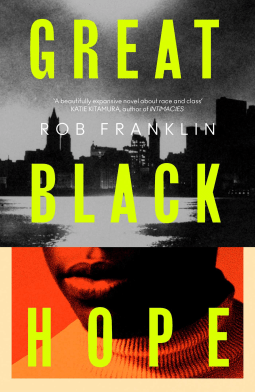
Great Black Hope by Rob Franklin

Great Black Hope is a novel about a well-off Black man living in New York City who is arrested for possessing cocaine in the aftermath of his roommate’s death. Smith is always looking for the next party, previously with his friend Elle whose recent death has shocked him and their circle of friends and acquaintances. When he’s arrested in the Hamptons, he suddenly sees a different side to the system, as well as the position he holds as a Black man who is also a graduate and from a well-off family.

This book dives deep into the world of the protagonist, Smith, and his life as a young queer Black man in New York City, surrounded by the potential for downward spiral amongst the great expectations for his life, and others living in similar circumstances. At a simple level, it explores race and class, and how they both impact each other when it comes to how people are treated and exist in the world. There’s also New York City nightlife and the stark reality of the court system in the US, there’s addiction and sobriety and what we do and don’t do for our friends. I liked how Franklin builds up this picture of Smith’s social circle, feeling like an updated version of 80s and 90s stories centred around New York City parties and restaurants, but also people and communities outside of this, and how Smith’s world in New York is only one snapshot. 

There’s not that much of a narrative to this book, despite elements of mystery and investigations, and it feels far more focused on character and vibe, which is does well. Great Black Hope is an updated version of the New York City party novel, in which intersections of race and class are explored to consider who can progress up and who can be in a downward spiral.

Immaculate Conception by Ling Ling Huang

Immaculate Conception is a novel about envy, connection, and art, as two friends end up with a new way to share traumatic experiences. Enka is an art student looking for original ideas, and Mathilde is the bright star in the class, already with art world buzz around her. They become close friends, but as Mathilde gets more famous and Enka falls behind thanks to an AI tool disrupting their art school’s work, their friendship feels different to Enka, more desperate. And then, as she marries and has access to her billionaire husband’s company and their futuristic technology, there’s a way for Enka to inhabit Mathilde’s mind, absorbing her trauma but also creating work as her.

The follow-up to Natural Beauty, Immaculate Conception is a novel similarly weaving together horror with dystopian technological elements and ideas about humanity and self, but this time, Huang focuses on the art world and what authorship and originality mean. The novel is told in different sections, with the first section moving between the past and present, and it actually spans longer than I expected, not telling the reader everything (especially as it is from Enka’s perspective). 

There’s a lot of technological ideas in there, not only the mind-sharing technology that forms some of the main plot and also ideas about cloning, but also the AI art generator that is the catalyst for a lot of Enka’s feelings and desperation. I like how Huang takes ideas about AI art and uses these to think about the human side, particularly in terms of artists looking to find work that still has value and the messy feelings of jealousy when someone else has that. Generally, this focus on the impact on individual characters of the technology in the novel makes it feel more than a story about dystopian technological change, and that makes it more engaging in my opinion.

Though the book has been described as horror, it much less horror-like than Huang’s previous novel Natural Beauty, and is more of a sci-fi-tinged exploration of art and envy that doesn’t go as dark as Natural Beauty. I like how it addresses AI generation and human-technology integration whilst also telling a story about a woman making questionable choices due to her own insecurities and fears.

Carnivore by K. Anis Ahmed

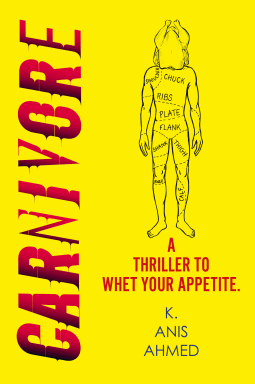
Carnivore is a book about a desperate plot by a New York restauranteur to make the money he owes, by catering for an elite dining club looking for something unprecedented. Kash’s exotic meat restaurant caused him to become embroiled with loan shark Boris and now Kash needs to pay up. When he has the chance to impress uber rich Victor, who happens to be part of a secret billionaire dining club, Kash formulates a plan to offer Victor something to impress his billionaire club, taking gruesome inspiration.

This thriller isn’t for the squeamish, but for those who aren’t, it’s a fun take on the ‘character in debt has to go to extreme lengths to escape a loan shark’ story that also plays with ideas of fine dining and the New York restaurant scene. Despite being a thriller, the book has a fairly slow pace, with a lot of flashbacks to Kash growing up in Bangladesh, and it explores the world of immigrants in the USA as well as the main thriller plotline. The ending is much faster, perhaps a bit too fast and without fully addressing all of the threat and tension that came before, but regardless it does follow through on what it sets up as the main narrative. One interesting point is that, in my (vegetarian) opinion, the descriptions of the meat aren’t quite as luscious and visceral as some other novels centred around food, which means the reader isn’t quite as drawn into the meal and its “unprecedented” conclusion (which may be a good or a bad thing).

I had fun with this novel, which you can easily imagine adapted into a film, and the current interest in media around restaurants and high end food hopefully means that the right audience will find it. If you like crime thrillers that are a bit deeper and with a satirical side, Carnivore is an enjoyable ride.

Sunstruck by William Rayfet Hunter

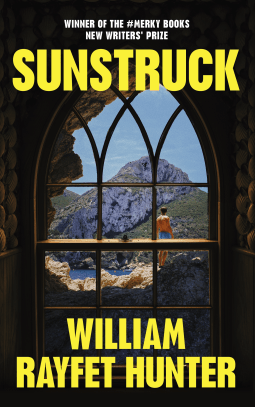
Sunstruck is a novel about class, race, and power, as a young man enters the world of a privileged family. Our unnamed narrator, of mixed White British and Black Caribbean heritage, goes to stay in France with his White friend from university, Lily, and her family, including her enticing brother Felix. Whilst there, he grows closer to Felix, and his desire seems to be reciprocated, as the family gears up for a big party. And then, months later in London, he tries to navigate his new relationship with Felix and with others in his life, pulled in different directions and by different allegiances.

This debut novel takes the ‘outsider enters the world of a privileged family’ novel and explores some of the power dynamics within it, particularly around race and sexuality as well as money and connections. The first half of the novel is set in a big French house where the unnamed narrator visits the family, and contains a lot of what you’d expect: simmering desire, secrets, and the narrator not necessarily understanding everything going on. Then, the book suddenly moves to part two, which is set in London and follows him as he and Felix navigate having a half-secret relationship with increasing arguments and tension. Alongside this, there’s his increasingly ill grandmother back in Bury and feeling torn between one White posh family and his Black friends and their activism and art. 

There’s a lot packed in—there’s also a Black Conservative MP who keeps popping up, the narrator’s childhood with a mentally ill mother, and the side characters all have plotlines as well—making it feel rich and varied, though a few elements don’t necessarily get enough space (for example, there’s multiple examples of the narrator not being able to support people after sexual assault and not knowing what to do, which could’ve been explored a bit more). Overall, this is a gripping novel perfect if you enjoy this kind of ‘outsider in a privileged world’ story.

Vanishing World by Sayaka Murata

Vanishing World is the new novel by Sayaka Murata, exploring a world in which family, love, sex, and parenting have changed. Amane grows up feeling like an outsider because her parents actually fell in love and conceived her, rather than everyone else who were conceived by artificial insemination and brought up by parents in “clean” marriages that made them a family. Romantic love is for outside of the family, either with real life people or fictional characters, and sex becomes less and less common. Amane grows up, has both real life and character lovers, and finds a husband in the societally acceptable way, but then her husband wants to move to Experiment City, where they are trialling a new utopian idea where all children are raised equally and people are inseminated simultaneously, so that he might carry a child using a new artificial womb.

After Earthlings, it isn’t surprising that this book is weird, pushing different ideas about love, sex, and family to various limits to explore convention and how easily things can change. The story itself is simple, following Amane as she grows up, tests what love and sex mean to her, and then ultimately ends up in Experiment City seeing a very different version of society. There’s a lot of interesting things about the world Murata has created (indeed, both worlds), from the obsession with the heterosexual nuclear family and the “uncleanliness” of sex going hand in hand in the ordinary world to the extreme off getting rid of family as well, but still revering the idea of bearing children. Fears about birth rates mix with conservative ideas around sex, showing how these things come into conflict even in a space in which people want to believe both, and generally this book feels like it might read quite different in and outside of Japan.

I’d say the start and the end are perhaps most impactful, and also the parts most likely to put people off, with the middle being slower and more conventional. Like with Earthlings, the ending ramps up the weirdness, pushing some its ideas to the limits whilst not coming to any kinds of conclusions. Vanishing World is the sort of book that throws a lot of ideas at you, and I think for some people those ideas might unsettle, for others they won’t really go far enough to say anything, and then there’s people who already live outside of some of the conventions explored through these ideas, for whom it can feel like a quaint novelty (such as queer people, who are explicitly not part of the world of the novel in which marriage still must be between a man and a woman even when artificial insemination is the norm). The novel itself was a gripping read, but I think ideas-wise it sometimes gets lost, almost encouraging people to have the kinds of disgust that also seem to be satirised through the characters.

Summer Rolls by Tuyen Do

Summer Rolls is a novel about family and cultures, as a British-Vietnamese girl battles with her mother who left Vietnam for her children. Mai lives in London and as a teenager in the 90s, she feels that she isn’t allowed the same freedom as everyone else in her class, with her mother’s strict rules and idolisation of her older brother who just graduated from university. But her mother, Trinh, hasn’t had a simple life, and secrets from the past resurface as they try to find a way to understand each other.

This novel is told in two parallel narratives, one in the 90s and early 2000s in London and the other in Vietnam over two decades, unfolding the stories of Mai and Trinh and what freedom, love, and family have meant to them. The style really draws you in, immediate and with enough untranslated Vietnamese in dialogue to get across the importance of culture and language in the novel. The blurb compares the book to Pachinko, but it is much less epic in scope than that novel, and more focused on two main characters and those close to them.

I enjoyed Summer Rolls and its powerful exploration of a mother-daughter relationship caught across countries and time. I do think the UK cover does the book a bit of a disservice, looking more like a YA novel or something without the depth of Summer Rolls, but it is nice artwork.

Love in Exile by Shon Faye

Love in Exile is a memoir about love and an exploration of types of love in modern society, centred around Shon Faye’s own experiences not just of love and sex, but also ideas of motherhood, addiction, friendship, and religious love. Taking the idea that love “in exile”, for those not in the mainstream of love, might give space to consider love far more broadly, she describes her own experiences and combines them with sociological and historical thought to explore the topic in chapters that function like mini essays.

I think a lot of people will come to this one on the back of Faye’s powerful previous book, The Transgender Issue, and it offers something quite different, with its themes focused on areas of her own experience. This means that it has some really great bits exploring what it means to be a trans woman attracted to men and the state of modern dating for women who are into men, and it feels in conversation with other recent books on the latter, bringing important trans and queer thoughts into that conversation. As someone for whom these conversations around modern heterosexual dating aren’t relevant, I enjoyed Faye’s insight, but it was probably less impactful for me than it would be for women dating men.

Other chapters broadened ideas of love and how love interacts with other elements of life too, like addiction. The chapter on friendship looked at the position of friendship in society and how this can differ between queer and non-queer people, offering a good space for everyone to reflect on their own friendships and how they treat these in their lives. Due to the fact Love in Exile is a combination of memoir and more of an essay style, there’s always going to be gaps or areas that could’ve been covered or mentioned (any kind of dating beyond heterosexual, polyamory, etc), but Faye’s perspective on the areas she covers is witty and interesting. 

Sky Daddy by Kate Folk

Sky Daddy is a novel about a woman who wants to ‘marry’ a plane by dying in a plane crash, and what happens as she tries to achieve her apparent destiny. Linda works as a content moderator, ensuring comments adhere to a tech company’s terms and conditions, but once a month she takes a flight somewhere, to be with her true love: planes. When her only friend, co-worker Karina, invites her to vision board brunch, Linda has to find a way to hide the fact she’s attracted to planes and wants to die in a plane crash but still create a vision board that represents this, and as her life starts to be changed, she has to decide whether to follow her true dream or not.

This is the sort of book that you feel you need to read, because the concept is so weird, but then you actually read it and it is actually quite sweet and explores what it means to live the way you want and have meaningful connections with others. In particular, it has an underlying exploration of friendship between unlikely friends, and what it means to be there for someone. However, it does also live up to the weird, not shying away from Linda’s attraction to planes and the fact she believes that she will find her soulmate, a plane in which to die.

I had a great time reading Sky Daddy: it’s fun, it’s occasionally sly and funny, and it takes something pretty weird at face value. It sits alongside other recent novels that take a weird concept and actually do something both fun and tender with it, without taking themselves too seriously.

I Leave It Up To You by Jinwoo Chong

I Leave It Up to You is a novel about a man who wakes up from a coma and returns to working in his estranged family’s sushi restaurant, finding family and love along the way. Jack Jr was in a coma for two years, during which a global pandemic happened, his parents got older, his little nephew became a teenager, and his family’s restaurant struggled. When he wakes up unexpectedly, he has to rebuild his life from scratch, with his job long gone, his soon-to-be-husband now married to someone else, and his only place to sleep being his childhood bedroom. With bonds to heal, a restaurant to fall back in love with, and a new love interest to get to know, Jack Jr has a lot to deal with.

I’ve wanted to read Jinwoo Chong’s previous book for a while now and not had the chance, so when I saw this one available on Netgalley, I needed to read it. This book is filled with a lot of heart and is your classic romcom setup of a character having to return to their hometown in order to rediscover what makes them happy, only with the twist that it is due to a two year long coma. Though the book is somewhat of a romcom (with some ridiculous elements like a video suddenly going viral on TikTok), it is really most about various characters feeling able to go after their passions, and how family can be complicated. I saw it described as ‘messy’, which is such a compliment in this case: both the protagonist and the supporting characters have a lot going on and it all comes together to show that you make the best of things.

If you’re looking for a queer version of the kind of romcom about returning home to rebuild your life, then I Leave It Up to You is a fun, heartwarming take on that story that has more of a focus on the protagonist and all of his relationships than just on romance.

North American Lake Monsters by Nathan Ballingrud


North American Lake Monsters is a short story collection exploring different kinds of monsters, human and otherwise, and the messy realities of these. There’s a real range of stories in the collection and you’re always guessing what kind of horror, whether creature or psychological or something else, is going to appear in each one. There’s a lot about class in America and the impacts of desperation in relation to class, wealth, and worth, and I particularly like how this plays out in the titular story, which explores how we see different kinds of monsters and the importance of viewpoint. I also like how often any supernatural or otherworldly elements feel almost secondary in relevance to the working class lives in the book, with other people having a more important role in their stories and the horror within. If you like literary-tinged horror that shines a light on working class America, then this collection will be ideal.