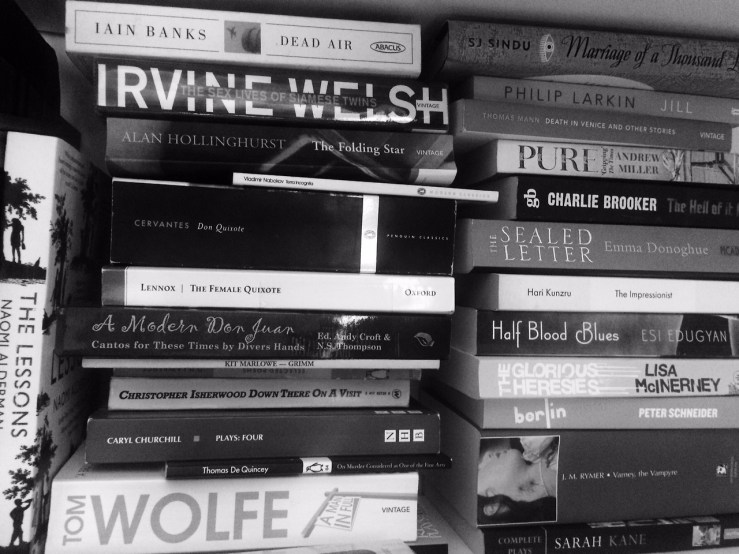
Scariest Stories

Fear is pretty subjective. Obviously. Some people laugh at horror films and others scream. Around Halloween, there’s often lists of the scariest films/TV/books ever, but it’s impossible to agree with all of them. Is Kubrick’s film of The Shining a masterclass of tense, slow horror or a dated relic lacking in terror? Zombie flicks—scary or ridiculous (or Shaun of the Dead)?

This isn’t about books, you say. I know. My point is, this is all subjective. Books are maybe even more so because it is up to the individual to picture the scares, to be drawn in and see them as more than words (I hope that hasn’t derailed you into thinking about the Extreme song). So when I talk about books I’ve found scary, I know it won’t be the same for anyone else.

The book I remember finding most scary is a Point Horror novel called Fright Train. It was from the ‘Unleashed’ range, which I think was meant to be more intense in some way (I’ve talked a bit about my love for Point Horror before). In Fright Train, a couple got on a train only to find their fellow passengers acting weird and the conductor terrifyingly rude. It turns out (spoilers, in case you really fancy trying to track down a secondhand copy) they’re on a train to Hell, incorrectly. A different couple were meant to get on that carriage instead of them. Their fellow passengers all have horrible recollections of whatever it was that got them on the train to Hell and our heroes try and convince the devilish conductor they should leave.

Doesn’t sound that scary, I know, but there was something about it that caught my imagination aged about ten or eleven. Maybe the combination of scary devil stuff, people who had actually done bad things, and the injustice of it all. Whatever it was, it threw the Goosebumps story about the Halloween mask you can’t get off seem like a fun trip to the park (Google tells me this is The Haunted Mask).

I have to admit, I don’t think I’ve read anything since that has made me personally feel scared in the same way. I think Cujo is probably the scariest Stephen King read for me, for the tension, and there’s definitely a horrifying factor to some of the stories in Chuck Palahniuk’s Haunted (one about a swimming pool drain sticks in my head), but it’s not the same. Maybe it’s because I don’t read much horror any more, or I became too immune, or because it is so dependent on time and place of the reading experience as well.

Maybe you think the scariest stories now are the dystopian fiction that feels like it is coming true. Maybe it’s still the horror genre, which can be tense and the fear believable even when it is otherworldly. Maybe nothing is scarier than real life. Regardless, pick up one of your favourite creepy books this Halloween (unless you opted for the last option there, then sorry).

Living That Library Life

It being Libraries Week at the moment and me having just left one job in a public library and started another in a university library, it felt like a good time to write something about libraries. People can be surprised that they are not just silent book-centred spaces any more, but places focused on information in many formats and often connected to various IT and wellbeing services. They are where individuals come to find out things, read books for free, and do a whole lot more besides. I had someone ask me on a boiling hot day whether the temperature recorded by the Met Office was in the shade or not (I didn’t know). For some people, libraries are like Google, except better at interpreting your search terms and more happy to accept tea and biscuits.

I liked libraries as a kid (except for the traumatic time I left my favourite soft toy in one overnight). I could take out a pile of books, put them into a specific order, read them as quickly as possible, and then go back for more. I begged my mum to let me use slots on her card to take out Young Adult books before I was old enough, and then when I was old enough I’d read most of what our village library could offer me in the way of Point Horror and teen fiction (this was before the huge amount of YA books available now, so everything was American teen horror or British groups of teen girl friends).

A bit older, I used the adult fiction section to discover all the things thrilling to 15 and 16 year olds—A Clockwork Orange, Lolita, basically anything from Penguin Modern Classics in fact—and then supplemented my A level English Lit by reading books I’d heard of or that looked exciting. This experimentation was possible thanks to being able to take out the books for free. One of the great joys of borrowing from libraries is it not mattering if you don’t enjoy the book because you didn’t pay for it and can just take it back.

Having frequented public libraries with my friends at sixth form to revise whilst imagining it was like we were proper students, it was exciting to finally get to use university libraries too. At both places I studied I had access to multiple libraries including a legal deposit library in both cases, so I was pretty spoilt in terms of accessing books. Probably my favourite academic library experience was reading bits of The Romance of the Rose (a medieval French dream poem, in translation) and then all of Glenarvon (Caroline Lamb’s ‘Byron is a vampire’ gothic novel) holed up in a corner of the Gladstone Link, which is a space-age underground bit of the Bodleian in Oxford made up of rolling stacks and the awareness that in the instance of a fire, you get locked in.

Working in a library tends to involve a bit less of the books than using one does. There’s a lot of giving IT support and knowing your way around Microsoft Office, answering queries relating to the building/local area/other services and reassuring people that no, just because you found the book where they didn’t doesn’t make them stupid, only not paid to know how to find the books. It’s interesting because days don’t end up the same, humans are infinitely varied and their ability to ask completely left field things is very impressive sometimes.

I didn’t plan to work in libraries. It came out of the thought that I could be around books all the time, which would surely go nicely with my hobbies of reading, writing, and keeping this blog. Other parts of the job—particularly helping with IT stuff—ended up very satisfying and a great way to keep learning and improving skills (not to sound like my CV). Libraries have a real place within the modern world, whether local libraries or university ones, as a place where books, technology, and information can all work together, and they should be inviting and accessible to all. Also, you get to eat a lot of biscuits if you work in one.

Poetry and me: a love/hate story

Lots of people love poetry. Lots of people hate poetry. It’s something you’re forced to read (and often try and write) at school and something that might not seem to come up often after that, except in greetings cards. Poetry is great, but it is also about finding the poems that work for you. Whilst it can be argued that almost anything with words can be poetry (as my undergrad English class tried to do with the category ‘literature’ when made to investigate the term), even the writing more typically termed ‘poetry’ can vary a lot and, though it can be off-putting for many reasons, there’s a lot of different poems out there to try.

I used to think I couldn’t ‘do’ poetry. In secondary school, we studied poems and sometimes they made sense, sometimes they didn’t. People were often too busy chatting or messing around for real discussion of the poems, so it could be difficult to be taught how to approach them, and they weren’t always ones that might interested thirteen year olds.

At GCSE (aged 15-16) there was quite a lot of poetry to look at, all housed in a handy anthology that someone had ill-advisedly decorated with black and white pictures that we used to colour in instead of reading the poems. We went through some of them in more depth and there were definitely some I connected with (thanks Simon Armitage for writing a poem—‘Kid’—about Batman and Robin that I read post-The Dark Knight and therefore thought was great). However, these were short and usually quite simple to pick techniques out of. The older poetry was usually awkwardly thrown at us so nobody really understood the point of say, Browning’s ‘My Last Duchess’, other than having written ‘dramatic monologue’ at the top of the page at the teacher’s insistence.

By A level (aged 17-18), the English Lit class was much smaller, and there was more time to look at poetry. We did Carol Ann Duffy’s The World’s Wife and mostly it introduced me to the stories and myths she was retelling rather than give any poetic insight. We did the metaphysical poets and they were okay, but still, a headache. Too many conceits, really. By that point, maybe the teachers assumed we knew how to read metre, or there just wasn’t time to spend more than the time it took to remind us Shakespeare mostly wrote in iambic pentameter. I remember once being told about iambs and dactyls and mostly thinking it sounded like the dinosaurs I loved when I was five.

I did find, though not through school, the next poem that was ‘mine’, one that I loved the sound and meaning of and would attempt to analyse because somehow it felt like it made sense. This was ‘The Love Song of J. Alfred Prufrock’ by T. S. Eliot, quite an obvious choice, but at the time it felt like a revelation. All the line breaks and separate sentences were chunks I could follow and the huge ambiguity of the poem appealed to teenage me. I printed it off the internet and reread it a lot.

When I got to university to study English, though, I still felt poetry was something I just didn’t understand. It was too hard and nobody had showed me how to read it properly. Faced with a lot of poetry, I tried, I tried hard, but sometimes it was the week we did Gerard Manley Hopkins in our Victorians paper and I had to try and write an essay about political stuff in his work because I didn’t understand it enough to write about the poetic techniques he was using. At times it felt like it must have been going to a state school that had done it, that I’d not been taught how to ‘get’ poetry and was now paying by desperately clawing my way through tutorials about scansion in Victorian poetry.

Luckily, the Victorians didn’t last forever. In second year I discovered Elizabethan narrative poetry and Milton that wasn’t the hell bits of Paradise Lost and then, after the headache of Middle English,  we got to the Romantics and I picked up Byron’s ‘Childe Harold’s Pilgrimage’ and loved it and discovered Keats is worth his reputation. By finding poems that made my brain go ‘this is incredible’, I could believe I could read and understand them, and discuss them in essays and tutorials without everything being a hesitant guess.

Of course, it might not be the Romantics or Milton who help you realise some poetry is for you. It could be twentieth first century stuff with modern references, or poems that relate to your own identity and experiences, or lines that are spoken or sung not read. There’s a lot of options. And poetry might seem pretentious or irrelevant, but when you find the lines that speak to you, that make you go ‘oh, yes, that’s how to describe that’, it helps make poetry seem worthwhile. And after all my insistence I can’t do poetry, I now love reading it, write it with varying degrees of success, and have had a poem published (admittedly one about swearing). Poetry isn’t for everyone, but give it a chance.

Well-adapted

Book adaptations are not always a disappointment. Whilst plenty of fans complain about the misrepresentation or loss of their favourite character or the changing of major plot points or important themes, there are also the films and TV shows that do books justice, transforming them into a different format whilst keeping essential parts that make them good adaptations. Maybe they capture an notable narrator in some way, make changes or cut out unnecessary material that actually make it a better experience, or just faithfully capture a book in a new way. However these adaptations work, they form an extra way to enjoy your favourite books, or even make a book even better.

There are plenty of books that don’t work in certain adapted formats. The Harry Potter films have to cut out so much that without book knowledge they can be at times confusing or incomprehensible. I couldn’t make it further than one episode of the Wolf Hall TV series before I got before, despite enjoying both books. The Baz Luhrmann film of The Great Gatsby is fun, but it can’t quite match up to the book.

On the other hand, both Trainspotting and Filth show that adapting Irvine Welsh’s books can make very different yet still fantastic and dark films. Plenty of classic and hugely popular films and TV shows are based on books, though sometimes loosely. I’ve picked out a few where I think the adaptation has been particularly notable to me, and would be interested to know which book adaptations are most important to other people.

  • American Psycho – Bret Easton Ellis’ novel is an onslaught of brand names, restaurant reservations, and graphic violence and sex. The film version pares this down into an unnerving vision of a psychopathic killer hidden in yuppie culture, talking over the action and dancing around the room to Huey Lewis and the News.
  • The Shining – Even though I was a fan of Stephen King, I didn’t actually read the book until after I’d seen Kubrick’s film. The psychological tension of following Danny around the Overlook Hotel can’t quite be matched by the novel, which differs in some major ways.
  • A Single Man – Tom Ford’s film of Christopher Isherwood’s novel somehow takes the breathtaking prose style and uses a visual beauty to get across a different, but somehow recognisably similar too, take on how the story is told. The ending differs too, but it is a case where both the book and the film feel valid in their own right.
  • Fight Club – One of the most famous cases of the adaptation surpassing the fame of the book, Fight Club has contributed to the cultural zeitgeist in a way that angers its author Chuck Palahniuk and allowed plenty of people to misunderstand and misrepresent its ideas of toxic masculinity and violence. Regardless, the film is incredibly good, with a great soundtrack and cinematography that gets across its twist and the bizarre perspective of its messed-up protagonist.

Fiction about Christopher Marlowe: the drinking game

  • Drink every time they get in an unsubtle use of the ‘tobacco and boys’ comment.
  • In fact, drink whenever a line is clearly using the Baines note as its source.
  • Drink every time he is referred to or refers to himself as one of his characters. Drink again if he quotes his own lines (or paraphrases for no apparent reason).
  • Drink every time ‘Ganymede’ is mentioned (this rule stands for his actual works too).
  • Drink every time one of the Toms is mentioned—Watson, Walsingham, Kyd, Nashe, etc—and finish your drink if this is turned into some kind of tom cat/Kit pun.
  • Drink whenever Shakespeare comes up in some overly casual way. Finish your drink if it is to call him a countryside yokel or an upstart.
  • On the flip side, if the thing is about Shakespeare and Marlowe is a side character, drink whenever Marlowe is in a scene or is implied to be a friendly rival to spur Will on and then die to get out of his way. Consume everything within reach if Kit is solely there to make flirtatious comments and talk about Hell.

Boy Wizard: an ode to Harry Potter

To celebrate the 20th anniversary of the UK publication of Harry Potter and the Philosopher’s Stone, I could make a recommendation list of books I feel are similar. However, I can’t. Partly because even as a child when I first read the books, I didn’t really like much fantasy and the main book I loved that also had mystery and magic was Terry Pratchett’s The Amazing Maurice and His Educated Rodents. And partly because it is very difficult to compare the phenomenon that is Harry Potter with any single book or other book series (maybe Lord of the Rings, but as is well-documented on this blog, I am not a fan).

Many people will have a Harry Potter story relating to the books and/or the films, even if that story is about how they refused to pick one up at all. Particularly with people around my age—I read the first four aged seven and then waited what seemed like forever for the fifth to come out—Harry Potter has been constantly there for a long time. There’s plenty that has been said about all this on the internet so I’m not going to add my own thoughts right now. Instead, I’ve gone for the slightly stranger approach of including a very rough poem I wrote about part of my own Harry Potter experience (please share your own experiences, whether they be in poetry or not!).

‘Lyrical Ballads’: books and music

“Would put me up on the bookshelf / With the books, and the plants?”

Adam Ant, ‘Desperate But Not Serious’

Books and music are two of my favourite things, but that’s not my whole excuse for writing about them together today. The Adam Ant lines above were the first thing that came into my head when I thought of books and songs which likely says more about the inside of my brain than their connection. Nevertheless, books and music are definitely connected.

The obvious starting point is how they’ve influenced each other. From the most famous songs influenced by books (e.g. Kate Bush’s ‘Wuthering Heights’, the reason many people know the plot, or Dire Straits’ ‘Romeo and Juliet’) to the lyrics and titles that make slightly less obvious connections (I was a proud teenager when I understood the very obvious reference in the title of Green Day’s ‘Who Wrote Holden Caulfield’, only slightly more understandable because I’m not American), there’s plenty of music that mentions or is influenced by books. And the other way round isn’t lacking either, with book titles (Coupland’s Girlfriend In A Coma comes to my mind because I’m a Smiths fan) and endless quotations and epigraphs proving authors often have music on the brain whilst writing.

Next is where my title comes in. Wordsworth and Coleridge’s 1798 book of poetry Lyrical Ballads may not be to everyone’s taste (I say as someone who somewhat agrees with Byron’s use of ‘Turdsworth’), but it’s a pretty obvious reminder of something pointed out to my class at undergrad: poetry and music are connected. Plenty of poems have been turned into music (sticking with the Romantics, Blake’s ‘And did those feet in ancient time’ is perhaps the most famous example, better known as the anthem ‘Jerusalem’). Bob Dylan won the Nobel Prize for Literature, somewhat controversially. It is difficult, especially when being pressed by an Oxford tutor who wants you to admit it could be arbitrary, to explain the difference satisfactorily.

And finally, my real excuse for writing about books and music being connected. I think that they can create the same sense of nostalgia, the same knowledge of where you were when you read/first listened to/reread/listened excessively to them. I can tell you that The Secret History is what I read whilst also trying (and succeeding, I must show off and say) to read Richardson’s 1500 page Clarissa in my second year of undergrad, that The Libertines are the band that means moving to Holloway Road and walking the same locations mentioned in the songs, that I reread Order of the Phoenix on a trampoline whilst waiting for the day of the Half-Blood Prince release. To me, there’s nothing quite like books, songs, or bands for generating memories of a specific time and what I was doing then. And I love them both for it.

Confessions of a Reader #1: The Recommendation

I love getting book recommendations, don’t get me wrong. A large amount of the books I actually buy are recommendations from friends, people whose book habits and preferences I know well and trust. Sending a ‘thanks for the suggestion, I loved the book’ message to someone is very satisfying, not to mention the all-important continuing the chain by recommending it to somebody else (this is how everyone seems to read Hanya Yanagihara’s A Little Life, after being told ‘it’s devastating but it’s so good’).

The problem is, sometimes people will not stop recommending you something you do not want to read. A genre you don’t like or a book you gave up on the first page of. Something with an insufferable first-person narrator. A book the time for reading has really passed (can you tell which specific book that I have actually read those last two are referring to?). It happens for other media types too, especially whatever TV series is big at that moment, and can leave you unnecessarily hating certain things that otherwise should just pass by you with ease.

For me, it tends to be fantasy or sci-fi books, because my tastes in those are very specific, especially the former. My Lord of the Rings exposure is having half-heartedly read The Fellowship of the Ring years ago and having owned The Hobbit as a child and never getting more than a few pages into it, despite liking the dragon on the cover. I don’t have any interest in it. I only like fantasy if it is a) Harry Potter b) modern/urban fantasy close to magical realism or c) very close to horror and probably either modern or like a historical novel but with the Unseelie Court or something. I share my undergraduate tutor’s hatred of Tolkien, though hers was more to do with his reputation as a tutor and his academic work. Mine is because I’ve had years of being told I would like his work, but I don’t.

I know from ranting about this with friends that I am not alone in this problem. I think that ranting with like-minded people might be the answer to this one, seeing as saying ‘X is not for me’ to somebody recommending it can sometimes just result in them trying harder to convince you. Often I feel like I have a club with anyone who also dislikes Lord of the Rings, or other things that are often recommended but not for me, one based on the exciting exchange ‘I don’t actually like…’ ‘oh my god, me neither!’. To anyone fed up of the same old recommendations of things they know aren’t for them, I say: come chat to me. We can rant together.

‘But don’t forget the songs that made you cry, and the songs that saved your life’; Regardless of Morrissey’s fears, it is pretty difficult to forget the songs that have been monumental in your life. It’s the reason that wedding songs are so important and why those pop punk tracks you loved aged thirteen are still waiting, word-perfect, in your brain for the next throwback playlist. And when those songs are the ones that kept you putting one foot in front of the other, forced you out of bed and stumbling down the road towards public transport, they become particularly significant.

“’The most impassionate song to a lonely soul’: Music, Cities, & Twentysomething Isolation“, Siobhan Dunlop for Shakespeare and Punk

(via shakespeareandpunk)

Just something I wrote for Shakespeare and Punk about music, cities, loneliness, and Olivia Laing’s The Lonely City