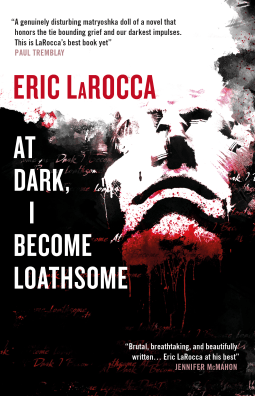
At Dark, I Become Loathsome by Eric LaRocca

At Dark, I Become Loathsome is a new short novel from LaRocca about a hopeless man who has invented an unusual ritual for people who want to die, but also want to live a better life. Ashley Lutin has lost his wife and his son has disappeared, he struggles with the knowledge of his queerness and the queerness he saw in his son, and he’s positioned himself as an outsider who can be contacted by strangers for a strange ritual that, unbeknownst to them, involves being buried alive. However, one of these strangers tested Ashley’s carefully planned ritual and his ideas of salvation.

I’ve read a lot of Eric LaRocca’s books, and I tend to find his stories either work for me or they don’t. This one is in the former category, with a good mix of some LaRocca trademarks (weird online forums, depraved actions, grim violence) and a self-aggrandising protagonist who believes he can really change people’s lives. The writing style and layers to this book, with constant repetition of the title phrase and some stories-within-stories as internet posts, are likely to divide people, but I enjoyed how the book was almost self-obsessed with its own rituals and motifs, reflecting Ashley’s ideas and how he uses these as a way to deal with his grief and regret. Ashley’s own belief in his edginess and outsider reputation (particularly through his claiming that having face piercings makes him really weird) is also an interesting aspect and again reflects the title of the book and the certainty of the protagonist that he is loathsome.

As a fan of Dennis Cooper and books like Exquisite Corpse and Brainwyrms, I didn’t find the content particularly shocking, and it all centres around our ideas of death and life so thematically makes sense. I did think that, though I liked the almost novella length (and think LaRocca writes that kind of length well), a few of the plot elements could’ve had more depth to them, particularly the backstory of Ashley’s child, Bailey, and their relationship. Ashley’s own queerness and his reaction to Bailey’s felt like something that needed more space to really make the queer horror element of this book work. However, this is one of my favourite Eric LaRocca stories I’ve read, combining a good concept with a narrative written through a distinctive perspective, and I was glad to enjoy it after not being a big fan of Everything The Darkness Eats.

Sick Houses: Haunted Homes and the Architecture of Dread by Leila Taylor

Sick Houses is an exploration of unnerving and haunted domestic buildings, from simple family homes to imposing concrete tower blocks, and the fiction and real life that shows us these. The chapters focus on different types of architecture and spooky homes, sharing a range of examples and some of the eerie elements of these, and drawing on a range of media to look into what makes a house haunted.

I like Taylor’s approach to the idea of haunted houses, making it quite a broad term that doesn’t just cover houses with ghosts, but a range of types of ‘haunting’. There’s a lot of different material covered in the book, with a lot of examples, but I did find that it was more of a collection of different kinds of haunted homes rather than an analysis of things about them. I expected it to have more of an argument than it did, though I did like that the final chapter was Taylor’s own experiences and a sense of uncertainty around what exactly a haunting is. I’d say that it is good if you’re looking for something that shares a lot of different types of ‘sick houses’, but it is worth knowing that it isn’t an in-depth exploration of the concept of these houses and what it might mean. I think it would sit well alongside Jacob Geller’s YouTube video ‘Control, Anatomy, and the Legacy of the Haunted House’, which takes the approach of analysing a few haunted houses more deeply, as for me that video set the bar very high for looking at the concept of a haunted house.

Bat Eater by Kylie Lee Baker

Bat Eater is a novel about Asian women being killed, and one crime-scene cleaner trying to deal with the death of her sister. It’s months into the COVID-19 pandemic, Cora Zeng is a crime scene cleaner, and not long ago, her sister was pushed in front of a subway train from beside her. She’s isolated from everyone, including her co-workers who also scrub blood away from the crime scenes of endless women in Chinatown, her Chinese aunt who wants her to prepare for the Hungry Ghost Festival, and her White aunt who wants her to be a good church-going American. When a shadow seems be lurking around her, Cora starts to realise she cannot ignore what is going on.

I didn’t know what to expect from this book going in, but it turned out to be a gripping horror novel that explores the pandemic, racism, corruption, mental health, and lurking ghosts. The novel opens with the shocking death of Cora’s sister, really setting the tone for the gory, no-holds-barred story to come, full of horrible deaths and a protagonist struggling with not only grief and trauma, but also the impact of COVID-19 on her mental health as she compulsively cleans and fears contamination. The book is often heartbreaking and horrifying, but as Kylie Lee Baker’s author’s note says at the end, it also has moments of humour and comfort, particularly as Cora finds herself becoming friends with the co-workers she wanted to keep at arms’ length.

Bat Eater is a memorable take on a COVID-19 novel, twisting the serial killer genre into something filled with emotion and the horrors of both the physical and ghost world, exploring anti-Asian racism in America at the start of the pandemic. Straddling horror and thriller boundaries with ghost and serial killer elements, it is perfect for anyone who likes hard-hitting, gory fiction that doesn’t shy away from exposing the horrors of the world.

Wake Up and Open Your Eyes by Clay McLeod Chapman

Wake Up and Open Your Eyes is a horror novel about an apocalypse brought about by right-wing news and social media in the USA. Noah’s parents have been parroting far-right views for a while now, but when his mother leaves a cryptic message and then can’t be contacted, he drives from Brooklyn to Virginia to check on them, but what he finds is his parents in a weird state, trying to attack him. Then it turns out they aren’t the only ones, and Noah’s brother and his family have fallen victim too, and then Noah and his nephew must try and make it back to Brooklyn, through the radicalised hordes.

I’ve been hearing about this novel for a while, and even though I didn’t really enjoy the only other Clay McLeod Chapman book I’ve read, I wanted to give this one a go, and I’m glad I did. The satire in this is very explicit—there’s Fax News, there’s influencer juice cleanses, there’s Baby Ghost to the tune of Baby Shark—and the horror is too, with memorable moments of gore and sex. This isn’t for the faint-hearted, and a good recent comparison is Alison Rumfitt’s work: if you enjoy that, you’ll be able to handle the stuff in this, with Tell Me I’m Worthless cited at the end in a list of influences and useful works for writing the book. I enjoyed that it was more extreme, not shying away from ideas of possession and what horrible things that makes people do to their bodies.

The structure is more experimental than most apocalypse stories, focusing mostly on the initial moment in the first part, then the build up in the second, and then just after that initial moment in the final section, which is intercut with lots of found footage moments to give a sense of the scale of devastation. This format doesn’t give much space for connection with the central figure, Noah, but you delve further into the minds of his brother Asher and Asher’s family, and it’s not the sort of horror where you need a deep connection as it is more about the shock of what is happening more generally than specifically what is happening to Noah. The ending doesn’t give much closure or explanation, and perhaps lacks a really memorable closing moment, but it also plays on a ‘liberal’ idea that such an apocalypse could be easily recovered from, suggesting that far-right threats aren’t just something to ignore.

I really like horror that blends together modern fears with classic horror elements like possession, and Wake Up and Open Your Eyes feels like an American version of Alison Rumfitt’s work, exploring the visceral horror of media radicalisation and far-right views. The middle section, about how one family got to that point, was perhaps the strongest part for me, especially in light of this theme, but overall this is a great horror novel that doesn’t shy away from being in your face, and you just can’t shut your eyes.

2024 in reading

Usually about this time, I start listing all the books I gave 5 stars to, sorted into categories like ‘fiction’ or ‘poetry’ and trying to split out books that were released that year or not. This year, inspired by Kat’s great musing on reading pre-2004 books, I’m going to be a bit less list focused, and just talk about my reading in general and my recommendations out of that.

I didn’t have any reading goals going into 2024. For the past few years I’ve stopped trying to read a certain number of books, which is nice. I ended up very busy at work and often too tired to read more than a few pages before sleeping, so it was less stressful to not care about racking up more books. My aim was just to keep my Netgalley ‘to read’ books manageable and try to get through a range of other books. I actually did read either 194 or 195 books in 2024 (depending on whether I finish Peter Straub’s Ghost Story today or not), which is a huge number but less than I’ve read in a year since 2018. Is that something I should be able to find out? That’s a separate rant about the datafication of hobbies.

I end up with such a long list of books I want to read that when I do finally get to read them and they’re good, it’s like an extra treat. This year, I read a bunch of books I’d been wanting to read for a while which lived up to my waiting, like Boys Weekend by Mattie Lubchansky, Fierce Femmes and Notorious Liars by Kai Cheng Thom, Little Blue Encylopedia (for Vivian) by Hazel Jane Plante, Idlewild by James Frankie Thomas, and These Violent Delights by Micah Nemerever. The latter two really hit the terrible part of me that wishes I could go back and read The Secret History for the first time again.

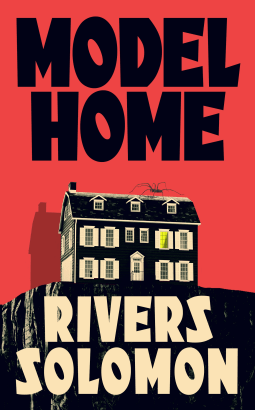
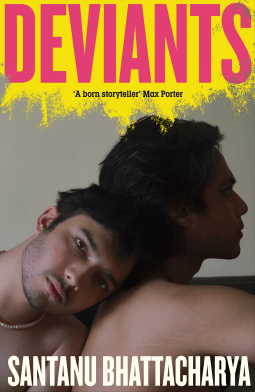
Looking back, I enjoyed a lot of new 2024 (and upcoming in 2025) fiction, but not to a level where I really loved it. However, there are a few notable exceptions to that: Katherine Packert Burke’s Still Life was a great exploration of writing trans autofiction; Model Home by Rivers Solomon was rich and haunting; and Santanu Bhattacharya’s Deviants (coming out in 2025) tells a three-generation story of being gay in a way that sold me on a structure (three concurrent narratives of generations) I usually don’t like. There was a lot of great poetry too, but for some reason I’m much worse at summarising what I like about poetry so I’m just going to say that Them! by Harry Josephine Giles in both printed and audiobook format was wonderful and transformative. I didn’t read many technology books this year, but Supremacy by Parmy Olson is my current recommendation for getting a sense of the race that led to generative AI products and where the money, power, and decisions came and continue to come from.

And finally, inspired by Kat’s discussion of reading older books, I really need to read more older books again (that aren’t just Dennis Cooper, who I seem to continue reading every year—this year I enjoyed The Sluts and its playful form). I did tackle The Godfather and loved it, reminding myself how fun it is to read a long book in physical form for a sense of achievement. Amongst others, I also read more Shirley Jackson, Poor Things, some haiku in translation, Samuel Delany’s Times Square Red, Times Square Blue, the first couple of volumes of Death Note, and Queer before going to see the film, so I think my pre-2005 reading has a few distinct strands. 

Storygraph’s stats just told me that I’ve not reread anything this year (if you discount the two different formats of Them!) so I think I also need to resolve to reread some books (The Haunting of Hill House, Last Exit to Brooklyn, Ada or Ardor, and Detransition, Baby are all on my reread radar currently). My physical to-read pile threatens to topple and crush my sleeping head, so I really should read more of those, too. I’ll return this time next year and we’ll see how I did (in the meantime, you’re welcome to find me on Goodreads or Storygraph to spy on what I read).

A person next to a huge tower of unread books
The author as apprehensive, next to the towering to-read pile on the last day of 2024.

Isaac by Curtis Garner

Isaac is a coming of age novel about first relationships, obsession, and finding who you are over a summer. Isaac is seventeen and is just finishing school, waiting to find out if he’ll get a place at his chosen university. He starts using an app to find men for sex, but when he meets twenty-eight year old Harrison at a party, he is suddenly infatuated, and their relationship takes over. As Isaac feels more and more that he cannot please Harrison, and pushes away the other people in his life, he has to ask himself difficult questions about what is really good for him.

This is a novel about queer growing up in the modern age, without focusing too hard on the digital elements to distract from the timeless story of unhealthy relationships and self-worth. It is set over a summer, but moves quite quickly through it, and the ending gives enough space to going beyond that time to see how Isaac moves forward, rather than just ending on a turning point without resolution. I liked how tender the ending is, not some romanticised perfect ending but showing signs of Isaac finding ways to keep growing and know that the summer isn’t the start and end of everything. Alongside this, there’s also Isaac’s relationship with his mum, which also faces turbulence, but ultimately is always safety for Isaac to return to. The writing style is straightforward, and the general vibe makes the book feel like the next step to growing up, capturing adolescence and mistakes, darkness and tenderness.

There’s some difficult topics explored in the novel, like toxic relationships, abuse, and body image, which are worth being aware of going in, and in particular it shines a light on some of the ways the modern world has impacted these things, without being entirely focused on apps or social media (for example, Isaac’s body image issues are more based on real life than because he’s seeing a lot of Instagram posts or something). It captures that moment when you think you’re an adult but really you’re still very much working out who you might even be and how others might see you, and ends with hope.

These Violent Delights by Micah Nemerever

These Violent Delights is a novel about two college students whose obsessive relationship leads them towards violence. In 1970s Pittsburgh, Paul starts college as a quiet loner, still grieving his father. He meets Julian in his ethics class and they are drawn to each other against the world, but Julian is unpredictable and Paul believes himself never good enough. As they play a game thinking up murder methods and grown increasingly obsessed with each other against their families’ wishes, they end up on a path that seems unable to have a happy ending.

I’ve wanted to read this book for a long time and now it is finally being published in the UK. It didn’t disappoint: it is all-consuming, written in a suitably pretentious way that delves into the depths and details of Paul and Julian, not painting Paul as some victim but as them both as flawed and all too obsessed not only with each other but with their own importance against the rest of the world. The narrative is third person but always follows Paul, which I wouldn’t have expected but actually works well to keep you always looking in on their relationship and not actually being addressed by Paul himself. The story itself is pretty simple, and I liked how this is far more of a character study than any kind of thriller (fittingly similar to The Secret History, which is tricky not to compare this to even though These Violent Delights is much less “dark academia” because their obsession is with each other and not something academic).

Nemerever’s author’s note at the end really sums up this book’s focus on late teenage queer relationships and how the lines between love, obsession, and toxicity can become very blurred, particularly for queer people and for people who have to position their feelings as them against the world (as this book’s characters explicitly do, à la Brideshead). If that’s the sort of book you like, then These Violent Delights is a delightful example of the genre, and for me it was exactly the sort of book I enjoy, focusing properly on the characters and their ideas and relationship. 

The Trunk by Kim Ryeo-ryeong

The Trunk is a novel about a woman who works as a ‘Field Wife’, a hired out temporary spouse for the rich, and what happens when one of her previous husbands hires her for another year of marriage. Inji took a job at matchmaking service Wedding & Life’s secret division, in which people can pay for a field spouse to have a fixed term marriage with, when she didn’t know what to do with her life, and now she’s had five of these husbands. The most recent husband wants another year with her, and soon various people in her life, and secrets from the past, start to appear, in this satirical novel that explores modern marriage, sexuality, and gender expectations in South Korea.

This novel wasn’t what I was expecting from how it is presented, as it is marketed as a feminist thriller, and between that and the title, I was expecting the protagonist to be involved in something like murder. Actually, the book is more about ideas of love and marriage, queerness and the space for people’s lives and relationships to be more fluid, with a plot that is more focused on the protagonist’s relationships to other people and things in the past that have impacted those relationships. There are some thriller-like elements—like her finding more shady stuff out about the company she works for, or the guy who won’t stop pursuing her, or the mystery of how her schoolfriend died—but the book is really more meditative and character-focused, with a lot of satire as well, rather than a thrilling page turner.

The first half of the book focuses on Inji’s work in the company and some of the people in her life, like her closest friend and the old granny who lives by her, and all of the characters are given a lot of quirks to explore how people’s lives aren’t straightforward. There’s also her current husband, a rich music producer she has avoided finding out much about, and a guy who has started turning up at her work, demanding to know why she’s not interested in him, and both of these two seem like something dramatic is going to happen, but then the second half of the book tells more of the story of her and her best friend, and their other friend who died after Coming of Age Day. as well as Inji’s revelations about a manager at her company. This all makes it quite a varied novel, but I enjoyed that it wasn’t a straightforward thriller, and instead questioned a lot of things about relationships, sex, and love that people tend to expect.

She’s Always Hungry by Eliza Clark

She’s Always Hungry is a collection of short stories from Eliza Clark exploring body horror, futures, and, above all else, hunger. In eleven varied stories, characters explore the edges of their desires, whether for better skin, a plant that might save the planet, or human flesh. Most of the stories are pretty conventional in structure, though a variety of genres, but one is comprised entirely of reviews of a mysterious takeaway (and is a very fun addition). A few are speculative fiction and it’s exciting to see Clark writing in a genre quite different to her novels Boy Parts and Penance, even though I typically am not a huge fan either of speculative fiction or most short stories, with these focusing on very specific moments rather than worldbuilding.

Overall, this is a collection that has a clear presiding theme, but which explores it in a plethora of ways, not sticking to the same styles of story or similar characters. As I expected from Clark, there’s some fairly dark stuff and some moments of body horror, but also a lot of playfulness, especially when taking things to extremes (like the almost ridiculous ‘The King’ with a cannibal protagonist excited for an apocalypse). There’s some fun little details—I loved that ‘Nightstalkers’ was set in Santa Carla—and generally this collection lived up to what I might’ve hoped for, even though some of the stories were perhaps a little tamer or more predictable than I wanted.

Hotel Lucky Seven by Kotaro Isaka

Hotel Lucky Seven is another assassin thriller from Kotaro Isaka featuring a web of assassins in Tokyo whose intersections cause a mess of violence, death, and ridiculousness. Nanao, the unlucky assassin known as Ladybird from Bullet Train, has a job to deliver a birthday present to a room in a hotel, an apparently easy job until a man ends up dead and Nanao discovers he isn’t the only professional in the hotel that day. When he meets Kamino, a woman with a perfect memory who seems to be the focus of these professionals, Nanao is drawn into far more than he expected.

Given that Nanao is one of the main characters, you can guess that this book is very much a follow-up to Bullet Train, even though there are other Isaka books in the same world featuring some of the same characters. Hotel Lucky Seven takes the Bullet Train mould of a single location and far too many assassins, rather than the more wide-ranging (and less comic) The Mantis, and this works very effectively as a fun journey around scheming and mishaps, with plenty of ridiculous deaths. There’s some fascinating character relationships in this one, and some further models for crime duos along similar lines to the citrus-themed pair from Bullet Train.

If you liked Bullet Train, Hotel Lucky Seven is another book in the same vein, with plenty of mishaps, gruesome deaths, and weirdly specifically skilled assassins. It’s ideal for people, like me, who love dark comedy crime films. The translation has a good balance of making sure Japanese-culture-specific elements are clear, whilst not spelling everything out or removing things that give the book its setting and context (and the author’s note at the end about yuzu pepper cheesecake is a funny touch).