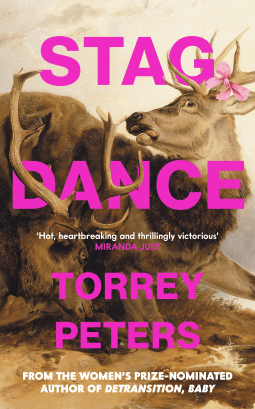
Stag Dance by Torrey Peters

Stag Dance is the follow-up to Detransition, Baby, a collection of three novellas and one short novel that use genre to explore different narratives of transition and gender. There are two previously self-published novellas, ‘Infect Your Friends and Loved Ones’ and ‘The Masker’, which explore trans community and desire from a speculative fiction and horror perspective respectively, and then a new novella, ‘The Chaser’, which tells a teen drama story in a boarding school. And then there’s the titular ‘Stag Dance’, a short novel about an illegal logging camp in which a winter dance brings to the forefront a rivalry between two ‘jacks’.

It’s hard to summarise my anticipation for this book, even with the fact that I’d already read the two self-published novellas before. I didn’t know how it would work with the four different stories, but as Peters herself explains in the closing acknowledgements, they come together as using genre to explore transition, each written at a different time for Peters but also taking a very different framing. The world of trans community and hormone farming in ‘Infect Your Friends and Loved Ones’ feels just as relevant now, and was just as punchy as when I first read it, and I think I enjoyed ‘The Masker’s depiction of a horrifying choice amidst the wannabe glamour of Las Vegas more this time, with its echoes of trans media to come post-2016 (for example, a very different version of I Saw the TV Glow). ‘The Chaser’ felt very different again for Peters, with boarding school teen drama not a genre I’d expected, and it sits nicely with Idlewild and ideas of pre-transition relationships and desire.

And then, there’s the titular story ‘Stag Dance’, which if you’d told me the summary without the author, I would’ve assumed there was no way I’d enjoy it, but instead, it turned out to be an incredibly written and gripping look into what a transition can be in a completely different context. The honesty of costumes and crossdressing for trans people becomes something fresh in this world of lumberjacks in which some are pretending to attend a dance as a woman, but for others, that is entirely revealing. It is written in such a specific way and I found that fascinating: as I’ve heard Peters talk about, her writing often is interpreted as having a trans audience through the vocabulary and what she does or doesn’t explain, but in ‘Stag Dance’, that is not explaining any of the ‘jack’ vocabulary and just letting you pick it all up through context. It shows how much language shapes our understanding and our ideas of gender and transition, with the narrator having a very different way of describing transition, but still having one nonetheless.

Stag Dance is funny, insightful, horrifying, deeply sad, and won’t be for everyone. I’ve heard a talk in which Torrey Peters spoke about the fact (in a far more nuanced way than I’m putting it) that there should be “trans” every genre rather than the idea of “trans literature” and Stag Dance is doing that work, four stories at once. Entirely predictably, I loved it.

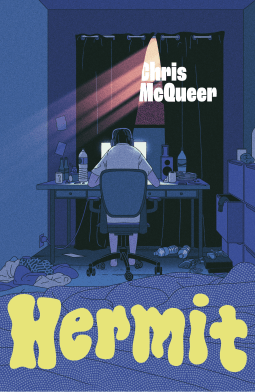
Hermit by Chris McQueer

Hermit is a novel about a guy who can barely leave the house, but whose attempts to get away from his mum’s nagging might take him much further than he thought. Jamie is nineteen and since he dropped out of school three years ago, he just stays in his room playing games and watching YouTube videos with his online friend Lee, occasionally venturing downstairs for microwave burgers and fries, and chocolate spread. His mum Fiona despairs, but she also struggles to connect with other people, especially after kicking out her abusive husband. When Lee tells Jamie about a new friend, who says they are both incels and should come down to London to stay with him, it seems like an escape, but it isn’t as simple as that.

Having enjoyed Chris McQueer’s short stories, I would’ve wanted to read this one regardless of the content, but the blurb drew me in too, with the idea of exploring online and incel culture through the perspective of someone who might be targeted by incels online as a potential ‘convert’. McQueer treats it all with nuance, through chapters that alternate between Jamie and Fiona’s perspectives to compare how their similarities led them in different directions, and particularly how online incel and “manosphere” culture preys on people who don’t even feel that connected to its key tenets and claims. Jamie doesn’t care that much about girls until he is told he should be angry at all women for rejecting him, and you see how that makes him lash out at his mum and believe she doesn’t care about him.

There’s an underlying dread that particularly sets in halfway through, as Jamie and Lee go to London, and you know something isn’t going to go well. It’s darkly ridiculous, but also feels horrifyingly real, especially if you know anything about incels or other online communities (for example, the elements in which Jamie didn’t understand the terminology or ideas of incels, but felt like he had to go along with it). Fiona’s story is also moving, not just how she cannot help Jamie or even feel able to tell him that she loves him, but also how she basically had a similar trajectory that was different due to it being a earlier time and her being a woman (and the element where people on Facebook accused her of killing Jamie was darkly real too).

From McQueer’s short stories, I was expecting something maybe surreal alongside the darkly funny elements, but Hermit is actually more of a deep look at feeling like an outsider and the impact these days of certain online communities finding prey in these people, with more dread and sadness than weird elements. It is refreshing to read a literary fiction novel that takes this kind of thing seriously, rather than just having some reclusive incel character as a joke. McQueer makes this a moving look at two people, mother and son, who could be described as hermits, with plenty of humour but not treating them as a joke.

Carrion Crow by Heather Parry

Carrion Crow is a novel about a woman shut in an attic to learn how to be a good wife, in a gothic exploration of polite society and secrets. Marguerite was locked in the attic by her mother, Cécile, with only Mrs Beeton’s Book of Household Management and a sewing machine for company, plus a crow she discovers has made its own within the roof. Cécile appears sporadically to bring food and check on Marguerite’s progress, but Marguerite starts to lose track of how long she’s been there, and why is she fighting to get married in the first place?

Told alternatively in Marguerite’s present and the history of her mother, this novel slowly unravels a story of social position, respectability, and secrets, whilst still not handing the reader everything on a plate. The narrative unfurls in a way that the reader starts to understand things before Marguerite does, creating a sense of dread as you realise what she hasn’t. In particular, Marguerite’s ‘plan’ that has led to her being in the attic is heartbreaking once you realise how her belief, from her mother, in ideas of polite society and what she must do to be allowed what she wants is misguided, but also deeply tied up in class, position, and gender. Queerness is shown in opposition to these ideas of polite society, but also the thing that offers alternative ideas of freedom.

This historical gothic novel is slow and lingering, without an easy answer or way out. I’m not usually a fan of historical novels, but Carrion Crow gripped me, though the backstory elements sometimes felt too drawn out. Fans of gothic novels will enjoy this one, which doesn’t shy away from some more disgusting elements.

Model Home by Rivers Solomon

Model Home is a novel about three siblings and what happened in their seemingly ideal gated home. Ezri grew up in Texas with their two sisters, Eve and Emmanuel, in a McMansion their parents were proud to own, even in such a White community. When their parents are found dead in the house, Ezri and their sisters must face the haunted childhoods they spent there, and their blame on the house and their parents for keeping them there, because sometimes the what haunts us isn’t always what we think.

I was excited to read a new book by Rivers Solomon and this one didn’t disappoint, combining a complex family relationship and a classic haunted house premise with ideas of memory, justice, and recovery. The chapters are mostly told from Ezri’s perspective, with some from others’ points of view, and it works well to make it hard to work out exactly what people know and what memories might mean. The plot is quite like a horror story, and is split between the past and the present to explore what it was like for the siblings to live in the house as well as the present events, but the book also plays with these ideas of haunting, and what kinds of harms might be out there.

The characters are rich and well-realised, even shown through mostly Ezri’s perspective, and I like how details about them are slowly revealed rather than told to us straightaway. There’s also a lot of character detail that feels very real, like diabetic characters taking insulin and checking their blood sugar, and characters are allowed to be messy, complicated people without it needing to have a plot reason. I liked the relationship between Ezri and their daughter, and the complexity of not always being able to be the parent a child might need, and also how various parent-child relationships in the book showed how these can change over generations and there can be new models of parenting. Model Home is very much about family relationships and the ways that these can haunt, as well as how choices made by family impact each other.

There’s plenty more packed into the book as well, as it plays with expectations about what kind of story it is, and it defies easy categorisation, but is just a book that explores memory, haunting, family, race, and belonging whilst having a gripping plot about a house that reminds the siblings of a terrible past.

Woodworking by Emily St. James

Woodworking is a novel about being trans in small town America, as two trans women with little else in common become friends. Erica is thirty-five and recently divorced, a high school teacher who directs community theater and seemingly doesn’t have much else on. She also knows she is a trans woman, but nobody else in the town does, until she tells Abigail, the school’s only trans student. Abigail lives with her sister after her parents threw her out and beneath her tough exterior, she might just need Erica’s friendship as much as Erica needs hers.

I’m not a fan of unlikely friendship novels, which tend to be trying too hard to be inspiring and end up bland and twee, but Woodworking is very much unlike those. I’d heard about the book so wanted to read it, and I’m really glad I did, as I love how it combines different genres of fiction that have been used to tell trans stories—the kind of thirtysomething divorce story and a young adult novel—into one book exploring the different experiences of different women, trans and cis. The narrative moves between Abigail’s first person point of view and a third person narrator focused on Erica (with another voice later on that it would be too revealing to describe) and this gives a sense of the differences between them and their outlooks, but also where they have similar needs for community with other women, both trans women and cis women.

Another thing I really liked about Woodworking was the fact that characters are allowed to be flawed: messy, annoying, selfish, etc. In particular, reading Abigail’s first person perspective as an adult can be frustrating, because St. James writes her very much as a teenager who has adopted certain defensiveness to survive, which is reflected in her tone. Both protagonists get frustrated and lash out at people, make bad choices, and even by the end, are still just trying to work out what futures they might have. Some people might not like this messiness, wanting characters who don’t do “bad things”, but it felt very fitting for a novel about different kinds of friendship and mentorship and the fact that these things aren’t linear. To draw out the obvious point of the novel, Erica is thirty-five and needs to advice of a seventeen-year-old who already knows about things like trans support groups and coming out, but both characters need each other and many of the other characters in the book to see a future in which they don’t have to hide.

I loved Woodworking and the way it explores ideas of hiding, existing, and community with gripping, messy characters. It is like if you crossed Detransition, Baby with a young adult novel about a teenage trans girl trying to balance rebellion and fitting in, and focused on the intersection between them.

Deviants by Santanu Bhattacharya

Deviants is a novel about three generations of gay men in India and the ways in which people are shaped by the time they live. Vivaan is a gay teenager in India’s Silicon Plateau, and whilst his parents are supportive, they don’t know about the online life he leads, in which sex and love aren’t simple. His uncle Mambro’s experience of being gay is very different, having grown up during a period when a colonial-era law prosecuting homosexuality was constantly being wielded, even as people in India fought to repeal it. And Mambro’s uncle, Sukumar, was born in a time when he had no option, and his love for another man must be hidden, as he struggled to find a place for himself without hurting others.

This is a cleverly structured novel that is very powerful, with each chapter moving between the three stories and each narrative told with a different voice. Through this structure, it is easy to become immersed in all three stories and their connections and differences, which isn’t always possible with a novel telling three parallel stories. Vivaan’s voice notes are confessional, whereas Mambro’s story is at a second-person remove, and Sukumar’s is told in third person narration, and al of these suit the characters and their stories as well as serving to make them distinctive from each other. The three characters struggle with many of the same things, but also specific issues to their time, and particularly Vivaan’s story takes a more futuristic approach to what intimacy might mean in new ways, that offer opportunity and peril.

Deviants is sad and humorous at once, balancing the three characters well to create a powerful exploration of being gay in India over the past decades. 

Disappoint Me by Nicola Dinan

Disappoint Me is a novel about relationships and growing up, as a thirty year old trans woman  meets a new guy and navigates a more heteronormative life. Max works as a lawyer for a tech company, doing what their AI tool actually can’t, and after a New Year’s party ends with her falling down some stairs, she’s looking for more stability. She meets Vincent, a corporate lawyer who is sweet and caring, even if a lot of his life feels unlike Max’s. Looming is Max’s friend’s wedding, in which she’s a bridesmaid, but a health scare and a secret from Vincent’s past push that to the background, and Max must face up to what her future might actually hold.

Having loved Bellies, I was excited to read Dinan’s next book, and Disappoint Me has a lot of similarities, focusing on characters’ emotions and relationships, and navigating acting in ways that are or aren’t see as ‘normal’. In her second novel, Dinan focuses on ideas of where to go next, what happens after. The protagonist, Max, is thirty and watches as people suddenly start focusing on weddings and babies, or being obsessed with their jobs as an alternative. The book considers what kind of future there might be, especially for a heterosexual trans woman whose job doesn’t challenge her and whose future as a poet didn’t seem to go anywhere. There’s a sense of trying out a heteronormative life, with some hilarious touches like that her boyfriend Vincent loves bringing up that he’s read Detransition, Baby whenever talk turns to parenting, and this novel in general does feel like it follows on not only from Dinan’s debut but other talked-about trans literary fiction like Detransition, Baby, exploring a world in which cis straight people have also read these novels.

Given the title, I did start fearing partway through that Disappoint Me‘s ending was going to be too bleak, but actually it is more ambivalent and purposefully ambiguous, showing the difficulty in seeing anything as an ending when the world always keeps going regardless. There’s a lot of things that are thrown up in the novel and don’t really get resolved, but again, as the book is trying to capture the fact that life keeps going on, and what that means when you’re trying to work out your own life, this feels purposeful. The characters are messy, but as the ending tries to highlight, people aren’t perfect and you can still love people when they mess up, and part of getting older is realising this.

Blob by Maggie Su

Blob is a novel about a woman who meets a blob in an alley and tries to turn it into a perfect man. Vi has dropped out of college, is still dealing with her last breakup, and works at the reception in a local hotel, where she tries to avoid talking to her friendly co-worker, Rachel. When she finally gives in to Rachel and goes out with her to a drag club, Vi finds a blob in an alley. Intrigued, she takes it home, where it eats cereal and watches TV, and soon Vi realises she can shape the blob as she wants, so she tells the blob to become an attractive man. However, even the blob resists Vi’s control, and she has to face the fact she might have to stop running away from everything.

The blob concept is such a fun one for a novel and I love weird novels like this, exploring a character’s constant fucking things up through the lens of something strange. Vi feels like a outsider everywhere and protects herself by ruining things or avoiding what she really wants, and the blob appears as an easy way out, until she realises that it isn’t, because the blob becomes Bob, who has autonomy and doesn’t want to do what she does. It’s like using Frankenstein as a chance to realise you have to actually take control of your life and be better to other people, rather than not putting the work in with them. The narrative does actually give Vi a chance to change, and it’s a charming take on a coming of age story.

Natural Beauty by Ling Ling Huang

Natural Beauty is a novel about the luxury beauty industry, being an outsider, and what it means to make something beautiful. The protagonist was a promising piano player, studying at the Conservatory to the delight of her parents who fled China during the Cultural Revolution, until an accident left them in a medical facility and her unable to play. When she is offered a job at Holistik, a beauty company that offers cutting-edge treatments for a high price, it is an opportunity not only to pay her parents’ medical bills, but to gain access to the world she couldn’t join through piano playing. As she becomes entranced by a new friend and her body starts to change thanks to Holistik’s products, she starts to realise that there’s a price being paid for what Holistik and its sister companies are doing.

This book is a combination of body horror and literary fiction with dystopian thriller elements, using this to explore the wellness and beauty industry as a concept, ideas of perfection in beauty and art, and personal experiences of immigration and race. It’s both satirical and not, as good body horror often is, and there’s a lot of little details that aren’t as explored as the main narrative, but are fascinating too (like the owner of the company also making money from a body modification business because alongside the ‘culture’ of beauty and wellness there’s always a ‘counter-culture’).

The unnamed protagonist tumbles down the rabbit hole whilst the reader is faced with knowing it isn’t going to go well, seeing the warning signs she misses. Her story highlights how the beauty industry often preys on people who need solutions to other problems in their lives, but also how when someone is desperate it is easy to not see things that don’t seem quite right. The parts of the book in which she’s thinking about music and the need for dissonance and harshness were some of my favourite parts, and beyond the obvious parallel with beauty, it also shines a light on ideas of who plays music and what they should look and seem like.

Natural Beauty is a gripping descent into a dystopian world of body horror. You can really picture it being adapted into a film that would sit well alongside a lot of recent films, not just in terms of the concept but in the fluid, hazy way it unfolds.

The Resurrectionist by A. Rae Dunlap

The Resurrectionist is a historical novel about a young medical student who arrives in Edinburgh, meets an intriguing dissection assistant, and falls into the world of stealing corpses for use in medical schools. James arrives in Edinburgh to pursue his dream of attending medical school, having escaped his family’s expectations for him but lacking money after this father’s death. When he strikes a deal to attend a private anatomy school with Nye, the assistant, James finds himself drawn into an underground world of supplying dead bodies for medical schools, treading the line between scientific progress and crime, but alongside the thrill of the danger is another thrill, as James finds himself with feelings for Nye.

I tend to be selective with the historical novels I read, but this one looked interesting for the queer love story and the gruesome premise. The former element is definitely prevalent in the book, though it feels more like a young adult book in the way this is treated with vague references to what James and Nye do together. There’s a slight level of peril due to the time period and legal and social ramifications of gay relationships, but it always seems to be kept as something that’s a vague annoyance to James rather than the danger it has previously placed Nye in, which again makes it feel like a young adult novel that doesn’t quite want to delve into how it would feel to exist like that. Not that this is a bad thing, as people often want to read historical novels that aren’t just about queer misery, but in this case it is meant to be a threat, just not one that is explored.

The gruesome element isn’t really all that dark, as this book is more of a gothic-atmosphere historical novel than anything particularly scary or gritty. There’s a bit of stuff about university medical education vs practical anatomy and dissection, but otherwise the medical student is really just the background, and James’ student friends are there as plot devices as needed. Again, this works for the book as it has a simple narrative, but it never really delves more deeply into anything, being quite coy about a lot of elements (like one of two female characters, a young woman who helps out Nye and the diggers, but we never quite see what her seemingly disreputable existence actually is). There’s a lot about class, wealth, and power in the book that again isn’t really explored, and particularly the ending is very neat, ignoring these things for a happy ending that seems to set up for a potential sequel.

This is a fun book if you like light queer romance with a gothic premise, though I think the style and narrative mean it would be better suited marketed as young adult fiction (and I can think of young adult books that do delve more into the kind of material this one avoids). I enjoyed reading it, but I found the ending too easily resolved and without much emotional power, because everything seemed too easy for them. I think there will be a lot of fans of this book who enjoy the romance and the vibes, but on reflection, it wasn’t entirely for me.