A Lukewarm Defence of Yet Another TV Adaptation

If you follow my Twitter, you’ll probably know that I just read Les Misérables (in Donougher’s nicely approachable translation). You may have also picked up that I used to hate Les Mis despite never having consumed any media relating to it. And the only reason I went from irrational hatred to picking up what cannot be described as a ‘quick read’ is the recent BBC TV adaption of the book.

Whenever there’s a new TV adaptation of a classic book, there tends to be fuss around how faithful it is, the casting, the directorial choices, and whether we really need more TV adaptations of classic books. There are plenty of other stories to be told, after all. Making more adaptations often seems to just give English teachers more options when they need to show the class a screen version of the text as a treat/bribe/[insert better reason here] (watching the 1970s ‘Tis Pity She’s A Whore film at A Level was more of a punishment, to be honest). Fresh adaptations of newer books give more stories a chance and possibly lessen period drama fatigue.

Regardless of this, I seem to be defending to some extent making more of these adaptations of old books. There’s plenty of good reasons to defend them—a chance to update interpretations of the text on screen, lots of old ones are quite bad, can finally make that very faithful or incredibly not faithful version that was needed—but I’m going to go with my personal one: bringing new audiences to books and ideas.

I hated Les Mis because I was on the internet around the time that the film of the musical of the book (must be said like that for full adaptation value) came out. Those who weren’t on the internet around this time may not be aware of quite how many people were obsessive about Les Mis. There was endless debate, screenshots, jokes, calling it ‘The Brick’ like everyone knew exactly what you meant, being obsessed with characters who turn up a long way in and then die not a huge number of pages later, and the songs. Oh, the songs. I hadn’t even heard the songs, but I felt like I had.

So I hated it. I don’t like musicals so that felt like justification, but really it was the fact so many people wouldn’t shut up about it. I lived my life for a number of years happy in my dislike of it. I had no interest in the news there was a TV adaptation. In fact, one of the main reasons I was willing to try watching it was because I spend a lot of time around people who study the eighteenth and early nineteenth century who were also going to give it a go, and they said the first episode was good. So I watched it. And it was.

Now, I don’t care if you think it was a good adaptation or a good piece of drama or what the hell was that font. That doesn’t matter. What matters is that I enjoyed it, hooked on the story and Javert’s endless “Jean Valjean!” and the fact there was less dialogue than there was David Oyelowo and Dominic West glaring and doing a lot of silent acting at each other. And because I enjoyed it, I gave up my irrational dislike and a few months later, actually read the book.

I conclude my lukewarm defence of all these damn classic book screen adaptations by saying maybe it doesn’t matter if people read these books or get into them, but at least the adaptations are ways people can get into these stories which are often referenced in other places and are also ripe for reworking and retelling in updated and interesting ways. Though that is venturing worryingly far into saying adaptations are good for creating the kind of annoying fandom that made me hate Les Mis in the first place.
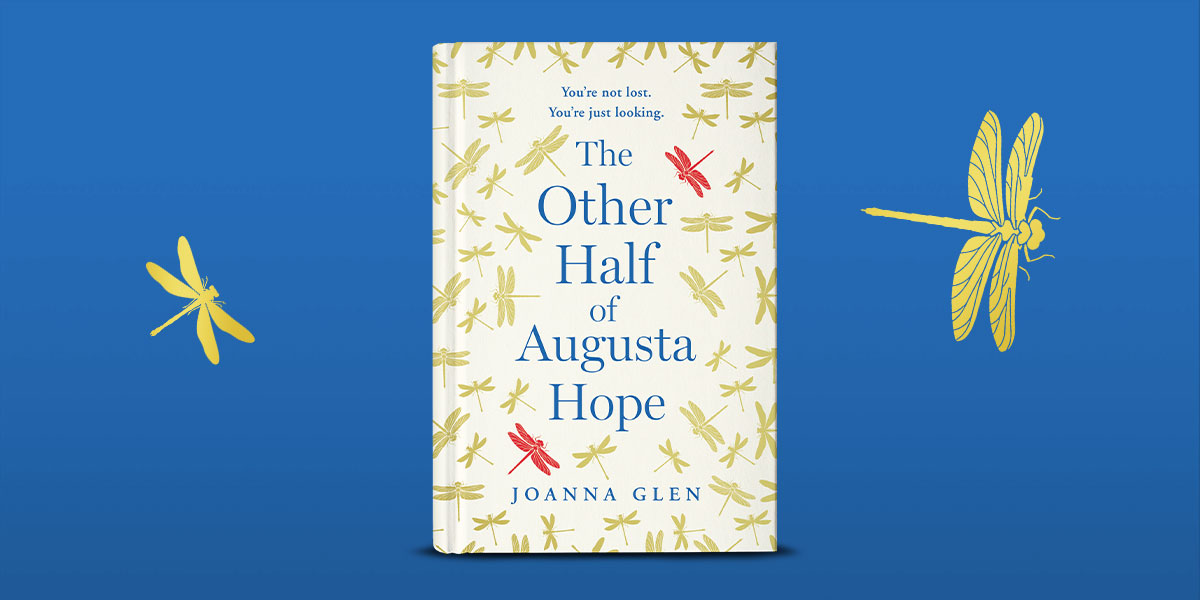
The Other Half of Augusta Hope by Joanna Glen

The Other Half of Augusta Hope cover with dragonflies

The Other Half of Augusta Hope is a novel about fitting in, loss, and the people you really have connections with. Augusta loves words and the dictionary. She chooses her favourite country—Burundi—based on its sound and learns all about it. And she’s different to her twin sister Julia. They grow up and when tragedy comes, Augusta realises that she really can’t stay in her hometown with her parents. Alongside this narrative is the story is Parfait, a boy in Burundi who wants to go to Spain, and becomes a man in Spain dealing with what has happened to his siblings.

This is a character-focused novel that has a lot of emotional power. The split narrative that moves between Augusta and Parfait works well to show their parallels and connections, and the narrative in general is well-crafted to foreshadow events. From reading the blurb, the novel sounded less multi-faceted than it actually is, and it was a pleasant surprise to have Parfait’s story as well. It sounded like it could just be a quirky novel similar to others with unusual character names in the title, but actually it covers topics like migrants in Europe and suicide as well as having main characters who don’t fit in.

It is the kind of powerful novel that a lot of people will find resonates with them after they’ve finished it, but which has a hopeful ending to match Augusta’s name.

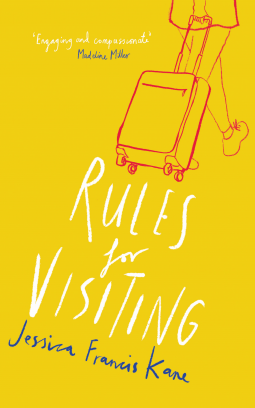
Rules for Visiting by Jessica Francis Kane

Rules for Visiting cover

Rules for Visiting is a novel about friendship, a meditative novel and focused on travel and home. May’s life is a series of routines: she lives with her elderly father, doesn’t see her brother, and doesn’t really talk to her neighbours. Though she enjoys her gardening career at the local university, she feels she needs something more, and some paid leave sparks off a chance to revisit some old friendships. As May visits her friends one by one, she reflects on their lives and her own, comparing classic literature and modern communication as she searches for what friendship is.

This is a calming sort of read, light and quirky but with some real meaning sown throughout. It has a precise and distinctive style, reflecting May’s thought processes, but leaving gaps for the reader to notice her loneliness and what she isn’t saying. The plant and book references are another distinctive feature, again very much linked to May’s character but also about how we use different points of reference to track our lives and our friendships.

Rules for Visiting is a quietly quirky book that looks at human connections and dealing with the past and the present. Maybe fittingly, it would make a good book to keep in a spare room or give to a visiting friend: a quick, understated yet moving novel that makes you think about friendship across time.

The Rapture by Claire McGlasson

The Rapture cover

The Rapture is a novel about a real life English religious cult and how one deeply entwined member finds something outside of what she knows. Dilys is a member of the Panacea Society, a group of mostly single women who lives across a number of houses in Bedford under the direction of their zealous leader, Octavia. When Dilys meets Grace, a new recruit to the society, it feels as if God has brought them together. As the society prepares for the moment of their salvation, and Dilys’ feelings for Grace deepen, Dilys must attempt to find the truth and protect herself from the others and her own mind.

McGlasson combines real documents and people with a fictional narrative that is gripping and powerful. The world and Dilys’ thoughts are immersive, and the reader into brought into the society as Grace is, seeing the message and slowly behind the veneer. Much of the tension is around Dilys’ personal struggles, but also a lingering sense of what the society might do next, as Octavia’s right hand woman Emily gains more power. Everything comes together in a satisfying way, but also leaving enough ambiguity as Dilys’ point of view can be unreliable.

This is a novel that takes a fascinating and little known bit of history and turns it into a moving story of finding yourself and finding love whilst fighting against all you know. The fact that a story like this is taken from historical fact and documents and happened in Bedford gives it an additional dimension, showing the reality of closed off zealotry and the line between faith and delusion.

Vicky Romeo Plus Joolz by Ely Percy

Vicky Romeo Plus Joolz cover

Vicky Romeo Plus Joolz is a romcom novel set in Glasgow in 2001, in which Vicky Romeo—heartbreaker of the gay scene who dreams of making her way as an actor—meets her match in Julie Turner, who isn’t falling at her feet as expected. Romeo can’t get her Juliet out of her head, but the course of true love does not run smooth, with stereotypes crushed, prejudices faced up to, and personal dramas abound in their friendship circle. At the same time, Vicky wants to pull off getting a role and performing in an all-female production of The Importance of Being Earnest, and falling in love wasn’t a complication she expected.

This is a charming novel that is incredibly detailed and really paints a picture of the characters and the time period (to the extent it’s hard not to come away from it with Atomic Kitten in your head). Vicky is a hilarious, flawed protagonist who is forced to confront some of her own prejudices and selfishness whilst navigating her own feelings about love, family, and who she is. There is a vein of learning greater acceptance and kindness running underneath the novel, which doesn’t shy away from characters’ views on sexuality and stereotypes and the need for greater understanding even from people who face prejudice themselves. To balance this, there is also a lot of witty banter and romance, and it is a fun read that allows characters to be loud, brash, and themselves.

If you’re looking for a funny novel with personality and a vivid setting and characters, Vicky Romeo Plus Joolz fills the brief, and proves that romantic comedy is not just the domain of straight, posh characters and scenarios.

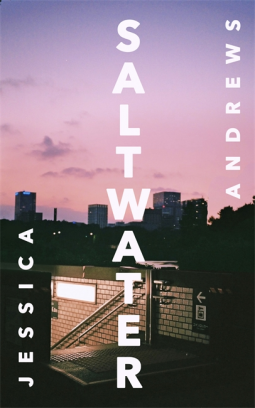
Saltwater by Jessica Andrews

Saltwater cover

Saltwater is a novel that tells the story of a girl who moves from Sunderland to London to an Irish cottage in a fragmented, lyrical style. Lucy grows up with a somewhat dysfunctional family and stories of what other family members did before her. She discovers the joys of gigs and drinking as a teenager in the North East, and when she gets a place at university, nothing seems better than moving to London, the home of indie icons and cool bars. Once in the capital city, however, things are harder than she thought, and when family issues come to a head after her graduation, she ends up in her grandfather’s old cottage in Ireland, trying to put herself back together.

Told in a non-chronological way that jumps between time and place very quickly, it is a novel that feels fresh and raw. The method of putting together bits of Lucy’s story out of order, amongst stories about her family members as passed down through the family, uses disorientation to get across Lucy’s mindset and the complicated ways lives are similar and different. At the same time, the pleasingly detailed story of how she was a typical teenager in the 2000s dreaming of meeting bands and how she then turned up in Camden too late for the scene (which is told, with interruptions, in chronological order) forms a strangely moving heart to the novel. It gives a real sense of the hopes of being a teenager and how her hopes and dreams of London were then not quite the same as reality.

Saltwater is perhaps most distinctive for its non-chronological narrative and fluid style, but its highlight is the way it depicts growing up and how provincial dreams of London don’t match up to living there, using the detail of 2000s popular culture and trends. There’s something very relatable and touching in elements of Lucy’s experience, weaved in with family issues and her own need to recover from London.

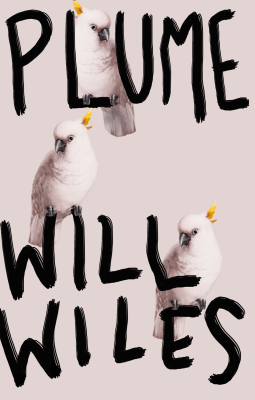
Plume by Will Wiles

Plume cover

Plume is a a novel about contemporary London, truth, and alcoholism, tinged with a darkly comic writing style and an ominous atmosphere. Jack Bick writes features for a magazine and pretends that his drinking isn’t a problem. When a column of smoke appears on the London skyline outside his office, it feels like an omen, particularly along with Jack smelling smoke all the time. He tries to ignore this and goes to interview reclusive writer Oliver Pierce, who reveals a secret about his most popular book that could save Jack’s job, if he can only get it written. Drawn into a partnership with Pierce against the city and tied to a new app that tracks people’s location, Jack must work out what is real and what is only imagination.

This is a surprising novel in many ways. It was quite slow to start and felt like it could have sparks of brilliance without a compelling plot (particularly some laugh out loud imagery and cutting depictions of London), but then turned into something much better than it first seemed. Particularly the way in which Jack’s alcoholism, which could’ve been a hackneyed trope that wasn’t really dealt with properly, was crucial and faced full on. In fact, though the book could be marketed as one about modern London and about what is real, it could just as easily be seen as a book about addiction and about how it makes people view the world. The underlying message about tech companies and big data was perhaps more predictable, but it worked well with the other plot elements, turning psychogeography into the digital as a recommendations app looks for urban myth.

What could’ve been a dull story about trying to write turned into a gripping look at addiction and space, which satirises London media culture and gentrification whilst taking its topics seriously. The desperation of living in London and the pain of addiction seem to blur, showing the psychological effect of both whilst questioning the line between truth and lies. Plume felt more than its blurb, with an unnerving sense of smoke lingering after you put it down.

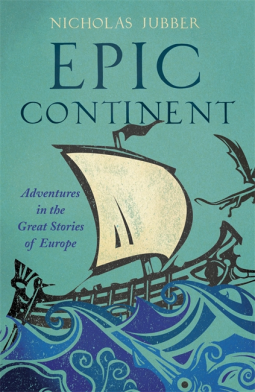
Epic Continent: Adventures in the Great Stories of Europe by Nicholas Jubber

Epic Continent cover

Epic Continent is a literary travelogue that charts the locations, history, and reception of six European epics. Focusing on change, war, and dominant narratives, these stories often span locations and Jubber travels across Europe, from Greece and Turkey of the Odyssey to Iceland for the Saga of Burnt Njal, to follow their progress. They are all major works—most will be familiar in name if not content, especially Beowulf, the Odyssey, and Song of Roland—and the focus is on major moments in history and important landscapes. At the same time, there is a lot of focus on modern Europe, on the refugee crisis and unity; Jubber meets a lot of refugees on his journey and also notices how similar tensions are found in the epics themselves.

The mix of travel with literature and history is an interesting one, feeling similar to other writers who combine specific journeys to find the locations of things and stories with descriptions of the people they meet there and their own reactions. The personal—from the lives of the refugees Jubber meets to a continuing theme of grief and dealing with it—is surprisingly present in a book about travelling through the great epics. Much of these stories’ reception history is tinged with the same violence, conflict, and ideological problems as occurs in the stories themselves (most obviously the Nibelungenlied and the Kosovo Cycle) and Jubber tries to highlight this, though it is clear he would need more space to fully explore the issues. Instead, the book has to pass through a lot of material in a short space, fitting six epics into one book.

It is likely that Epic Continent will draw in people interested in the epic works, but what is perhaps most notable is the way Jubber’s travels through their locations and history give space to reflect on modern Europe and its divisions and problems. In some ways it is a manifesto for cross-border stories and a shared epic tradition, even though the history and content of these is not straightforwardly good.

Marilyn and Me by Ji-min Lee

Marilyn and Me cover

Marilyn and Me is the story of a woman traumatised by the Korean War who ends up as the translator for Marilyn Monroe during her visit to Korea performing for US soldiers. Alice works as a typist on an American military base in Korea, where she colours her hair with beer and is haunted by the horrors of the war. An unlikely chance to translate for Marilyn Monroe gives her a chance to compare her life to the star’s, but it isn’t long before men from her past are catching up with her and the truth of what happened to her during the war starts to unfold.

This is a powerful and gripping novel, that goes deep into Alice’s emotions and into the situation in Korea during the war. It is short and fast paced, moving between the past (just before and during the Korean War) and the novel’s present (1954) to unfold Alice’s life and a web of survival and betrayal. It is both a book about war and trauma and a book about a lonely woman having a brief and unlikely friendship with a Hollywood star.

Complex and interesting, Marilyn and Me takes a real life moment from history and constructs a narrative around it that looks at the personal horrors of war and espionage and the difficulty of survival even once the war is over.

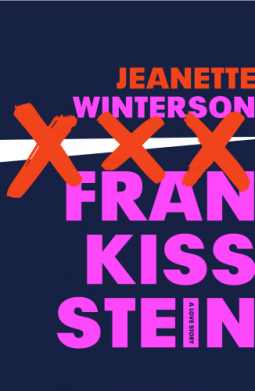
Frankissstein by Jeanette Winterson

Frankissstein cover

Frankissstein is a fresh, thoughtful novel that blends a retelling of Frankenstein using AI with the story of Mary Shelley thinking about life and death. In the modern day, Ry—a young trans doctor in love with Victor Stein, professor working on AI—meets Ron Lord, businessman from Wales trying to make his range of sex robots sell. Ry met Victor at a cryonics facility in Arizona, but now Victor is working on something and Manchester and Ry, Victor, Ron, and the religious Claire somehow all become part of it. And in 1816, Mary Shelley starts work on Frankenstein, thinking about vitality and the moment of life. Across both narratives, questions are asked about what makes life, what is the future of humanity, and what control do we have over our own and other bodies?

There have been a lot of retellings of classic novels over the past few years and a lot of attempts to fictionalise the story of Frankenstein‘s creation for its 200 anniversary. What Winterson manages to do with Frankissstein is blend the two in a way that makes sense, allowing modern questions of AI to mix with Shelley’s look at life creation and ethics, but also making a novel that says more than that. The modern storyline is often funny and engages with medical concepts of the body as well as how technology can remove people from traditional ideas of a body in a way easily comparable to the manufactured body of the Creature in Frankenstein. Ry being trans is used to explore his own sense of body and the fact that people often change parts of their bodies even without digital technology or robotics.

Winterson’s version of Mary Shelley’s life—not only Villa Diodati and the creation of Frankenstein, but going beyond that to her experiences of death and to the work of Ada Lovelace—is highly fictional, based around conversation rather than reciting historical fact. This means that it is mostly about debate and about thoughts on artificial life and related areas, including gender roles. The key figures are painted as complex, not simple heroes and villains, which is refreshing in the subgenre of fictionalised versions of the people Mary Shelley knew, and it feels like one of the few that allow Mary Shelley to think and consider the issues she raises in Frankenstein and clearly have an interest in scientific thought, but also be a woman in a strict society who runs away because she falls in love with a poet.

Considering the many afterlives of Frankenstein as a novel and how unfaithful most of them tend to be, Frankissstein shouldn’t be a shock, but it also feels fitting, sewing together parts of Mary Shelley, other stories, quotations, and a new twist on a Frankenstein-inspired narrative that considers the human body, its changeability, and its future. Both witty and informal, and engaging with interesting debate, Frankissstein is unsurprisingly good. It isn’t really about the story as much as what it is saying (which may be what a lot of people think about Frankenstein, too).