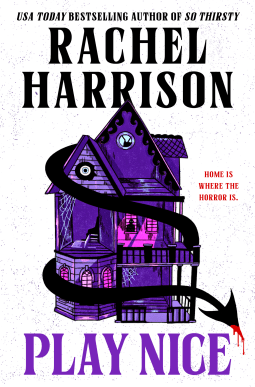
Play Nice is a horror novel about a possessed house as a fashion influencer attempts to flip the house where her and her sisters were plagued by their mother’s insistence a demon was living there. Clio is a stylist and influencer with a devil-may-care attitude, unlike her sisters Leda and Daphne. When they find out that their estranged mother is dead, they convene at their father and stepmother’s house, but there Clio finds out that her sisters don’t want anything to do with their mother, not her funeral and not the house that has been left to them. Clio is determined to get the house ready to sell, but as she starts to learn more about what happened there in her childhood, the process isn’t as simple as it seemed.
I like Rachel Harrison’s style of high concept horror with modern day female protagonists, and Play Nice fits with her usual formula. The book is told from Clio’s perspective, so all of the family drama is filtered through her viewpoint. It is purposefully difficult to know what really happened, as the book explores the line between seeming crazy and trying to be believed about demonic possession. There’s not a simple answer to who you should sympathise with or what should be believed, but instead there’s plenty of classic haunted house ‘what is really going on’ moments. There’s also some commentary on how women are believed or not and the complexities of family dynamics and what matters when someone says they acted out of love.
The plot itself is pretty simple, with plenty of tension and an expected but fitting ending. There are some details or plot points that seemed like they might become relevant again but didn’t, and generally I think the influencer side of things could’ve had a bit more of a role in the book as it felt like there could have been more to say. Overall, Play Nice is another fun horror novel, one that isn’t particularly scary but which offers a family drama-centric take on the haunted house subgenre.
Catalina is a novel about an Ecuadorian student caught between the Harvard lifestyle and her and her grandparents’ undocumented status in the USA. Catalina is a witty English major starting her final year at Harvard, where she has a thing with the son of a famous filmmaker and gets invited to be part of a secret society. Back home in New York City are her grandparents who raised her in the US, but the two sides to Catalina’s life come together as undocumented immigrants become the focus of political battles.
This is a self-conscious campus novel, unpacking the often trivial concerns of campus novel characters through a messy protagonist who stresses about her thesis but also her and her grandparents’ ability to stay in the US. Catalina says that she was born in South America and now lives and studies in North America so how can she not call herself American, and that makes this book feel very “American”, as in it explores the complexity of the connection across these countries and in different spaces in the USA. There’s a lot of discussion of US literature and thinkers, as you’d expect in a campus novel, and also how Catalina does and doesn’t interact with South American history and thought, both through her grandfather and through Harvard. In this way, the book explores knowledge and the different ways people come by it. At the same time, it is an emotional novel, with a spiralling protagonist who rejects help from people when she needs it.
I’ve seen this book miscategorised as ‘dark academia’ and that isn’t going to do it any favours: it is a modern successor to the American literary campus novel, questioning what gets to be part of a campus novel and who is excluded, but it is certainly not going to fulfil anyone’s desire for dark academia. It is witty and sad, not really focused on a particular plot but more on Catalina’s character and her experiences across a number of months.
Spiralling is a novel about a gay man living in Manchester whose life falls apart after his boyfriend cheats on him, so he has to spend the next year trying to pull himself back together, with the help of his friends. Gabriel has just broken up with his boyfriend and then he’s fired from his job, so he’s ready to start spiralling. His best friends Tasha and Evie are there to help him, but they have relationship ups and downs of their own. As Gabriel tries to deal with his problems and not forget to care about his friends’ problems too, everything gets messy.
This is a fun book that manages to cover a lot of aspects of modern day life for gay men through Gabriel and other people he knows, delving into some serious topics but always keeping things pretty light-hearted. The story is told through a combination of first person narration, messages between people, and occasional other, more creative forms of writing, seemingly to reflect Gabriel’s desire to be a writer (even if he hardly ever writes, a highly relatable trait). There’s also occasional footnotes to explain things, which were meant to be humorous but sometimes read like the book was entirely aimed at straight people with no awareness of modern queer culture or any slang. Generally, the style of telling the story worked well to keep the book light and funny even as things went wrong, in the same way Gabriel tended to make jokes about things even when they were bad.
The Manchester setting was great, with a lot of recognisable details, and generally it is packed full of British culture and things like exactly which pair of Dr Martens Gabriel is wearing. It was refreshing to see this kind of book—someone down on their luck in terms of love and work who has a messy time with their friends—being about a gay man, and I liked how the book had space to explore some of Gabriel’s feelings about what it is like to be a gay man in the modern world. As you’d expect from the genre and vibe of the book, things are wrapped up pretty neatly with some potential big drama averted at least for Gabriel. Overall, this is a funny, messy read that reminded me of the sitcom Big Boys in its approach to both serious topics and showing modern gay life.
No Body, No Crime is a thriller about two reunited women battling a powerful family whilst rekindling the romance torn apart by the guy they killed aged sixteen. Mel is a private investigator whose latest job sees her tasked by the Harper family to hunt down their daughter, Chloe. The thing is, Chloe was Mel’s girlfriend back when they were teenagers, after they bonded killing Toby Dune at Chloe’s sixteenth birthday party, and Mel’s been battling internally for years after feeling left by Chloe disappearing. Chloe had her reasons, however, and those reasons are still out there: a powerful local family, after something that Toby had stolen from them.
This book sounded like an adult version of Sharpe’s novel The Girls I’ve Been, and that’s really what it is: a fun, queer thriller that makes for an escapist read. Even though the book does touch on some deeper topics, like Mel’s brother’s drug problems or her abusive dad, these tend to be more like texture in the story rather than anything that is really explored. The narrative is told from a variety of perspectives, mostly Mel and Chloe but not just them, and this works pretty well alongside the non-chronological structure to build up a picture of events slowly, so revelations come at the right time. However, I was expecting a few more twists at the end, as the conclusion was all a bit too neat and perfect for a book that seems messier.
You have to take this book like you would when approaching an action film: sure, it’s going to be a bit ridiculous at times, with the two protagonists being ridiculously good at fighting and survival, but that’s the kind of fun you signed up for. As a queer person who loves action films, I like what Tess Sharpe does in making action thriller-type stories which also feature queer romance.
These Mortal Bodies is a novel set at an elite university in which a young woman is drawn into the world of secret drinking societies and ancient power. Ivy grew up by the coast, but now she’s about to start at a prestigious university. Despite feeling like a outsider, she quickly finds intoxicating new friends and becomes intrigued by the drinking societies and the witchcraft-related history of her women-only college, but she has to decide how far she will go.
This is a dark academia novel that blends detail about Oxbridge with invented history of women accused of witchcraft, and blurs the lines between traditions and rituals, power and mysticism. The narrative focuses on Ivy and her friends’ first year at university, structured around each week of term, but it is more about small dramas and Ivy’s trajectory that big plot points, with the ending being more about characters coming into their own as ‘sisters’ at the college. For me, the ending felt more like a setup for a sequel than an actual ending, with lots of unexplored areas and unanswered questions.
The settings in the book are never specified, but the words used give it basically away, so the blurb I read specified that Ivy is from Scotland, but only particular terminology like Hogmanay’ made that clear, and the university is clearly Oxbridge (I assumed Cambridge as I was reading because it has a women’s college still and Oxford doesn’t, but given that it is fictional, it could be purposefully either). One downside of this is that I think anyone without a familiarity of the terminology used at Oxbridge may end up confused, trying to guess where it is set and unfamiliar with concepts like different colleges, drinking societies, and the short terms. As I am familiar with them, I liked the detail (and I like dark academia that manages to be realistic with the university detail of where it is set), and it did accurately explore the balance between academic work and other elements that becomes all the more apparent when terms are short and workloads are high.
The characters were intriguing but perhaps lacking in detail at times, even Ivy as the narrator (anyone else you could blame on Ivy’s perspective, as a lot of the side characters seemed to have no personality traits at al). Again, the blurb I read said Ivy is neurodivergent, but the book itself leaves that unspoken as far as I remember, and there are a lot of points like this where things are hazy and unspoken, but which perhaps actually needed to be spoken. Ivy’s obsession with binaries, which is foregrounded at certain points in the book, brought something interesting to what I was starting to think was a book obsessed with the difference between men and women, but again, it wasn’t really followed through on, not even with the one lesbian character or the one singular mention of the concept of non-binary people in the ‘dear’ part of a letter/email. I think it is a perspective on Oxbridge that often isn’t explored—how so much is set up as some kind of binary—so I would’ve liked more depth around it (particularly as a non-binary person who went to Oxbridge myself).
The toxic friendship and obsession stuff is enjoyable, reminding me of things like The Craft in which there’s a blurry line between this kind of obsessive female friendship and ideas of witchcraft. Oxbridge drinking societies do work quite nicely as a way to do dark academia (they are perhaps one of the most famous ‘dark’ aspects of the places) and the way they are worked into the characters’ dramas and relationships make them integral rather than background. I think the darkness and actual narrative drama could’ve gone further, as what actually happens in very tame (and I assumed things were setting up for darker plot points, but then didn’t). And once again with dark academia I feel that ideas around kinds of obsession and betrayal are so focused on female friendships and boys as the distraction from them that they don’t even explore the homoeroticism they contain, not even in this case where one of the friends is a lesbian (though she never really mentions this).
These Mortal Bodies is fun if you like dark academia vibes with an accurate (if trying to be non-specific) Oxbridge setting, but for me it lacked substance and the combination of darkness and charm that makes The Secret History continue to be a standout book amongst its many successors. It felt like the first half of something, without the ‘fall’ or fallout from events ever happening (I do find it hilarious that Ivy gets a first even when she constantly admits she doesn’t take her work as seriously as she should). However, I do appreciate when dark academia books do actually understand how to combine the academic setting with the ‘dark’ obsession side, and it was a good book to read in autumn with the new academic year feeling.
Moderation is a novel blending tech commentary and romance, as a content moderator gets a new job in VR. Girlie works as a content moderator for a social media company, and she’s good at it, allowing her to fund her large Filipino family’s life in Las Vegas. When the company buys out another and starts a new venture in virtual reality theme parks, she’s offered a new job, with better money, and a new boss, William. William’s best friend founded the VR company and Girlie is fascinated by him, even though their interactions are mostly in the VR world.
As someone interested in big tech, I’m always interested in literary fiction engaging with and critiquing it, so Moderation sounded fascinated. It turned out to not really be the book I was expecting, as despite the title and premise, it is only really half about the content moderation and VR side of things, and half about Girlie as a character and in particular builds towards her attraction to William, her new boss. The content moderation side is very prevalent at the start, with the novel slowing building up a picture of what it is like for Girlie and her colleagues alongside Girlie’s carefully constructed life. As the book goes on, the focus changes, and though the company itself stays relevant throughout, the content moderation doesn’t, and the tech side of things moves more towards big companies and the clash between different potential usages of virtual reality.
The first half of the novel feels entirely like setup, with not much happening, and then there’s a few major events in the second half, but actually the slow pace continues throughout, so it definitely isn’t a book for people who want fast-paced action. Instead, the book takes a more unexpected route, focusing on Girlie and William’s slow burn romance that is enjoyable to read, if not what I thought the book would be about. The ending is not where I thought the book would go, but actually I was invested in it and I liked the return to a human focus rather than the tech world. The novel has its ups and downs, not quite resolving any of the technological side, but overall I found it an enjoyable story about people, wrapped up in a story about tech.
Basilisk is a horror novel about an online game that leads two ethical hackers down a road towards a mysterious cyber weapon for targeting people, not technology. Alexandra Webster worked for a cybersecurity firm, and now we’re reading her story, written down to document what happened when her and her colleague Jay found the start of an online game created by ‘The Helmsman’ that rewarded participants with further “chapters” about a mysterious weapon. Jay disappeared, and Alex was still searching for what happened to him, and who the Helmsman was, whilst evading the strange smiling people trying to stop her.
This is a very distinctively-told horror novel, most easily summarised by saying it is like if you tried to do House of Leaves about a tech-focused ARG rather than a house. The actual writing is partly a narrative written by the ostensible protagonist, Alex, with added comments by someone else investigating the manuscript, and also the texts of the Helmsman’s chapters. On top of that, there’s links to articles, videos, and playlists, and a general expectation that you get drawn into the mystery enough to want to know what is going on. In that way, it makes you a player too, even if a passive one, and that is perhaps how it is most like an ARG as well as being about one: the meta- and intertextuality make it a horror novel with a ‘this is true document we found’ framing that actually has that creepy sense that could be true. Alex as a character isn’t particularly transparent—in her narrative she barely reveals anything about herself that isn’t part of what happened—but this works to allow the reader into the position of Alex, or to project their own things onto her. In a way, this is a book that is more about avatars than actual people.
Despite not being a hacker or a cybersecurity person, I’m otherwise perhaps the target audience for this novel: I love horror and internet horror, I find the concept of ARGs fascinating, I work close enough to tech-y stuff that I can recognise some of the tech terminology and don’t find the rest of it intimidating if I don’t understand it (and, I love mentioning ‘The Game’ as an example of a game). Like House of Leaves, there is a lot contained within this novel (or linked from it), including the hacker stuff, but also Old English, The Matrix, cryptic crosswords, philosophy, creepypastas, and other things that all feel part of a certain milieu. However, if you’re not really engaged with those as potential ideas that might fit together in some kind of weird way, this book might feel off-putting, rather than a fun sort of rabbit hole. For me, it was the latter, a story packed with references to things I knew a bit about and an atmospheric sense of dread as it slowly unfolds through Alex’s narrative.
There’s something about modern day fears captured in Basilisk even though it might appear to be a fairly silly horror concept, from the idea that there’s some kind of cyber weapon that could actually cause people to go insane as in the book, to other technological thought experiments and conspiracy theories that can cause people to extreme actions. The book itself has sections in The Helmsman’s chapters that discuss some of these things, such as Roko’s Basilisk and Slender Man, and being aware of some of the very real possible consequences of online ideas makes Basilisk even scarier in some ways. Again, this does require some knowledge of these things already (for example, I think the Zizian cult stuff around Roko’s Basilisk is too recent to even be mentioned in the discussion of Roko’s Basilisk in this novel), but even just knowing that ideas on the internet can become something more primes you. In this way, the book is also similar to something like Alison Rumfitt’s Brainwyrms, another horror novel that takes the internet seriously.
From seeing some early reviews before I started reading, I expected Basilisk to be difficult to read and impenetrable (ironic given that Alex and Jay are penetration testers), but it turned out to be a readable, slow burn descent into what is apparently a purposeful madness. Maybe I’m just really the right person for this book, but I had a great time with it, and if you have any interest in the intersection between horror and technology, especially in terms of the transmission of the horror ‘threat’, then Basilisk is fun, dark, and has a satisfying enough ending despite feeling like a book that could perhaps never end in a way that really brings it all together.
Thirst Trap is a novel about three friends in Belfast turning thirty in the wake of their friend’s death and facing up to the reality of their lives. Maggie, Harley, and Róise live together in a crumbling rented house, with one room still empty after their friend Lydia’s death. They’ve all been coping in different ways, still clinging on to the drinking and nights out of their twenties, and not talking about the events before Lydia’s death. As things start to unravel, they must see if their friendship can survive into the next decade.
Moving focus between all three of the friends, this book does very well to tell the story of their friendship at this moment and in the past, not making any of them seem like the protagonist. This energy stops the book from being similar to other ‘young millennial women falling apart’ novels that become a depressing spiral without saying much, because instead it can focus on friendship and grief and not very healthy relationships both with people and with drugs and alcohol, as seen through the lens of three different people. There’s not a huge amount of plot in terms of dramatic events (other than some collapsing stairs), but the story follows them facing up to the fact that they might not all want the exact same thing at that moment, but are also united in their friendship. At times, you can hardly see why they are friends, but that is also what it is about: turning thirty and seeing how different people can be, but also who you still want to be close to regardless.
I liked that the characters weren’t all straight and looking for a settled down relationship with a man, but instead didn’t have much direction and were looking for the smaller things that would give them purpose (especially against the backdrop of people from school and uni all with babies). Maggie, who is a lesbian, gets a few elements of queer girl problems, like knowing most of the people on dating apps already, and these kinds of details made it feel more real, rather than about unrealistic young women as some of these books can be.
Overall, Thirst Trap is a sad and funny look at people who are on the brink of realising they need to grow up a bit, but also are trapped with each other and their shared grief. It feels like the sort of book people might say is for fans of Sally Rooney, but is actually for people who wish Sally Rooney’s books were a bit more realistic and messy.
Great Black Hope is a novel about a well-off Black man living in New York City who is arrested for possessing cocaine in the aftermath of his roommate’s death. Smith is always looking for the next party, previously with his friend Elle whose recent death has shocked him and their circle of friends and acquaintances. When he’s arrested in the Hamptons, he suddenly sees a different side to the system, as well as the position he holds as a Black man who is also a graduate and from a well-off family.
This book dives deep into the world of the protagonist, Smith, and his life as a young queer Black man in New York City, surrounded by the potential for downward spiral amongst the great expectations for his life, and others living in similar circumstances. At a simple level, it explores race and class, and how they both impact each other when it comes to how people are treated and exist in the world. There’s also New York City nightlife and the stark reality of the court system in the US, there’s addiction and sobriety and what we do and don’t do for our friends. I liked how Franklin builds up this picture of Smith’s social circle, feeling like an updated version of 80s and 90s stories centred around New York City parties and restaurants, but also people and communities outside of this, and how Smith’s world in New York is only one snapshot.
There’s not that much of a narrative to this book, despite elements of mystery and investigations, and it feels far more focused on character and vibe, which is does well. Great Black Hope is an updated version of the New York City party novel, in which intersections of race and class are explored to consider who can progress up and who can be in a downward spiral.
Immaculate Conception is a novel about envy, connection, and art, as two friends end up with a new way to share traumatic experiences. Enka is an art student looking for original ideas, and Mathilde is the bright star in the class, already with art world buzz around her. They become close friends, but as Mathilde gets more famous and Enka falls behind thanks to an AI tool disrupting their art school’s work, their friendship feels different to Enka, more desperate. And then, as she marries and has access to her billionaire husband’s company and their futuristic technology, there’s a way for Enka to inhabit Mathilde’s mind, absorbing her trauma but also creating work as her.
The follow-up to Natural Beauty, Immaculate Conception is a novel similarly weaving together horror with dystopian technological elements and ideas about humanity and self, but this time, Huang focuses on the art world and what authorship and originality mean. The novel is told in different sections, with the first section moving between the past and present, and it actually spans longer than I expected, not telling the reader everything (especially as it is from Enka’s perspective).
There’s a lot of technological ideas in there, not only the mind-sharing technology that forms some of the main plot and also ideas about cloning, but also the AI art generator that is the catalyst for a lot of Enka’s feelings and desperation. I like how Huang takes ideas about AI art and uses these to think about the human side, particularly in terms of artists looking to find work that still has value and the messy feelings of jealousy when someone else has that. Generally, this focus on the impact on individual characters of the technology in the novel makes it feel more than a story about dystopian technological change, and that makes it more engaging in my opinion.
Though the book has been described as horror, it much less horror-like than Huang’s previous novel Natural Beauty, and is more of a sci-fi-tinged exploration of art and envy that doesn’t go as dark as Natural Beauty. I like how it addresses AI generation and human-technology integration whilst also telling a story about a woman making questionable choices due to her own insecurities and fears.
You must be logged in to post a comment.