[I was asked to blurb this book by the lovely Haunt Publishing, so this is a mini review I wrote for that.]
In Benothinged, Alvar Theo asks what if the real monster of queer horror is isolation, mental illness, grief, poverty, and all of the other things that people face in modern day Britain, and if so, how might we defeat that monster? The result is a book that is haunting, bittersweet, and yet also full of tiny joys, as the trans protagonists learn to work together to build a world free of this monster.
House of Bone and Rain is a novel about revenge, as five Puerto Rican friends must come together to face the horrors in their lives. Five friends—Gabe, Xavier, Tavo, Paul, and Bimbo—in Puerto Rico are used to death, hearing all stories are ghost stories, but when Bimbo’s mother is killed, they agree to help him avenge her. As they fight their way to get information, a hurricane comes, and the lines between revenge, natural disaster, and otherworldly happenings are blurred.
Though positioned as a horror novel, House of Bone and Rain is more complex than that (the comparisons with Stand By Me perhaps reflect this fact well). The narrative is told mostly from Gabe’s perspective and it offers a complex picture of not only these friends, but others around them, and the lives they lead. Gabe, for example, is torn between his home, his friends, and the memory of his father’s death, and his girlfriend’s dream of leaving Puerto Rico. Even as Gabe is drawn into the violence of revenge and taking on a drug kingpin, he is also looking for purpose, and also sees the mystical happenings that show the world not to be as simple as some paint it.
The narrative is a coming-of-age story mixed with a classic revenge narrative: boys growing up and violence begetting violence, but also the undercurrent of colonialism and ecological collapse. It feels like a crime thriller film mixed with horror and I really enjoyed that, and the fact it didn’t shy away from the weird side of the horror as well. If you go into the book just expecting horror, you might find a lot of the book quite a different tone, but there’s a lot packed into it. Iglesias doesn’t give answers to everything and this works well as a coming-of-age novel that acknowledges the things that haunt you as you grow up can’t always be resolved or explained away.
Small Rain is a novel about a fortysomething man facing a sudden health crisis, and what such an event can lead someone to think and feel. The unnamed narrator has a pain out of nowhere and his partner, L, encourages him to go to the hospital. Once there, it turns out his pain is something serious, something he’d never known of before, and now he’s stuck in a hospital bed, experiencing the American healthcare system.
Having read Greenwell’s earlier novels, I chose to read this one despite the blurb not being the sort of thing I would usually go for. The focus on hospitals and illness isn’t something I’d usually pick up a novel about, not out of squeamishness but more health anxiety and the horrible realities of healthcare, but Small Rain explores someone suddenly in hospital when they weren’t expecting to be, and the disorienting effects of assuming your own health and then being told otherwise. Essentially, the story that the novel has—of the time the narrator spends in the hospital—is a way of meditating on ideas of health, life, love, and art, and how the narrator thinks about these things in this context (as the story seems to be autobiographical, presumably some of these things Greenwell also thought about in that context).
The writing style is beautiful, but also picks up on the kinds of routines and details of medicine and healthcare. The narrative has many reflective digressions by the narrator, which mostly add to the portrait and the story, though even as a poet who likes to read and think about poetry I found the one analysing poetry a bit too long and digressive. Generally, I found the novel quite unlike other things I’ve read, including Greenwell’s other novels, in the way that it confronts something so terrifying and mundane in a literary way, exploring some of the complexities of human life and love through this lens. This is not a novel to go into unprepared: it is about being in hospital during the Covid-19 pandemic due to a different health issue, with vivid descriptions of needles going in and other elements that people might find hard to read. I found it full of tenderness and real snippets of emotion; even if it doesn’t sound like something you might usually read, it’s worth giving it a go.
Coup de Grâce is a horror novella about a man trapped in an impossible subway station. Vicken is on the subway, planning a one way trip to the Saint Lawrence River, but when he gets off, he’s in a huge, Brutalist station. A station with no exit and no return line. A station that changes as he explores. And suddenly things aren’t as certain as they seemed when he stepped onto the train.
This novella combines some fantastic horror elements: liminal spaces, fourth wall breaking, body horror, and the kind of terrifying impossibility of space you get in House of Leaves. It is also a dark look at depression, suicide, and self-harm, and the warning at the start is important to note because it does make up a lot of the book. What you end up with is something visceral and weird, almost absurdly funny in the way it paints hopelessness and lack of control by its ending, and a book that never quite offers a reprieve. The ending might be a bit divisive, leaving a lot up to the reader, but it is exciting to see this kind of horror, that isn’t afraid to be unrelenting, and I loved the creepypasta and liminal space elements (the book itself feels like it could be a creepypasta even as it refers to them).
William is a short horror novel about a reclusive robot engineer who creates an AI consciousness in his house. Henry doesn’t leave his home and spends all his time on his project, an AI-powered robot he’s called William, even though it is impacting his marriage to his wife, Lily. As William starts to turn dangerous, Henry tries to stop him, but their high tech house shows William’s power is further reaching than Henry thought.
This book was compared to Stephen King, Black Mirror, and Frankenstein, and unusually, I think that’s actually quite a good set of fiction to compare it to, particularly as it doesn’t give away too many of the twists whilst still setting up the kind of vibe you’re going to get. Initially, there’s the creator/creation thing that is key to the book, exploring ideas of artificial intelligence and what kind of ‘spirit’ might be created. Then you get the kind of horror when a house seems to work against its inhabitants, and that’s where you can really picture the book adapted for the screen as it cuts between different parts of the house.
The length is ideal for a quick, gripping horror story that purposefully focuses in on certain parts of the plot and characters, and it feels precise rather than too short. William is a tense, fun read that builds on a lot of existing ideas and tropes to play on fears of things we create turning out to not be as they seem, and ideas of creator and creation.
Supremacy is a book charting the race between OpenAI and Deep Mind to bring out their AI products, focusing on their founders, Sam Altman and Demis Hassabis. Journalist Parmy Olson explores these two founders’ starts in the tech industry, interest in AGI (artificial general intelligence) and ultimately the race between their two companies (and the tech giants behind them) to have the best AI product on the market in this generative AI age.
As someone who reads and teaches people about AI, I was interested to see how this quite recent race would be turned into a book. The narrative starts early and quite broad, looking at Altman and Hassabis’ initial failures and interest in AI, as well as early tech industry contacts, and I found this part of the book was a bit too obsessed with the ‘tech genius’ idea, not just from them but around people like Elon Musk as well. Thankfully, as the book goes on, Olson moves away from this idea and looks more broadly at the big picture, including the struggles around both ideas of AI safety and of AI ethics, and the need for the AI world to be dominated by existing tech giants like Microsoft and Google.
The part of the book describing the invention of the ‘transformer’ and the impact of this on work to build better AI models was a highlight as it was an approachable explanation of why this breakthrough was so important, helping people to understand why these huge AI products seemed to come out of nowhere a few years later. I found the section that explores how effective altruism ended up connected to some of the movements in AI also interesting, showcasing how it is often the ideas of billionaires that have a massive impact on world-changing technologies. There was plenty I learnt from the book, even as someone who has a fair interest in the topic, and knowing where these companies came from is a useful part of critiquing and evaluating generative AI.
I did find that sometimes the book was so focused on tech billionaires and companies that it dragged, sometimes accepting at face value what these people say and argue for. Especially by the end, there was decent discussion of many of the issues surrounding AI, but I did think some were notably absent, particularly the climate impact of the GPU power needed and the human cost of data labelling for training data. The climate angle in particular I felt was needed, given that these companies often try and hide their negative climate cost, and it links back to other technologies like cryptocurrency that are mentioned in passing in the book. I do think that the way the book clearly distinguishes between AI safety and AI ethics, and how these can even be in conflict with each other, was very useful, especially for raising awareness of these to a general audience reading the book to learn more about the world of AI as it has become.
Overall, Supremacy is a detailed account of these two AI juggernauts over the past fifteen years and the road to get to tools like ChatGPT that have become household names, and it is a good place for people who want to know where AI has come from recently to start. For me, I found it did lean too heavily on ideas of the solitary tech genius billionaire and I wasn’t interested in that much detail about conversations between them, but the book didn’t go entirely in for the AI hype and did address a lot of the issues and controversies around AI at the moment.
So Thirsty is a novel about a woman whose dull suburban life is thoroughly thrown away when she becomes a vampire along with her best friend. Sloane didn’t want a surprise trip for her birthday, but when her cheating husband says she’s off to a remote luxury retreat with her best friend Naomi, she figures maybe she could do with it. When Naomi arranges them a night with mysterious strangers at an exclusive party in an attempt to get Sloane to live a little, they don’t know that they are about to be changed forever.
Having read some of Harrison’s previous novels, I was excited for this one and what her take on vampires was going to be. So Thirsty has her usual casual, fun style and story in which a female protagonist has to adapt to supernatural goings on, with the main narrative about Sloane and Naomi becoming vampires and Sloane finding herself again after settling down for something that didn’t quite work for her. There’s perhaps not as much as plot as you might expect, as it is mostly driven by character dynamics, but then again, quite a lot of vampire fiction is mostly based around vibes and newcomers adapting to being vampires rather than anything else particularly happening. If the book hadn’t had an epilogue I would have definitely expected there was a sequel, as the ending is quite sudden after the relatively slow pace of the earlier part of the book.
So Thirsty is a novel exploring lasting female friendship and what happens as you get older, but also a novel about vampires who like sex and fun parties, and about how the combination of these might help someone stuck in a rut to find new excitement. It’s silly and fun (and would make a great vampire film), with a lot of good things packed in (I love the dream mall idea) and some great vampire moments, but I think I wanted more of it, more gore and sex and exploration of vampires living a wild “life” as an alternate for Sloane and Naomi.
Still Life is a novel about a trans woman trying to make sense of her messy life and the realities of queer love and friendship. Edith is trying to write her second novel and trying to deal with the fact out of her two best friends, now both two exes, one is dead and the other is marrying a man. She’s returning to Boston for the first time since her transition, and the narrative moves between the present and the past, her friendships and relationships with Valerie and Tessa, and whether Edith can move beyond this tableau she’s caught in to some kind of movement forward.
I didn’t know what to expect from this novel, but it really hit me hard. It functions as a character study, exploring not just Edith but snatches of Tessa and Valerie as well, a narrative about transness and queerness and the messiness of moving between categories and identities and existences, and a meditation on autofiction and art more generally, even when a lot of that art is Sondheim and Gossip Girl. It can be disorienting to read at times, moving between the ‘present’ of the novel and the story of the ‘past’ chronologically, but for me that works, letting the line between past and present bleed together as Edith tries to form her past into a coherent narrative she could turn into a novel.
The book doesn’t offer much closure or many answers, but I love how visceral and full of emotion it feels, making me genuinely cry and laugh (I loved Edith complaining she didn’t want to have to learn what 100 gecs is). Like another recent novel, Greta and Valdin, Still Life offers a bittersweet look at the joy and messiness of queerness through the three women that made up its central characters, and it is also an exploration of the glimpses of what might’ve been and how we cannot solely dwell on these. I think I’ll be haunted by Edith for a while.
Compound Fracture is a young adult thriller about an autistic trans teenager in West Virginia seeking vengeance in a decades-old feud. Miles Abernathy lives in an Appalachian town ruled by Sheriff Davies, where the Abernathys have been fighting ever since Miles’ relative Saint Abernathy was killed in a public execution following a miners’ strike. When he’s beaten almost to death by the sheriff’s son and his friends, Miles is forced to confront the violence of the town and the price you have to pay to fight against injustice and cruelty.
Fans of Andrew Joseph White’s other YA novels will see similarities here, with the trans teen boy protagonist and harsh violence of the narrative, but Compound Fracture is a less of a horror or supernatural story, and more of a grounded one, with the horrors being more about power and violence in rural Appalachia. The narrative is pretty straightforward, with a generally recognisable young adult novel plot of fighting against something and growing into yourself, just with a much more brutal reality than the typical YA book. As someone who no longer reads much young adult fiction, I find myself drawn to Andrew Joseph White’s books because they offer something different, something with more edge and violence. In this one, the community-finding and identity-exploring elements are carefully combined with the thriller-like plot as Miles is drawn into violence, and it makes for a gripping read.
A lot of the class and politics in the book isn’t something familiar to me as a UK-based reader, and the narrative simplifies a lot in order to be a compelling YA novel, but there is some interesting nuance around people drawn into violence and hatred. There’s a lot of big things covered in the novel—opioid addiction, poverty, alcoholism, disability—alongside the difficulties of being trans and queer in the USA, and the book explores Miles’ family’s reactions to his coming out without offering hopelessness to trans teens reading the book. This isn’t the first YA novel I’ve read that explores what happens when teenagers are forced into larger community violence and issues (Angeline Boulley’s Firekeeper’s Daughter was in my head when reading this book, for example), but I think it’s a great way for young adult fiction to go beyond what are normally seen as the interests of teenagers and YA fiction readers specifically.
Compound Fracture was probably my favourite Andrew Joseph White novel so far, despite the fact I’m usually more of a horror fan. There’s a lot to get into and I liked how many different things the book played with, even when things had to be simplified for the sake of the story or chosen perspective.
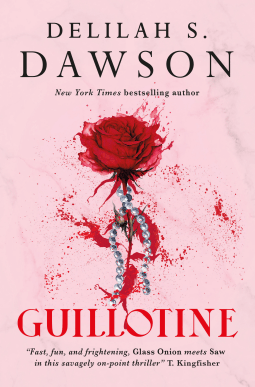
Guillotine is a short, sharp horror novel about a young woman who snags herself a chance to spend time with her heroine, fashion magazine editor Marie Caulfield-Ruskin, by dating her son Patrick, only to find that the private island retreat is going to be the site of revenge. Dez needs a job as she finishes college, but she’s not privileged and applying to fashion houses isn’t going anywhere. When she meets Patrick Ruskin, she realises that dating him might give her an in with his mother, but when that turns into an Easter weekend on their private island, things start to get weird. All the servants wear pink and mustn’t be talked to, and their prize polo pony breeding hints towards the family’s secrets that soon Dez must try and escape.
This is not subtle horror. This in in-your-face, eat-the-rich horror about going to an uber rich family’s home and discovering their secrets, whilst the servants fight back, and it’s great fun. The plot and pacing is very much like a film, which I do think is a good kind of horror novel: one that can be easily read in one go, not really a slow burn or explaining the backstory too much, but instead is filled with gore, revenge, and a memorable setting. It’s easily compared to a lot of horror and thriller films because of this, making it great for people who don’t want sprawling, long horror, but instead a fast-paced story filled with revenge set pieces that don’t overstay their welcome. The ending is pretty predictable, but this isn’t a book going for nuance and unexpected twists, because the rich people are just terrible.
I had a fun time with this book, which was gripping and dark, and delivered on the revenge set pieces. Some people might not like that it is so much like a film, down to not really dwelling on the characters, but I liked that it worked as that kind of narrative and didn’t leave space for greater nuance around all the rich people covering up their terrible actions.


 Fiendfully Reading
You must be logged in to post a comment.