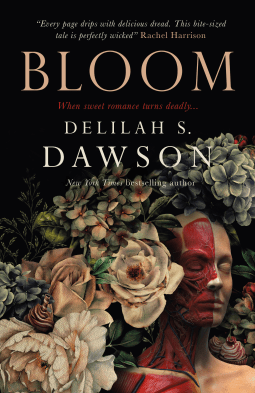
Bloom is a short horror novel that takes a cottagecore style romance between two women and plays out a slow burn tale of obsession and consumption. Rosemary—Ro—has moved to a new town to work at the local college, but feels lost until she goes to the local farmer’s market and meets Ash, who sells beautiful cupcakes, candles, and plants. Ro is transfixed, and keeps returning to the market, building up a relationship with the mysterious Ash, who makes everything from scratch and is very guarded about her life. As Ash offers Ro delicious food and passion, it starts to seem like everything isn’t so rosy.
This is a very slow burn horror book, which does have a decent amount of clues about where it is going to go, but which spends most of the book focused on Ro and Ash’s relationship and the way that Ro falls headfirst in love with Ash, before a quick ending that provides the payoff for all the clues. The blurb is the main way you’ll know from the start of the book that it is anything other than a cosy romance between a woman realising she is into women and a mysterious accomplished stranger, and generally it is the sort of book for people who like very aesthetic horror, rather than scares throughout the book. There’s a lot of hints of Christina Rossetti’s poem Goblin Market in it, which gives quite a good sense of what the vibe is. There’s a lot of luscious detail in the description, particularly around food and sensations, which is very effective once you know what the twist is.
Ro as a character (and whose perspective the third person narration follows) becomes secondary to her obsession with Ash, though there are hints of character development as she reflects on realising she is attracted to women. Her actual background, with a kind of magical whirlwind academic job and a book published with an advance, feels more unreal at times than the actual horror story, especially as it seems like she has to do very little work at her job, and it would’ve been interesting to see more of her life unravel as a result of her obsession. I like the use of Ash as a seemingly put together and perfect cottagecore character who turns out to be much darker (maybe particularly as someone for whom the aesthetic doesn’t appeal), but the narrative’s use of both characters could perhaps have been a bit more subversive and interesting, rather than playing out a predictable tale of Ro’s naivety and Ash’s controlling nature.
Bloom is a fun, slow burn horror novel that feels very much of the moment, playing with popular aesthetics and feeling similar to other current horror. Personally, I would’ve liked the narrative to be more subverted or complex, or to have another layer to it, but I think people will like the romance turned horror scenario and the descriptive prose.
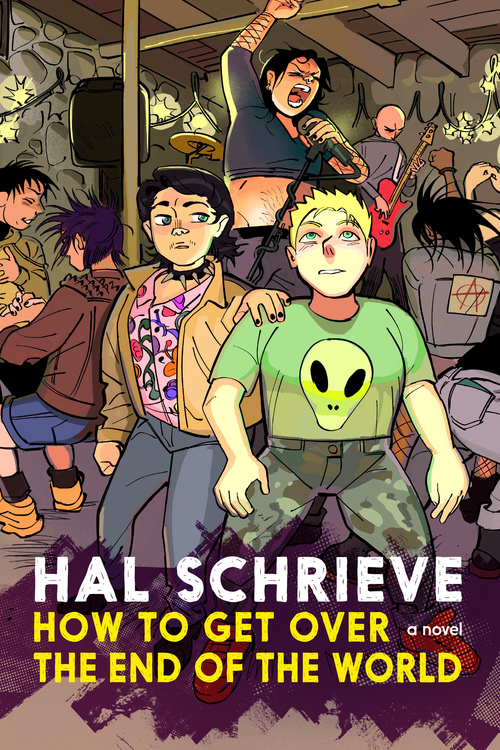
How To Get Over the End of the World is a young adult novel about trans teenagers coming together to raise money through a rock opera whilst some of them see visions that are trying to prevent climate destruction. James is a messy gay trans senior who is ignoring high school to focus on keeping the local LGBTQ+ youth space, Compton House, open, alongside his best friends, who are forming a band and dealing with their own stuff. When James meets Orsino, a trans boy having visions of the future, the two of them seem to be able to share this look at escaping destruction, but to make a difference, they all need to navigate the messy world of being queer teens.
Having read Schrieve’s previous book Out of Salem (and following hir on social media), I was looking to this one, and it doesn’t disappoint. It’s quite a different book, far less focused on the otherworldly elements (to me) than the interpersonal dramas and realities of being a queer teenager that is part of various friendship groups, support groups, and “scenes”, and this is what makes it so powerful. The style of writing, and the moving between three different points of view, really immerses you in the world of these characters and the ways in which they miscommunicate, try hard and not enough, and navigate the messiness of queer teenage life. Everything is fast-paced and Schrieve really pulls you along for the ride, not explaining everything but letting you feel as inside and outside of things as a lot of the teenagers do.
The characters are far more flawed and interesting than in a lot of books aimed at similar readers, making a lot of mistakes and having to learn that you can’t always see yourself as the protagonist of everything because other people matter too. James in particular is at a real point of self-discovery as he explores the excitement and frustrations of being almost an adult, but not quite (and his friends express when he needs to be better to them). At the centre is a love triangle that is, as it is hard not to keep saying in this review, messy, but in a way that isn’t annoying or forced, and it is woven into the entire plot. The inclusion of adults who are complex in their relationships with the teenagers is also a nice detail, bringing in some of the questions around how community support can push against personal circumstances.
This is a purposefully weird and messy book that revels in not just being another paint-by-numbers queer teenagers book, but instead mixes speculative elements (to a level that I as someone who doesn’t really like sci-fi or fantasy felt was ideal) with the punk DIY queer scene. It’s bold and fun, with some great characters, and like Out of Salem, may be aimed at teens but is great for adults too.
Bad Dolls is a collection of four horror short stories that combine modern life, the trials of being a woman, and what happens when everyday objects aren’t as they seem. The stories include one about a Magic 8 Ball influencing a woman looking for change, one about a bachelorette party that doesn’t go as expected, another about an unusually dark dieting app, and finally, the titular story about a strange doll that appears to a woman after the death of her sister.
These are longer short stories which felt very fleshed out, which I enjoyed. You get to really delve into the mind of the protagonist in each story, rather than feeling too fleeting and not really getting to know them. I particularly liked the first story, ‘Reply Hazy, Try Again’, as the Magic 8 Ball horror combined with a woman needing a push to throw away her apparently neat life worked well, building a sense of ‘what have you done’ combined with ‘good for you’ that made it feel quite complex by the end. ‘Bachelorette’ felt quite similar to a recent novel I’ve read in terms of the plotline, which let it down a bit, though it had a good vibe. ‘Goblin’ was unusual, exploring dieting and disordered eating through a horrific goblin, which was interesting. And ‘Bad Dolls’ was dark and intriguing, with a flawed protagonist, but I did feel like I wanted to know more so maybe it should’ve been a slightly longer novella at least to delve a bit deeper.
These tales are a great kind of horror, bringing horror elements into what are otherwise quite everyday yet sometimes horrific situations. The extended length of the stories meant that they were narratively satisfying and quite character-focused. I don’t read a huge amount of short stories (though horror can be an exception), but I’m glad that Harrison’s Such Sharp Teeth made me want to read Bad Dolls, as it was a fun horror collection.
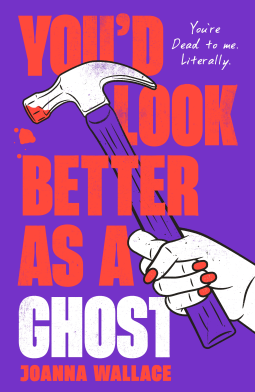
You’d Look Better As A Ghost is a novel about a serial killer attending a grief counselling group who finds herself entangled in something unexpected. Claire sees people as ghosts right before she kills them, but now she’s dealing with her father’s death (not by her). An email mix up sends her on the trail of Lucas, the man who sent the email, but Lucas was tangled up in other things, and now Claire seems to be being watched as her serial killer side is under threat.
This book has such a fun cover and title, and the tone of it does match up to that, with flippant first person narration from Claire, who doesn’t feel bad about her killing and sees it as almost inevitable. Occasional third person chapters that flash back to Claire’s childhood fill in some of her story, but the focus is on a black comedy thriller type plot as Claire goes between her grief counselling group and a nursing home trying to get things back on track after killing Lucas. There’s plenty of ridiculousness and some red herrings as the plot goes on, and I could really imagine it adapted into a darkly comic film, as the pace of the plot and the twists it takes feel similar to other comedy films with a lot of death and mishaps.
Claire is a fun protagonist, highly opinionated and treats being a serial killer like a quirk she has, and that makes the book an enjoyable read, nothing too complex or requiring a lot of thought, but a good ride through the twists and turns that leaves you guessing if she will get caught.
Doppelganger is a book about the warped internet and real world of conspiracy theories, wellness bloggers, and far right podcasts, centred around author Naomi Klein being mistaken for the now pretty infamous Naomi Wolf. Klein explores what happened as people started to conflate the two of them and how she became obsessed with her ‘doppelganger’ Wolf, wanting to understand her seemingly changed opinions and political stance, and the impact it was having on Klein’s own position. Through this lens, she explores some of the areas of conspiracy theory and culture that make up the media world that Wolf is part of, and calls for collective action to fight this ‘mirror world’.
From the blurb, it is easy to be drawn to the book if you have any awareness of who the two Naomis are and the impact it might have being thought to be the other one. I’ve not read any of either of their books, but are aware of their respective works and Wolf’s decent into Covid conspiracy seemingly started with the radio debacle blowing a whole in her entire book, so I felt it would be an interesting story to hear, and it was definitely something different, framing a book not just around the polarised viewpoints in current politics and internet discourse, but in being drawn into them through a sense of doubleness and how this doubleness pervades other discussions in this area too.
Some of the best parts of the book are Klein’s personal experiences with being mistaken for and being obsessed with Wolf, as well as the charting of Wolf’s public life and work. Though there’s lots of other interesting content (particularly Klein’s analysis of why wellness/New Age type people might find themselves agreeing and working with right wing commentators, which hits hard if you’ve ever known anyone in the former category), it feels less ordered and structured than the stuff about Wolf, meaning you’re not always sure where the argument is going. I expected the ending to have more about what can be done about the polarised ideas causing people to fall down rabbit holes of conspiracy, but a single book isn’t going to solve that, and Klein’s parting argument about collective action fights against the individualism that she highlights so many people fall into as part of these beliefs.
This book feels like the sort of long YouTube video essay I’d watch, combining the personal with commentary and analysis, and the concept is fascinating, a chance to really look at one person’s adoption of conspiracy theories and huge fame with the far right coming after being most famous for a 90s book about feminism and beauty. In an age of personal brand monetisation, it is really interesting to read a book by someone impacted by the ease of mistaken identity in the digital age, and to think about why some conspiracy theories have become so popular.
No One Dies Yet is a genre-defying literary novel about three Americans visiting Ghana and the two very different tour guides who work to show them a complex place and the foreigners’ strange position in the country. It is 2019 and Elton, Vincent, and Scott have come to Ghana for the Year of Return. The two narrators, Kobby and Nana, are their tour guides: Kobby, a writer and Instragram book reviewer who might be able to show them the underground queer scene, and Nana, who wants to protect the travellers from the dangers he sees with his religious beliefs and sense of tradition.
This is an epic and experimental book, told through two narrators who paint very different pictures of what happens, and whose tense relationship forms a weird centre to the narrative. There’s an awful lot packed into the story, from biting critique of a range of people and actions to literary fiction jokes about what African literature that becomes popular in the US and UK has to be and who should read it. The main looming event is murder, teased from the start, but it isn’t as simple as a murder story, and there’s some fascinating layers to what goes on, particularly around queerness and survival. Woven throughout is Ghanian history and ideas of who tells it and what they engage with, and the book doesn’t have any easy answers to its questions. Then there’s the characters and their own experiences: of queerness, of race, and how they view the world.
It feels a bit meta to be writing an online review of a book that is by and about an online book reviewer, but the book also has some jokes about that world mixed in, with plenty of dark humour amongst the issues it explores. It is a book trying to subvert your ideas about what it is, whilst also questioning why you had those ideas in the first place.
As the title says, this isn’t a book review, because it’s about my book! My debut poetry chapbook, Syntax Error, is out tomorrow from kith books. If you’re a fan of poetry, computer code, or living on the internet, you might enjoy it (and check out kith’s other books too)!
It is the result of a number of years of writing poetry relating to digital things, based on both my job teaching digital skills and various interests in digital things. There’s some definite inspiration from books like Several People Are Typing (especially the way that book plays around with the self in relation to chat app Slack) and also a lot of poetry I’ve read recently and tweets I’ve seen. It also pairs very nicely with the VERY ONLINE zine, which a couple of the poems in it were first published in.
Don’t forget, you can always check out my published poetry on the my poetry page – there’s lots of stuff there you can read online for free as well.
To finish up, here’s a little sneak preview of one of the poems:
Learned By Heart is a historical novel about Eliza Raine and her relationship with Anne Lister whilst they were both at school in York. As the daughter of a British father and Indian mother, Eliza stands out, boarding alone at school whilst her older sister is a day pupil. Her solitude is broken when a new student, Anne Lister, arrives at the school, throwing usual convention and routine out the window.
It isn’t surprising given the modern resurgence in interest in Anne Lister that Emma Donoghue has gone for writing a novel about some of her life, but it is interesting that the book takes a very different approach to the TV series Gentleman Jack by focusing not on Lister as the central character, but on Eliza. The book is from Eliza’s point of view as a schoolgirl, but is intercut with letters she is writing in adulthood, which is a nice way of bringing both the youthful love story and the reality of what happened to her later on without just making the narrative do a huge time jump. As I’ve already read a couple of books about Anne Lister, the plot was as expected, more about their deepening relationship than much actually happening, and the ending is quite quick, but the letter at the end rounds off the story. If it wasn’t based on a true story, there probably would’ve been more drama in the narrative, but most of the drama in this book comes from the gaps in the story afterwards, as told in part by the letters.
It is packed with detail and from Donoghue’s afterword, you can see the amount of research that went into it (as someone who lives in York and sometimes goes to King’s Manor for work, I did appreciate that it felt very accurate). I’m not a huge fan of historical fiction, but I appreciated that you didn’t feel like all the historical detail was piled on, and the afterword shows what was used in the narrative and where Donoghue focused on telling a story. The book is an exercise in imagining someone’s life who has far less documented detail than someone like Anne Lister, who wrote so much down and has therefore been written about and fictionalised a fair amount.
If you’re already interested in Anne Lister, this book is likely to be a fresh take on telling part of her story through the lens of another person. It is mostly a story about young love between outsiders, but also gives a glimpse into some of the whirlwind left behind Anne Lister. I found it well crafted, but as I’m not a huge historical fiction fan and I already knew what was going to happen, it didn’t quite grip me as it might others.
Sea Change is a book about a woman who is stuck in a rut and friends with an octopus, but needs to try and change her life before she drifts away. Ro is in her thirties, works in an aquarium where she looks after an octopus who her now-disappeared dad discovered, and is struggling to deal with her boyfriend leaving her to go on a mission to Mars. She’s drinking too much and barely makes time for her childhood best friend, but when she finds out that the octopus, Dolores, is being bought by a rich guy, it becomes clear Ro can’t go on like this.
This is a book with a pretty weird premise—woman whose dad disappeared and ex-boyfriend left to go to Mars is friends with an octopus—but it tells a pretty down to earth story of someone hitting rock bottom and needing to change their life. Ro hides behind the past and the people who’ve left her or let her down, and the novel moves between the present and the past to explore the things that happened that have led her to this point. Though the novel doesn’t have a huge amount of plot, as this kind of narrative often doesn’t, and doesn’t resolve any of the big plot elements that run throughout, meaning that you can end up a bit ‘so what’ by the end, Ro is a gripping character and the unusual backdrop of the novel that is used to tell a story of a downward spiral brings something fresh to the book.
I chose to read Sea Change because of the weird sounding premise, and it does deliver on being partly about a friendship with an octopus. It’s easy to read and enjoyable, exploring a character needing to adapt to change, and though it could go deeper or have more going on, the sense of drifting through it does match up with Ro’s mental state in the book.
Bliss & Blunder is a novel which retells Arthurian legend in a modern setting, placing Arthur as a tech company CEO and Gwen as his Instagram-famous wife, as a blackmailer and someone from the past both try and tear down Arthur’s empire by revealing hidden secrets. In the Wiltshire town of Abury, Arthur’s name is writ large, with his tech company and band of loyal men who work for him, but there’s secrets lingering, like what his wife has been doing, and why her childhood best friend Morgan hates both of them, and what to do with Arthur and Gwen’s wayward adoptive son, Mo. When Morgan returns to Abury, people are forced to revisit the past and things are about to get dramatic.
Bliss & Blunder is basically a modern AU (alternate universe) version of Arthurian legend, perhaps most recognisably Malory’s Le Morte D’Arthur. I’ve read (and written) a fair few classic literature modern retellings, and loved Malory as an undergrad, so I felt I needed to read this one and see what it does. In short, it does what it says on the tin: updates Arthur’s role to a modern tech CEO, rewrites many famous characters in various ways, and tries to find modern ways to explain some of the less straightforward elements of Arthurian legend (when I realised Gawain and the Green Knight was actually going to be a subplot, I was a bit impressed, as I’d assumed it would just be the pub name and that’s it).
The narrative moves between the present day of the story and the past, mostly the schooldays of Arthur, Gwen, and Morgan, but there’s plenty of the modern day story to move things forward. There’s a lot of characters, and in most other books that might be tricky to manage, but the thing is, because it’s based on something with so many characters (and a tendency to suddenly focus on one for a while), it does make sense, especially if you’re familiar with the source material. Arthur himself, though important to the plot, doesn’t really get as much of a focus as a character as Gwen and Morgan do, but generally the narrative has to move on characters pretty quickly to fit everything in (again, like in Malory, really, and that’s long enough). Morgan in particular gets a nice deep delve into her as a character, with a strong emotional core to what she’s doing and enough complexity to her feelings.
The actual plotline is pretty straightforward, following all the points you’d expect to tell a modernised version in which a tech company falls apart due to surveillance choices and treatment of employees and perhaps the most famous affair in literature is exposed (it can’t be a spoiler to say it’s Gwen and Lance, given that it’s both incredibly famous and in the book from the start). There’s fun subplots as well, bringing in other stories, but the story itself isn’t really what makes the book, as with most modern retellings, as you can tell that certain elements have to be used just to make it work. If you don’t know Arthurian legend, I don’t know what you might think of the plot, and the fact that some of the subplots can feel a bit random without knowing why that they’re based on (like Mo and Gal’s eventual plotline, and definitely Wayne’s).
The danger of a modern retelling is that people who know the source material will like some choices and dislike others. For me, I liked Galahad being a non-binary hacker who wasn’t actually treated that well at the company as it draws something interesting out about Galahad being different to the other knights from Malory (if anyone could be a token non-binary character, it’s probably Galahad), and I liked Mo, this book’s version of Mordred, and I liked how their plotlines came together. I enjoyed that Gwen and Lance’s relationship was translated into something still vital to them, but I also did wish we got more insight into Lance, and definitely into Lance and Wayne and the whole history between them, as that’s one of my favourite bits of Malory. The use of a tech company instead of knights of the round table is an obvious modern retelling option, but is actually fleshed out enough here that it works, and the use of conflict in Afghanistan as a backdrop for some of the characters having actual being soldiers was interesting, but I think both elements were more background that really explored in depth, especially the latter. A lot of this is probably because more of the focus is on the female characters, so you get more of Gwen and Morgan’s backstories than other parts that are more there to explain parts of the narrative.
On an almost side note, as someone who knows a lot more about Henry IV than Arthurian legend generally, I was very confused when a character starting speaking Falstaff’s lines, and even more confused when said character turned out to actually be Falstaff. I mean, it’s fun, for sure, and the book is full of easter eggs for people who know Arthurian stuff so why not also a bit of Shakespeare, but also, it was a tad bewildering.
The ending is going to be predictable, not just because of it being a retelling but really so is the end of a lot of knightly romances anyway, and I liked the attempt to give an overview of what happens to most characters, given how many there are of them. Overall, Bliss & Blunder has the wide ranging genre elements and characters of medieval romance, and the obvious modernisations of a retelling. Because a lot of the retelling choices felt like well-written fanfiction to me, I did find that at times I missed having a central character or relationship that was the focus, even though you don’t get that with plenty of versions of Arthurian legend (Malory definitely not) but by the end, I do think it managed to pull together the many different threads in a way that felt purposeful, whilst still leaving people wondering a bit what happens next.
There are some books you cannot write a short review for. I’m not a medievalist, but as a non-binary fan of Malory who has done modern retellings of Henry IV and talks about tech companies and privacy at work, this was a book I had to read, and it certainly brings the fun, romp-like element of Arthurian legend into the modern day. Not everything in the book satisfied and there were parts of the modernised stuff that felt like they needed a bit more exploration of the implications (at times I wished it were grittier, but that’s my tastes), but also you’ve got to appreciate a book that tries to pack in so much Arthurian legend into a modern version. It makes me long to get my scribbled-in copy of Le Morte D’Arthur back out.
You must be logged in to post a comment.