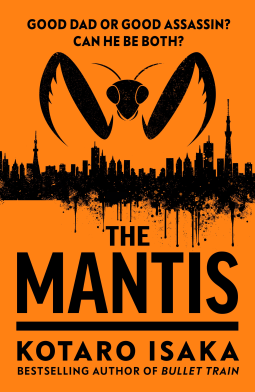
The Mantis by Kotaro Isaka

The Mantis is a thriller about an assassin who just wants to retire, but knows his family would be under threat if he did. Kabuto works an office job, tries to keep on the good side of his wife, and worries about his son going to college. He also goes to the doctor’s office, but it isn’t any old doctor’s office: he is being given jobs for assassinations. Despite his skill in this world, Kabuto wants to retire, to pay his way out and stick to family life, but the doctor doesn’t want to see him go.

Having enjoyed Bullet Train and the combination of fast-paced thriller and dark assassin comedy, I was hoping for similar from The Mantis, and it didn’t disappoint. The narrative has a great balance of Kabuto in action as an assassin and Kabuto dealing with things like wanting to have a friend and trying to make his wife happy whilst his son sees him as a pushover. There’s some fun twists and turns (though nothing hugely surprising) and cameos/references to the events of Bullet Train, and generally this book is the same kind of good time you get from dark action films like the John Wick films (also with the assassin retirement theme). The pages flew by and as someone who usually prefers watching thrillers to reading them, Kotaro Isaka’s books really give me that experience.

The Future by Naomi Alderman

The Future is a dystopian novel about tech billionaires, cults, survivalists, and what you’d do to protect the future. Told from multiple perspectives, it follows the daughter of a cult leader, a survivalist vlogger who was in a refugee camp, an ousted tech company boss, the non-binary problem child of one of the tech CEOs, and a programmer turned billionaire’s wife, alongside three tech CEOs, as the end of the world looms. The billionaires who destroy the world plan to be safe from any apocalypse, but the future isn’t so clear cut.

It’s quite hard to talk about this book without giving away some of the plot twists and turns, but it is a fun dystopian novel that really takes as its premise ‘what does the future mean to tech billionaires and to other people’. The three CEOs and their companies are pretty blatant parodies of real tech companies, which is enjoyable though occasionally a bit too on the nose (there’s only so many ways to obfuscate some of the more outlandish things real tech billionaires have done), and the narrative moves between past and present a lot, building up a picture of a near-future that isn’t too different from what we have today. The plot is slightly confusing at first, as it is hard to tell where it is going and chapters jump between past and present a lot, but then moves towards a conclusion that is maybe surprising for a dystopia, if quite neat.

The characters add a lot to the book, and particularly Zhen (the internet survivalist) and Martha (the cult leader’s daughter) get a lot of exploration, as well as a teasing romance. The sections of the book are separated by forum posts, many of which are by Martha, which explore some of the cult’s pseudo-religious ideas and how they relate to survival and the future, and these are a nice addition, plus there’s a subplot that relies on them. Some of the other characters appear less frequently, but were compelling enough that I almost wished there was more of them (e.g. the gay ousted tech boss, the non-binary child of the tech CEO trying to make a difference in the world, the former-programmer-turned-tech-wife, all of whom could really be the protagonist of a book about tech billionaires themselves.

As with many dystopias, The Future can be a bit too on the nose and simplistic at times, but it also engages with the current moment in an interesting way, considering what the future actually means to different people and what might need to happen to change the world. I enjoyed it more than Alderman’s previous The Power (my rogue favourite of her novels is The Lessons), maybe because I like content that is critical of Big Tech and this book does it in a light-hearted way that is gripping to read.

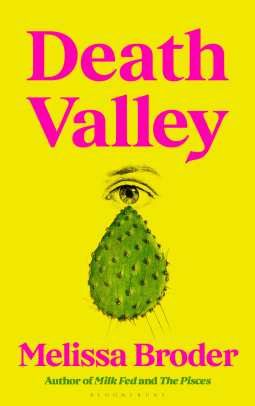
Death Valley by Melissa Broder

Death Valley is a novel about grief and the self, set in the California desert. A woman is staying in a Best Western, escaping her father in the ICU and her chronically ill husband, but without purpose. When a receptionist suggests a nearby hiking trail, the narrator finds a strange giant cactus, unusually there and with a gash that allows you to climb inside, and transfixed by the cactus, the woman is drawn back to the place again and again.

I didn’t know what to expect from this book and any summary doesn’t really give away the hazy, unreal nature of it, really capturing the sense of this character out in the desert, experiencing things that don’t seem real. The narrative keeps being interrupted both by memories and by calls from the narrator’s family members, and this all gives a real sense of the character as she reflects on her own selfish ideas of other people’s illnesses and deaths. Later in the book is a more extended sequence in the desert and this was my favourite part—I wasn’t expecting it and it was both surreal and grounded in a sense of danger. Other than this, not a huge amount happens in the novel, but it is the little details that stand out, like the contents of the Grab N Go breakfast packs.

This book won’t be for everyone, as it is fairly anticlimactic, but I liked the combination of a narrator who doesn’t know what she should be thinking and feeling with a surreal cactus and some strange details. 

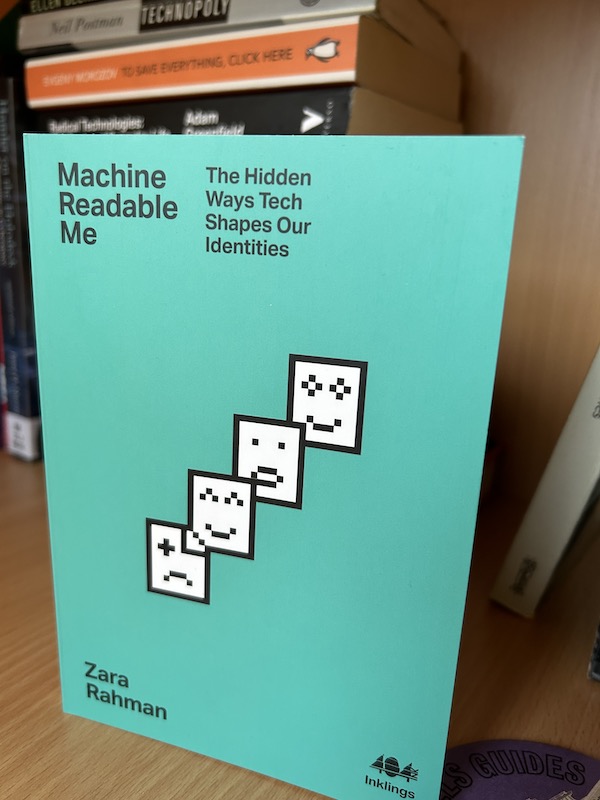
Machine Readable Me: The Hidden Ways Tech Shapes Our Identities by Zara Rahman

Machine Readable Me is an exploration of the data collected about individuals and what this means for the lives of people globally. Part of 404 Ink’s Inklings series, it is a pocket-sized look into the world of digital data, identification, and biometrics that then goes on to question if we should accept being categorised in such rigid, unchangeable ways.

I’ve enjoyed other books in this series, but this one was particularly exciting for me because I tend to read quite a few ‘tech books’ looking at similar topics. By the end of Machine Readable Me I felt revitalised in my interest in our technological past, present, and future, because it was a fresh look into the tech world and had a global focus (many of the books are very US-centric). As it’s a short book, it can only cover so many examples, but there’s a lot of situations I’d not seen covered before in other books rather than using the same old talking points.

The power of categorisation feels central in the book, and Rahman builds on other tech writers’ work to question some of the societal reasons behind power and tech, rather than focusing just on the technology itself. I’ve heard people talking about the need to let data be messier and less machine focused, letting humans and their needs take centre stage, and it was good to see that argued here.

I think Machine Readable Me is a good introduction to the area of personal data and technology, borders and ID cards, that focuses on people not tech companies, politics and society rather than just capitalism. At the same time, for people who are already engaged in the area, I think the energy and examples bring fresh insight and something a bit different, all in an accessible size.

The Reformatory by Tananarive Due

The Reformatory is a tense historical horror novel about a boy sent to a reform school in 1950s Florida. Robert Stephens Jr is twelve and living with his older sister Gloria when a momentary fight with a rich White boy results in a judge sending him to The Gracetown School For Boys, a segregated reform school that is haunted by the many boys who have died there. Robert can see these ghosts, and he must use that power to survive, even when the ghosts have their own motivations and the school governor wants to stop these spirits who could reveal his horrifying actions.

This is very much a horror novel when a lot of the horror is the horrifying reality of reform schools and the system that sends children there, making it charged with a sense of fear that isn’t just due to ghosts. The supernatural element is then woven into that in a very effective way, a reminder that there are lingering traces of terrible things happening, and that ghosts might most haunt those who deserve it. There’s a lot of historical and political stuff particularly in the earlier two thirds of the novel, which cuts a lot between focusing on Robert and on his sister Gloria trying to fight for justice for him. The narrative holds back on Robert’s story for a while, giving small amounts whilst showing Gloria’s attempts to free him, and then as it draws towards its conclusion, you see a lot more of the horrors of the reform school close up.

Long and intense at times, The Reformatory keeps you on the edge of your seat whilst combining events based on real historical ones (there’s an afterword going into this) with a supernatural edge.

Sisters in Arms by Shida Bazyar

Sisters in Arms is a novel about three friends, racism, and expectations. Kasih, our narrator, is reunited with childhood best friends Hani and Saya as someone they knew before is getting married. Having grown up in Germany dealing with racism, being poor, and being women, the three have different views on struggles and injustice, but now Saya is obsessed with the trial of right-wing terrorists and the actions of one night might change everything.

This is a very distinctive novel, told through an unreliable first person narrator, Kasih, who uses this position to play around with assumptions and expectations, as well as imagining scenes that didn’t happen in the past and moving between the ‘present’ action and what happens when they were younger. The effect is Kasih telling you stories, moving between stories, rather than a straightforward narrative, and complicates ideas of a single narrative, a single version of the truth. Add to this the fact that Kasih imagines what other people do or think, and you get a book that forces you to consider the fact it is impossible to really know other people’s perspectives.

Due to the style of narration and meandering structure of the book, it is less about the plot and what happens as what might’ve happened, what you think happened, and what happened before. Kasih and Saya are particularly distinctive characters, and through a constructed, subjective viewpoint you see how they are both flawed and full of their own assumptions, as well as having deal with so many of other people’s assumptions, micro-aggressions, and lack of understanding. It might not feel like a satisfying story to some people, as the ending leaves a decent amount of ambiguity, but it isn’t a book that is just about some events happening.

Sisters in Arms is a book with a pointed playfulness in its relation to the reader, drawing them in and making its own assumptions about them. People drawn in by the blurb and title’s promise of friendship might find it a different book to what they might expect, as it is a book about someone telling a story, and about why people tell stories to protect themselves, though the friendship is central to it.

Family Meal by Bryan Washington

Family Meal is a novel about queer friendship, loss, finding family, and food, as two childhood friends learn to be around each other as adults. Cam is struggling after the death of his boyfriend, Kai, and is back in his hometown, losing himself in sex and drugs. Meanwhile, TJ, Cam’s childhood best friend whose parents took Cam in, knows Cam is back in town, but they circle one enough, wary after a sense of betrayal. As Cam sees Kai as he goes about his life and TJ looks for what he wants in his future, the two must find their friendship again in a new way.

This is a powerful book, filled with emotions, as well as exploring things like disordered eating and drug abuse. At its heart, it is about family and friendship and the need to find the right people around you, which isn’t just one person, but a whole load of people. It is told from multiple perspectives, mostly Cam’s for the start and TJ’s later on, and this allows the book to explore intimacy in various ways and show the complexity of relationships. Possibly unusually for this kind of book, which isn’t so much focused on a narrative but on characters, the ending did feel like a turning point and a good way to end it. There’s some really compelling side characters as well, that help to show the idea of found family and that human relationships are not simple.

Family Meal is a strange book to describe, with a surprisingly low-key ghost element and a plot that is really centred around friendship and doing things for other people, and a lot of food throughout. Perhaps most notably for me, it leaves you with a sense that not everything has to be fixed by putting it back together the same way.

Brainwyrms by Alison Rumfitt

Like many others, I’ve been waiting for Brainwyrms for a long time, as I love Rumfitt’s first novel, Tell Me I’m Worthless. It’s horror once again, but very different horror that explores similar ideas of political extremism, transphobia, and where ever creeping fascism ends up. Instead of a haunted house, we have parasites, but this isn’t a simple body horror story of being taken over by an alien creature. Instead, this is extreme horror about trauma, fetishes, and disgusting moments that mean I’ve seen other reviews question how it even got published. And it does it all very well.

Rumfitt’s conversational yet experimental writing style works well here, infecting the narrative with different voices at times, and having an expected twist of genre for a moment when it becomes what feels like a Sarah Kane play for a moment. The book in general is always going to be divisive, not just for all the disgusting bits and the obvious political nature of the horror, but because the style blends modern internet conventions, experimental poetics, and just a lot of sex and gore descriptions. For me, it definitely works, but you have to recommend it to the right people. I really liked the tone of Rumfitt’s introduction, written as a future fictionalised version of herself that reminded me of Bret Easton Ellis, as it really sets up the book well (I also enjoyed the interjection to the reader midway through to take a break and return, which I did just because it felt like part of an interactive experience).

Similarly to Eliza Clark’s recent novel Penance, Brainwyrms explores different facets of the current and past internet, which may mean that it doesn’t age well, but I don’t think it’s a bad thing to have books, especially political horror, that are very rooted in the time and place they were written, and I’m not bored yet of people exploring the internet in interesting ways. For example, Frankie’s job a a content moderator and Vanya’s adolescent use of kink forums bring different dimensions to the messy world of the internet and how it impacts the stuff going on in the book. You can’t say anything simple about the internet, after all. I liked the balance in this book between the level of stuff about the internet and TERFs etc and the actual characters and narrative, with the spectre of the former hovering over the characters and descriptions through more metaphor and theming rather than always front and centre in the plot.

As with Tell Me I’m Worthless, this is a bold, uncompromising book that delves deep into British transphobia through a queer horror lens, not shying away from satire and ridiculousness even as awful things are happening. It’s more intense horror that Rumfitt’s first book, reminding me of when I first read Poppy Z. Brite and saw what you can really do with extreme horror to be interesting and witty and cool, not just “edgy”. Everything in this book feels like it is covered in a layer of dirt, and that is very effective (though I regret to say that the book didn’t actually make me feel sick, like a lot of people say). Definitely not a book for everyone, but trans horror continues to be one of the best genres.

Luda by Grant Morrison

Luda is a sprawling novel about a drag star working in a new pantomime who becomes obsessed with their mysterious new co-star. Luci LaBang has had a varied career, but now she’s appearing in a meta-pantomime in her hometown of Gasglow, an alternate version of Glasgow. When the Principal Boy playing Aladdin has an accident, the mysterious Luda appears to take the part, and with it, capture Luci’s interest, wanting to know the secrets of the Glamour to be able to transform yourself, but as might be expected, things means not everything is as it seems.

I really wanted to enjoy this book more than I did, as it has a great concept and some really fun elements woven in. The thing that I—and I think many people—found difficult was the narration style, which is very purposefully too verbose and full of digressions as Luci’s style. I appreciated what it was doing, but even with this, it felt like it still needed more cutting down or honing, so that the style didn’t actually become a barrier to wanting to keep reading. It is all about obfuscating, both the style and the book, and I like that, but it wasn’t always enjoyable to read.

In terms of the plot, it’s fairly simple, with a lot of bits of backstory (that may or may not be true, as the whole book is fashioned with layers of lies and ambiguity) thrown in as well: obsession, mirroring, and people mysteriously dying. A lot of the twists are very obvious, and it was hard to tell if this is purposeful or not, which might in itself be intentional. The setting of Gasglow is a whole thing, though for me I found there wasn’t actually as much of it as a setting as I might’ve expected, and I felt like the speculative element (which isn’t so much my thing anyway) often got lost amongst the narration. I did like the way you slowly learnt things about Luci’s history and these felt like they could’ve been whole books in themselves, which is a testament to the messy ambiguity that was conjured around them.

One of the themes that really comes across when reading is the idea of being who you are without worrying if it’s what people expect or problematic or anything else, and it’s interesting how it addresses this, with Luci’s narration often focusing on weird details and comparisons to be edgy and shocking, but at other times being very nuanced about who people are and what is expected of them. If nothing else, it gets across the complexity of a person’s inner self, whether or not it is actually authentic, but hilariously, at the same time, the book argues that pantomime shouldn’t be politically correct or change, maybe because it’s too much of a mess to actually be offensive (and ‘messy’ definitely describes Luci and Luda, too).

I like that Luda is bold and, yes, messy, playing around with what is appropriate and the reliability of anything you are told in a book. It also takes a very British look at queerness and drag, filtered through the eyes of a very specific character. At first, I could handle the narrative style, but the further I read, the more it grated on me, and by the end I was lost in the swirling references and digressions. I don’t know Morrison’s other work though I’m aware of them, so maybe fans of their work will enjoy this more, but for me, I would’ve maybe liked the same vibe but just more cut down.

Land of Milk and Honey by C Pam Zhang

Land of Milk and Honey is a novel about a chef who takes a job at a mountain colony, where a man and his daughter are attempting to reshape the world. Food is disappearing as smog has spread across the world, when the narrator, a chef trapped in England hoping for a way back to California one day, takes a job as the chef at a mountain colony run by a man bringing back the world’s creatures and plants for decadent pleasure. Her new employer has a daughter, a determined woman who believes in his mission, and as the narrator is drawn into a world of gastronomical delights, violence, and pleasure, she starts to understand what she desires.

I wasn’t sure what to expect from this book, which ended up being much more description-based and sensuous than the dystopian-esque blurb suggested. It sets up a world in which the pleasure of food has been lost, and then brings it back for the narrator, whilst also exploring how the rich envisage reshaping the world and what is classed as desirable. There’s also a love story, one with strange undertones and direction, deeply tied in with the food and the situation. The narrative goes fairly slowly and then the ending races through a conclusion, but that does feel like it matches the pacing of what happens, and the trajectories of desire in the book.

Turning a story of eco-crisis and the rich into a tale of longing and desire is impressive, stopping the book from being either moralistic or plain satire (it does have hints of something like The Menu in the ridiculousness of the food, but it goes far beyond that). Maybe the ending is a bit rushed and neat, but this is a book that really revels in human experiences and explores what really makes food matter.