
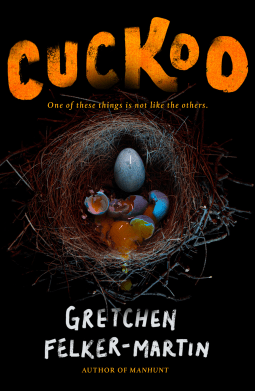
Cuckoo is a horror novel about a conversion camp that aims to make queer teens a whole new person, and a group of kids who fight their way out to stop it. In 1995, a group of queer teenagers forced by their parents to attend Camp Resolution realise that it is more than just abusive staff and religion: the camp is far darker than that, stealing their very selves. Despite this, they band together, find friends and lovers, and hatch a plan to escape, but even getting away isn’t enough, and the survivors, now adults, have to try and stop it at the source.
Anyone who has read Felker-Martin’s Manhunt is surely waiting with baited breath for this book, and Cuckoo didn’t disappoint, as a book very different to Manhunt and yet still exploring what happens when the worst horror happens to queer people. Cuckoo has a big cast of protagonists and I was initially wary (after the prologue that serves as your horror ‘here’s what is going on’ opener) that it would be too hard to tell the characters apart. However, by midway through, I wasn’t worried, and had a good handle on the various characters, who all have different lives, flaws, and experiences. One of the things I enjoyed about the book wasn’t the horror, but was the fact that it takes a bunch of different queer teens and imagines not only them under pressure, but then how they react as adults.
Notably, the book doesn’t end with the 1995 narrative, but moves forward in time to the characters as adults (it’s hard not to compare this to It), and I was excited when I realised it had done this, as it is so rare to get a good deconstruction of the aftereffects of extreme horror on the characters. This later part has to be a lot faster in pace and by the end quite action-centric, but you still get the chance to see that these characters are still broken, have grown up into adults not only dealing with the trauma of Camp Resolution, but also normal things, like relationships and grief and money and the difficulties of being queer in the world. A lot of stories about queer people only show one point in their lives, and a lot of horror stories don’t deal with the aftermath, so combining these elements offers a different picture of survival.
In terms of the horror, there’s unsurprisingly from the title body snatchers-style fear, alongside abuse and trying to survive in a desert, and a decent amount of body horror from the cosmic evil threat. I liked that the body snatcher stuff didn’t focus too much on the protagonists not knowing who had ‘turned’ or not at the camp, as I find that kind of horror quite frustrating, but instead it was more about the wider implications in the world, particularly at the end (the ending has similarities to Alison Rumfitt’s Tell Me I’m Worthless, playing with the horror’s impact on a happy future). Felker-Martin makes the audience very aware of the horror tropes she is playing in, with plenty of overt and subtler references, and this is far more gory horror than scary, as a lot of queer horror seems to focus on at the moment.
Overall, the book plays with ideas of replacement and parents’ anxieties around queer kids, particularly around the idea that having a queer child makes parents act like their child has been replaced because they aren’t “normal”, and what that might mean if they really were completely different. As conversion therapy horror, it really digs into the idea of what changing means and if it would even be the same person, making it actually quite a good exploration of the philosophical issues (never mind all the myriad other issues) with conversion therapy as a concept. I liked Cuckoo more than Manhunt, and some of that might be because I find its take on the subgenre it is in even more interesting (and also I liked the characters and their dynamics).
As with Manhunt and a lot of other queer horror out there at the moment, there’s going to be people aren’t going to ‘get’ it, either because they don’t like the amount of body horror and sex or because they don’t like having a load of messy, flawed characters who don’t do the right thing all the time or even necessarily learn from things. For me, I really liked how it explored the horrors of conversion therapy and abusive families, but also toxic relationships to yourself and with others. The characters didn’t all get neat resolutions or development, but how could they be expected to in a world in which this can happen to them? If the idea of the cuckoo and body replacement tells us anything, it is that anyone can really be anything underneath.
 Fiendfully Reading
[…] call it experimental. But now is a good time for Felker-Martin to try something new. Manhunt and Cuckoo (not to be confused with the movie of the same name that came out around the same time) were both […]