So you want to give impressively up to date book presents?

I vowed not to do another gift guide like everyone else, but then I changed my mind. I decided to lend a helping hand to people who want to buy books as gifts, but also want to seem up to date and ‘with it’ by giving books that came out this year (and also hoping that the recipient is less up to date and hasn’t read these recent books yet).

This is not my top books of 2017 list. For starters, there’s still a month of 2017 to go, so I refuse to make any judgements until then. Instead, this is just some suggestions for who might like different books that came out this year.

  • For the beleaguered twentysomething: One of the vague sub- sub-genres I’ve noticed this year is the ‘twentysomething cannot cope with life, retreats to countryside or makes a bad life choice to reflect on how shit the world is’. Because art doesn’t imitate life at all. There’s A Line Made By Walking by Sara Baume, which is exactly that description. Sally Rooney’s distinctive Conversations With Friends stays in the city, but very much captures this spirit. English Animals is about culture shock, love, and hipster taxidermy. And straying further away, I’ll Eat When I’m Dead by Barbara Bourland is the American Psycho for the social media world and shows the toxicity of fashion in these conditions.
  • For the person who likes to dip into things: What do you buy the person who has limited time to sit down with a huge tome? Sure, you could go for a novelty comedy book that requires no memory of previous plots, or maybe something more original. For short stories, Chris McQueer’s Hings offers the surreal, the drug-fuelled, and the downright weird. From the same publisher (404 Ink) you can offer intersectional essays about being a woman in the twenty first century with Nasty Women. Bone by Yrsa Daley-Ward is modern and concise poetry that cuts deep and can be enjoyed by adults and teenagers.
  • For the character-focused reader: If you’re buying for someone who likes engrossing and quirky characters, there’s plenty of options from the past year. All The Good Things by Clare Fisher tells the story of a young woman in prison and how she ended up there. Eleanor Oliphant Is Completely Fine by Gail Honeyman offers a surprisingly uplifting story of coping with trauma whilst seeing the world differently The Book of Luce by L.R. Fredericks is a weird tale of a gender defying rock star and the obsessive fans that surround them.
  • For the ‘dark and tense, but not actually crime’ fans: It’s a specific-sounding genre, I know, but there’s so many people who want dark and dramatic literary fiction. Offer them My Absolute Darling by Gabriel Tallent, about a girl called Turtle who has to fight to survive, or The Roanoke Girls by Amy Engel, about a family with twisted secrets (and featuring an epigraph from Lolita, to suggest the tone). For the Shakespeare or The Secret History fans, there’s If We Were Villains by M. L. Rio, about a group of actors who fall apart after one of them dies.
  • For the YA fans: Note that I didn’t say ‘for the teenagers’, because not only could teenagers enjoy other books on this list, but anyone can enjoy young adult books. Girlhood by Cat Clarke shows contemporary older teenage girls at a remote boarding school in Scotland and what happens when a new girl turns up who seems to be just like the protagonist. Stephanie Perkins’ There’s Someone Inside Your House is like tense modern Point Horror with a complicated main character, and One Of Us Is Lying by Karen McManus takes the concept of The Breakfast Club and spins it on its head in a story about death and secrets. For something a little lighter, there’s The Upside of Unrequited by Becky Albertalli, about a girl who thinks she’s unlikeable and her sweet family.
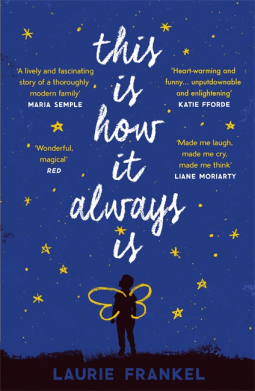
This Is How It Always Is by Laurie Frankel

This Is How It Always Is is a novel about family, secrets, fairy tales, and gender. Rosie and Penn are busy parents—Rosie a doctor and Penn a writer—with five children, all boys. When it turns out their youngest wants to grow up to be a girl, Rosie and Penn do what they can to be supportive parents, but that turns out to involve making a big change for the entire family and keeping a secret that nobody sees lasting forever.

The book is focused particularly on being a parent of a transgender child, and particularly a set of parents trying to be as encouraging and accepting of all of their children as possible. The whole family is very important to the novel, as Frankel gives all of them—not only the parents and Poppy, the youngest—individual personalities and lives, which are all tangled together as families are. The narrative is split into separate parts, broadly different phases in the family’s life across five years, and the writing style is informal, meaning it is quite easy to read much of the book in one sitting.

Frankel says in the concluding Author’s Note that the book is not based on her own experiences with a trans daughter, but is a made up story that has sprinklings of her own life as well as imagination and research. Indeed, this idea of storytelling runs throughout the book, through Penn as a writer using stories to give morals to his children and through the stories that everyone tells to make situations seem less confusing.

It is a heartwarming and sad book that ultimately tries to give hope, using a happy ending and a running theme of fairy tales and telling stories to make sense of life. I’ve seen people claim the happiness is unrealistic and the parents “too” accepting, but that is why this book is an important one as well as an enjoyable read: if a trans child’s fictional happiness is seen as unrealistic, it shows the one, there’s maybe something wrong with reality, and two, then books are needed that show happiness and a future for trans people of all ages, and This Is How It Always Is is one of these books.

The Underground Railroad by Colson Whitehead

The Underground Railroad is a book deserving of its hype. It is a sharp, clever novel that gives the Underground Railroad of US history—a network of routes and safe houses used by slaves to escape into free states—a physical form as a steam-powered escape that must stay secret. Cora is a slave on a plantation in Georgia, ostracised due to her mother’s disappearance from the plantation when Cora was ten. When a new slave, Caesar, tells Cora about the hope of escape on the Underground Railroad, her journey begins to find safety along the lines of the railroad, whilst being pursued by the slave catcher Ridgeway.

Whitehead’s conceit is simple, yet the transformation of the metaphorical railroad into a physical one feels momentous. It brings a sense of momentum and also gets across the idea of something beneath the ground, beneath both Southern states and those in the North, that is alive and working to help black people escape. Cora’s story is a compelling narrative of a desperation to keep escaping, even when those around her are not so lucky. By combining a character’s personal battle with a sense of larger scale—not only through the railroad, but also by describing other characters’ lives and looking into the future at times—the novel is both an engrossing and brutal read and a sharp look at not only slavery but race in America across the centuries. It is clear that many of Whitehead’s concise sentences are true now as they are to the time of the novel.

The Underground Railroad is an impressive combination of style, structure, narrative, and concept to produce a novel about slavery that is both devastating and fresh. Whitehead’s writing style, clever and direct,  gives the book an immediacy that feels vital to reading it and thinking about the past, present, and future.

Order in the bookcase

This blog has been a little quiet for the past week as I was moving house and working. One part of this was building a bookcase. Only a thin one because I left the majority of my books with my parents, having learnt my lesson that when you know you’ll be moving again in a year/under a year, don’t take all of them with you (unless you’re planning, as I did one year, to build your bedside table out of books and a piece of wood). After two English graduates remembered how 3D space worked and marvelled at how wood and screws can come together, a bookcase existed. And then I had to organise it.

How you organise your books is controversial (though there’s a fairly uniting disdain for people who do it by colour). There’s alphabetical, the classic, but then do you split further into categories like fiction and non-fiction or form or genre? You can just sort by categories, maybe subdivide by topic. Time period works if you own a lot of  ‘classic’ literature. When you’re lacking in space, as I have been, the best option can be by priority, creating your own ‘high use’ material (this is the only way to make a book bedside table without needing to dismantle it all the time).

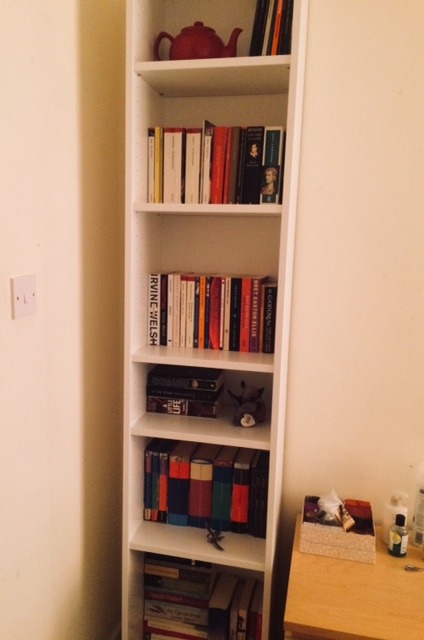
I work in a library so you think mine would be very organised. Actually, they’re not. The shelves are as follows, from the top: drama (and a teapot); poetry and two books about Byron; prose, mostly novels but also Wollstonecraft’s Vindication(s); a small thematic shelf that is solely The Secret History, A Little Life, and If We Were Villains (and a cuddly bat); the Harry Potter books plus DVDs, a copy of Quidditch Through The Ages that my friend delightfully graffiti’d in character, and a Buckbeak keyring; and finally, a misc shelf that is keeping the bookcase stable by containing the complete works of Shakespeare, The Goldfinch, The Stranger’s Child, a single hardback book, and a selection of things I didn’t think I’d be reading too soon, but I did want to have with me.

It’s a fluid system that needs to be able to integrate parts of my to-read shelf once they’re read (these books are currently on my desk urging to be chosen next). It is also based upon whim and could be totally changed in a few months (say, after Christmas and my birthday, the main book gaining times of the year handily only a week apart). I think my point is, organise your books how you want. You’re the person who has to find/look at them, after all. Though if you have a particularly notable system, do share it so we can all be outraged/inspired.

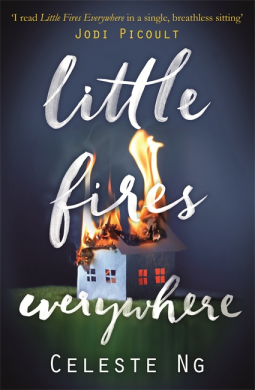
Little Fires Everywhere by Celeste Ng

Sparks and flames: Little Fires Everywhere by Celeste Ng

Little Fires Everywhere is an intricate and observant novel that shines a light on false perfection and the intricate way in which everyday things are interlinked. Shaker Heights is a carefully planned suburb of Cleveland, where everything has order and they pride themselves on being progressive. Elena Richardson embodies much of Shaker’s ideals, but when the Richardson house is found burnt down, the recent past must be unravelled to see how the arrival of the Richardson’s tenants, the artist Mia and her teenage daughter Pearl, affected the four Richardson children, their parents, and the whole community, showing how underneath things aren’t always quite as they seem.

The narrative structure is particularly impressive, with an omniscient narrator flashing back from the burnt house to tell the story from many perspectives in a way that foreshadows and hints at past events in a satisfying way. Key moments and details that will clearly cause a ‘little fire’ later on, be misunderstood or reinterpreted by other characters, are apparent to the reader, but also not overly signposted by the writing. Through this, the book has a great sense of connection and coincidence as the present and past come together in the relationship between the Richardsons and their new tenants and in the battle over the custody of a Chinese-American baby that grips Shaker Heights and puts Elena and Mia on different sides.

Little Fires Everywhere is a novel somehow both charming and tense, with the drama between the characters built upon tiny moments and the overall narrative one that doesn’t reveal surprises so much as fill in the gaps to show how interpretations can be different. The teenage characters are a highlight and this is the kind of adult novel that can also be enjoyed by older teenagers. This tangle of characters and detail is an impressive book with a very satisfying linking of structure and themes and a very apt title in multiple ways. The ‘little fires’ are what makes the novel blaze.

Quick book picks for November

Now that we are in the midst of autumn and I am sat here drinking smoky lapsang souchong (as if I don’t all year round), it’s time for a new list of books out this month. Here’s some portraits of American memoirs, an endearing memoir, and a weird book about Nabokov (with links to reviews in the titles).

  • Heather, The Totality by Matthew Weiner – The creator of Mad Men writes the story of a girl, her family, and what happens in their orbit. Summaries can’t capture the strange atmosphere Weiner creates.
  • Demi-Gods by Eliza Robertson – A stylistic and unnerving novel about growing up in the 1950s and 60s in Canada and the US, told in episodes.
  • Trans Mission by Alex Bertie – This YouTuber’s memoir about his life so far as a trans man combines humour and emotion and is perfect for older children and teenagers, but also parents and other adults who want to be more understanding or know more.
  • The Dreams of Bethany Mellmoth by William Boyd – A collection of stories of varying length about flawed characters at decisive moments in their lives and relationships.
  • The Future Won’t Be Long by Jarett Kobek – The 80s and 90s America novel that wasn’t written then. Kobek tells the story of a gay guy and a straight girl who become friends and try to survive America, featuring comic books, drugs, clubs, AIDS, money, famous authors and artists, and a metafictional awareness of what came next.
  • Insomniac Dreams by Vladimir Nabokov – A book on Nabokov and dreams that uses a combination of Nabokov’s own words in dream diaries and his published works alongside Gennady Barabtarlo’s notes and commentary.